Showing posts with label Joseon Era. Show all posts

Thursday, February 18, 2016

Recovering a stone wall walkway around Deoksu Palace that never existed

A few weeks ago articles appeared in the Korea Times about a plan to "restore" a walkway around Deoksugung Palace (here and here):
A narrow walkway along Deoksu Palace in downtown Seoul will be restored 132 years after it was cut off by the construction of the British Embassy in Korea, a Seoul City Council member said Monday.

The council member said the Seoul Metropolitan Government will restore the 170-meter-long sidewalk along the stonewall of the Joseon Dynasty (1392-1910) palace at the embassy compound at the expense of 2.8 billion won (US$2.34 million).

The capital city will finish the 3- to 6-meter-wide walkway, commonly called "doldam-gil" in Korean, by the end of the year after compensating the British Embassy, according to council member Choe Pan-sul.

In 1884, the British Embassy purchased the land site for the soon-to-be restored walkway, cutting it off from the present tree-lined sidewalks, famed for their seasonal beauty.

As if such "tree-lined sidewalks" even existed then! There's much more to say about this, but it has already been written by Jacco Zwetsloot in a letter to the editor published a few days ago, which can be found here. Actually, the letter that appears there was rather heavily edited and differs from the one Jacco sent to the Times, so I asked him for permission to reprint his entire letter, which he graciously granted.
Last Tuesday (26th January, 2016), the Korea Times carried a story titled “Seoul city to restore palace walkway.” It showed a map with a proposed 1.1-kilometer long walkway around Deoksu Palace, following the palace wall. It is apparently the plan of Seoul Metropolitan Government to gain access to a 170-meter-long section of wall that abuts the British Embassy. This would involve pedestrian access through embassy property. The article raised a number of interesting questions: about historical accuracy, “authenticity” of heritage, and journalistic practices.

The article states that the proposed walkway is “interrupted by the British Embassy […] and has been since 1884 when the mission purchased land near the palace.” This idea, and, by extension, that the British and U.S. embassies purchased land around the palace, thereby encroaching upon it, is one I have seen repeatedly over the years. However, it is misleading. Deoksu Palace was not a fully-fledged “beop-gung” (a palace where a monarch resides) before King Gojong issued orders from the Russian Legation in 1896 to construct his new palace.

Why did he choose this area? The answer lies in the history of Jeongdong neighborhood. It was once owned by the Joseon Dynasty’s ruling Yi family. Prince Wolsan (1454-1488), older brother of King Seongjong, 9th king of Joseon, once had his official residence there. Although called Deoksu Palace, it was humbler and smaller than a kingly residence, having no throne hall for instance. During the Imjin Wars (Hideyoshi Invasion) of the 1590s, after King Seonjo had fled to the far north and then returned to the capital, he lived temporarily at this old residence, becoming the first king to do so. This is because Gyeongbok and Changdeok Palaces had been destroyed or made unlivable by the population of Seoul, who were angry at his having deserted them.

Once Changdeok Palace was rebuilt in 1618, King Gwanghaegun moved there, Deoksu was renamed Gyeongun, though it was also known as the “Western Palace”; it served as a lesser auxiliary palace until King Gojong’s time. During the intervening centuries, parts of the land around this residence were sold or given to the powerful Min family, and they sold parcels of it to the first Western legations, whose arrival, beginning with the Americans in 1883, marked the opening of Korea to the non-Chinese world.

In 1894-5, the waxing Japanese and waning Chinese empires fought a war in, and for control of, the Korean peninsula; Japan won. Barely 6 months later, Japanese agents and their Korean henchmen infiltrated Gyeongbok Palace to assassinate Queen Min (later given the posthumous title Empress Myeongseong). This caused King Gojong to flee with Crown Prince Sunjong, never to return again.

By 1896, the year that King Gojong spent boarding with the Russians atop Jeongdong’s highest hill, there were also British, American, French, Austro-Hungarian and German legations nearby. A permanent “safe haven” from both Japanese and Chinese influence would have been attractive, and having a palace in Jeongdong was a very visible way to moved Joseon closer to Western powers. It was at this time that Gojong ordered Deoksu Palace to be expanded, rebuilt, and upgraded. Except for Jeukjo-dang and Seogeo-dang, which had long stood there, all buildings and structures date from that feverish period of construction. Upon King Gojong’s move here in early 1897, he proclaimed the Great Han Empire, had himself crowned Emperor, and Deoksu Palace became Gyeongun again -- now as the first imperial palace in Korean history.

It should be clear, then, that the legations in Jeongdong predate the existence of Deoksu Palace as a fully-fledged royal palace. There can be no sense in which the palace was spoiled by the arrival of Western powers in the late Joseon Dynasty. Indeed, the palace became what it did because of the presence of the legations.

Moving on to look at the question of authenticity of heritage, I note also that last Tuesday’s article used the words “restoration” and “recovery” to talk about the proposed new walkway. It is a common theme of historical sites around the world to claim authenticity and genuineness as virtues, but this is often a fraught and deeply contested idea.

A quick look at the signboard map beside the Deoksu Palace ticket window shows that the original palace perimeter looked very different than it does today. In fact, the complex is today about one third its size in 1897, and most people will be surprised to learn that much of the present wall was built no earlier than the late 1960s.

Construction of the original wall was still ongoing when Gojong moved to the palace, and was not completed until 1900, his fourth year as emperor. During his reign, the palace wall had gates to the British, American and Russian legations, perhaps in case the king needed to flee again. After his abdication in 1907, forced by the Japanese unhappy with his attempts to have Joseon represented at The Hague Peace Conference, Gojong remained in Gyeongun Palace, and the name reverted to Deoksu Palace for the last time. Seonwonjeon, a network of buildings where the sacred portraits of past kings were stored in the northern part of the palace, was dismantled and removed to Changdeok Palace; the site was sold. In 1915, Jungmyeongjeon, once the imperial library and Gojong’s temporary residence after a massive fire in 1904, became the headquarters of the Seoul Club.

Gojong’s death in 1919 led to the March 1st Independence Movement, but also provided the opportunity for the Japanese colonial government to tear down even more palace buildings and sections of wall. Dondeokjeon, a western-style building, was torn down, and the western wall of the palace was moved inwards, in order to build a two-lane road between the palace and the US legation. The eastern palace wall was later also moved inwards for the widening of Taepyeong-ro.

Sadly, destruction did not end with Korea’s Liberation. In the 1960s, the entire eastern wall facing City Hall was demolished and replaced with an iron fence. Taepyeong-ro was widened once more, leaving the Daehan Gate of the palace orphaned in the middle of a busy road, until its removal to its present location in 1970. The iron fence was once more replaced with a stone wall in 1968, except for the north east corner, where a police sub-station was built that stood until 1994. A diplomat formerly stationed in Seoul remembers that the gate between the British Embassy and the palace still stood there in the 1980s, but it was removed sometime later by either Seoul Metropolitan or the Korean Government. Perhaps the only section of wall that is in its original location and (more or less) original condition is the western end of the south wall, where the abutments of a pedestrian bridge that once connected the palace to the Uijeongbu (or State Council of Joseon).

Therefore, the idea of “restoring” the palace wall to its former glory and then putting a walkway all the way around it is a very difficult one, since so much of former palace land is now something else, and most of the wall was built in its current location and form after King Gojong’s death. The erstwhile existence of gates connecting the palace to at least three foreign legations shows further that there never was a pathway for ordinary citizens to walk around the entire palace wall. The authentic historic experience that the city wants to re-create through the construction of the circumferential walkway is in fact a new creation, and a very modern invention, connected to ideas of heritage tourism and universal ownership of national history. Nevertheless, the idea is an appealing one that, if it succeeds, would doubtless attract many visitors to the area and grow the interest in Korea’s early modern history.

The final point I would like to raise is a brief but important one. It was surprising that last Tuesday’s article contained quotations from both Seoul Metropolitan Government’s plan and a current City Council member, but no word from the British Embassy. Most embassies have staff that handle public affairs and media relations, and given that the proposed walkway would enter and exit embassy gates and traverse embassy property, one would imagine that the British government would be keen to have a voice in discussing any such plan, especially given modern-day concerns about diplomatic security, personal safety and privacy, but there was no mention of it in the article. Normally in such circumstances, one would at least expect to see a sentence like, "The embassy was not available for comment," or, "We reached out to the embassy, but did not receive a response by time of press," or even, "The embassy declined to comment for this story." The absence of any such statement could leave a newspaper open to the criticism that not enough had been done to get all sides of the story. I think this is a regrettable editorial decision from your otherwise fine newspaper, to which I have subscribed for over 10 years.
Jacco Zwetsloot
Many thanks to Jacco for permitting me to reprint the full letter. He covers a great deal of history there, and I thought I'd add a few photos to illustrate some of what he wrote about.

Here is a photo of Deoksugung Palace in 1961 after the wall had been torn down and replaced with a fence (also seen in the last photo here), with a gate standing in the northeast corner; this was before Taepyeongno was widened.

(From here.)

Here is a photo of Daehanmun orphaned in the middle of the road after the wall was rebuilt in 1968 but before it was moved westward to its current location in 1970:

From here (where lots of photos can be seen).

Here is Dondeokjeon, which was built in 1901 and destroyed around 1926 to allow the Japanese to punch a road through between the U.S. consulate and Deoksu Palace:

(From here.)

Here it is in relation to Seokjojeon, which still stands today; it likely wasn't necessary to tear it down, but the fact that Sunjeong, the last Korean monarch, was crowned there may have have made its demolition more tempting.

(From here.)

It can also be seen in the background of this photo of Samil protesters in 1919 walking around Deoksu palace (most likely to the US Consulate), which should make clear that one could not walk around the palace back then. (Originally from this post.)


Jacco managed to find a column by Nam Jeong-ho in the Joongang Ilbo which dealt with this issue and in which the UK Embassy was actually contacted, and the Embassy said that due to a number of issues the cost quoted by the city (2.8 billion won) is likely far too low, and it may be closer to 10 billion won. Nam suggests that a way around this would be simply to allow people to walk through the back gate (Podeokmun) of the palace and open the north gate near the British Embassy entrance to allow people to walk "around" the palace. Needless to say, it would certainly be a lot cheaper.

Tuesday, February 16, 2016

From an elementary school in Daehangno to a temple bell in Deoksu Palace via Tapgol Park and 560 years of history

If you walk along Daehangno about halfway between Jongno 5-ga Station and Hyehwa Station you'll come upon the gates to Seoul Sadae Buseol Elementary and Girls Middle School.


These gate pillars originally stood at the entrance to Pagoda (now Tapgol) Park, Seoul's first modern park, built under the direction of John McLeavy Brown in 1897. [Hat tip to Ji-hoon for showing this to me.] About the only photo of the gates I've ever seen is this one from the time of the Samil Uprising in 1919:


I originally posted that photo in this post, which includes photos taken from this page, which has scans of a 1919 Korean Red Cross pamphlet about the suppression of the Samil independence movement. It includes the declaration of Korean independence, 34 photos (taken by Francis Schofield), and a statement from the Korean Red Cross. It was in this park, of course, that the declaration of independence was read on March 1, 1919.

Before the park was built, the ten-story pagoda it is named after stood surrounded by houses, as captured by Percival Lowell in 1884:


Many more photos of the pagoda from both before and after the area became a park can be found here, while Brother Anthony has posted James Gale's 1916 article about the pagoda here.

I hadn't realized the fate of Wongaksa, the temple it was built to be a part of. As Wikipedia reveals, King Sejo had Wongak-sa temple built in 1465, followed by the pagoda 2 years later. on the site of an older Goryeo-period temple, Heungbok-sa. The temple was closed and turned into a kisaeng house by Joseon's most notorious king, Yeonsan-gun (who ruled from 1494 to 1506), and his successor, King Jungjong (ruled 1506–1544) turned the site into government offices.

This was actually part of a spate of temple building / improvements by King Sejo, as Gregory Henderson explained in his 1959 article for Transactions of the Royal Asiatic Society, "A History of the Chŏng Dong Area and the American Embassy Residence" (available as a .docx file here - more Transactions articles can be found here). He made a specific addition to Hŭngchŏn-sa, a temple which stood near present day Deoksu Palace:
In 1462, King Sejo, a devout Buddhist, deeply conscience-stricken over his murder of his own nephew Tanjong to attain the throne, repaired and built many temples, notably Wŏngak-sa in Pagoda Park with its pagoda; with these repairs he had a great new bell made for Hŭngch’ŏn-sa in the seventh year of his reign. For more than thirty years the temple continued with this embellishment and with its high tower. In 1495, however, there came to the Korean throne one of the most notorious tyrants of Korean history, Yŏnsan-gun, a man dedicated to sybaritic personal habits, malice and impetuousness. In July, 1504, he ordered the temple razed and built in its place an extra office for the care of his royal horses and their accoutrements. The next monarch, Chung-jong, after overthrowing Yŏnsan-gun, abolished this extravagance and built a public office here. Of the temple, only the five-story shari hall remained. 
Of that five-story hall, Henderson tells us that on
the night of March 28, 1510, the students of th[e] central Confucian college, firmly convinced by their instructors that Buddhism was heresy, marched on the shari hall and enthusiastically set fire to it. [...] The bell now alone remained and this, after many perigrinations through Seoul’s palaces, finally came to the grounds of the Tŏksu (Duksoo) Palace where it hangs today, the only remaining reminder of this temple’s colorful history.
And that's the history of the bell (this one, from this page) that you can see in Deoksugung Palace today, which was cast around the same time as the Wongagksa Pagoda in Tapgol Park was built, the park which saw its original gate pillars moved to an elementary school on Daehangno. A bit of a detour, but hopefully the ride was worth it.

I'll save the story of one of the architects of Yeonsan-gun's overthrow, and his tomb behind where I used to live in Banghwa-dong, for another day.

Sunday, June 14, 2015

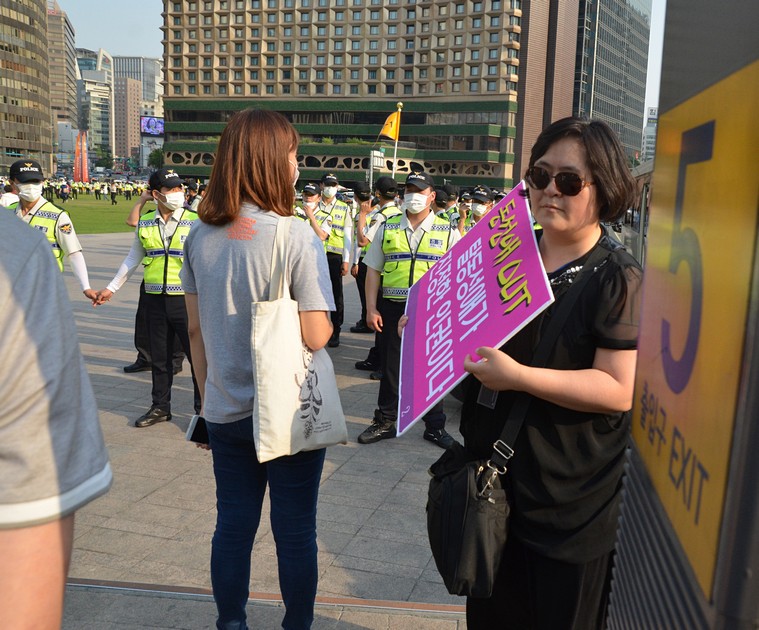
Protests against the Queer Culture Festival by the Countermeasure Committee for Homosexuality Problem

Christian protesters of the Korean Queer Cultural Festival have been getting quite a bit of attention online. As Korea Observer reported, the Christian protesters first managed to submit rally declarations forms for all available spaces in Daehangno, blocking the Korea Queer Culture Festival from being held there; then when they competed with Festival organizers to submit petitions to Namdaemun Police Station, neither was allowed to hold festivals - a victory for the Christian groups. When part of Seoul Plaza was secured for the on June 9, the Christian groups then set out to hold a counter protest, which is the one which has gotten attention online, mostly at this Korea Observer report (do watch the video); many more videos can be seen at Daehanmindecline.

One note I have to make is that there really isn't any justification to be translating '동성애' - 'homosexuality,' or in the context of many of the posters, 'homosexuals' - as 'fags.' Using that word suggests the protesters were using some specific anti-gay slur in Korean when they weren't. In fact, one sign has "queers" written in English, while one handout referred to the "homosexual party" and another directly translates "동성애 문제 대책 위원회" as "Countermeasure Committee for Homosexuality Problem," so I don't see the need to use such an inflammatory word when the messages on the signs are bad enough already.

There were several equating homosexuality and AIDS:

(From the video here.)
Wrong administration causes our children to die of AIDS (above)
Oppose homosexuals!! What is the reason for the increase in teen AIDS patients?
Abolish the student rights ordinance promoted by homosexuals which spreads AIDS
MERS-AIDS fatal virus - desperately oppose the homosexual festival - the increase in AIDS via Homosexuals
There seemed to be several signs ridiculously tying MERS and AIDS together. A number predict the doom of the Korea or use the language of human rights, even addressing UN Secretary General Ban Ki-moon:
Homosexuals will disease Korea’s future.
Is anal sex also a human right?
UN Secretary General Ban Ki-moon - Is homosexuality a human right? (in English)
UN Secretary General Ban Ki-moon! Homosexuals collapse a country built with blood and sweat.
UN Secretary General Ban Ki-moon! Do you really want a homosexual man as a daughter in law or a woman as a son in law?
A number also address Park Won-soon and call for his ouster:
MERS+AIDS fatal virus - Homosexuals collapse a country built with blood and sweat. Homosexual-friendly Mayor Park Won-soon OUT
Homosexuality - Park Won-soon OUT
Park Won-soon, who allowed Homosexuality rally packaged as culture OUT
I can't help but see the 'Out' posters like this one and think of the earliest examples of signs using the English word 'Out' on them - during the mad cow protests against evangelical Christian President Lee Myung-bak:

(Taken on bike path heading up to Haengju Bridge, 2008.)

One of the more jaw-dropping pieces of literature was not the signs the protesters were carrying, but a handout in English addressed to foreign ambassadors being distributed outside of city hall. (First seen here.)


A few notes on this collection of rants that comes rather close to self parody:
That's one of the few times in Korea you'll see Uganda getting praised. Or not being called 'Africa.' As well, we finally find out who the real victims are - those anti-homosexuals who keep being called mean words like 'homophobic.' (Hat tip to Taeyang.)
As well, the last time I checked homosexuality wasn't illegal in Korea. And as for countries with same-sex marriage permitting beastiality and incest, that doesn't seem like the Canada I remember. Which I should be heading to ASAP considering the ending "we want you to leave Korea right now!" Lots of love there. (For comparison, here are some pamphlets handed out by Christians during the 1988 Olympics.)

It's hard to know about the entirety of 5000 years of Korea's "great moral virtue," but according to Richard Rutt and others (as I noted here) homosexuality was practiced and even tolerated in some cases up until at least the Colonial Era; Robert Neff has also uncovered evidence in the writings of early missionaries at the end of the Joseon Dynasty.

I was sent this handout, which names its distributor as the 동성애 문제 대책 위원회" or "Countermeasure Committee for Homosexuality Problem," which they say "consists of 35 major civil groups fighting for our national security, sound religion's [sic] identity, morality and the human rights of North Koreans suffering from dictatorship." It also names 13 embassies (USA, UK, Germany, France, Canada, Spain, Belgium, Slovenia, Denmark, Finland, Norway, Sweden, EU) and states its purpose is "To request ceasing the embassy participation in the 16th queer culture festival in Seoul".


Once again, there is an astonishing amount of linking AIDS to homosexuality: "We are sure the Europe court's __ decision will prevent gay marriage from expanding AIDs [sic] disease everywhere in the [world] threatening the health of mankind. The Europe highest human rights court's decision ___ high level of sound sex moral to save mankind suffering from AIDs [sic]."

And one can’t help but note this: "Koreans have not intervened in other nation and other country their ethics and [culture.] Koreans historically respect other countries." This is a bit on the hilarious side, considering Korean Christian missionaries are all over the world "intervening" in the cultures of those countries by trying to convert non-Christians, with one memorable instance being when a number of missionaries were captured by the Taliban in 2007, with two being killed before they were ransomed, with the Korean government paying an unspecified amount (usually thought to be 20 million dollars). As a result, the Korean government banned Koreans from travelling to a number of countries, mostly to keep missionaries out. As this Korea Herald article points out,
Korea Crisis Management Service, a nonprofit launched in the wake of the kidnapping of 23 Korean Christians doing missionary work in war-torn Afghanistan in July 2007 [...] was founded in part at the government’s request. The nonprofit body trains missionaries working in countries with extreme crime or civil unrest to avoid dangerous situations and, if confronted with trouble, how to get out of it.
The article also points out the desire to 'intervene' in the 'ethics and culture' of other countries:
"Many missionaries want to go to these Muslim countries," Kim of KCMS said. "They have a love for Muslim people and a calling to preach the gospel."
Perhaps if these Christian groups could promise to respect other countries' cultures by keeping their missionaries at home they might not appear so hypocritical. Needless to say, these Christian groups' hateful and ignorant messages aren't going to get any serious attention by their intended recipients. Having groups known for trying to impose their religion on other cultures - a religion whose founder said "Thou shalt love thy neighbour as thyself" - call on foreign embassies to "leave Korea right now!" because they're interfering in Korea's ethics and culture would be funny if it weren't so sad.

Monday, May 4, 2015

RASKB Excursion to Yangcheon Hyanggyo and Gaehwasan next Sunday, May 10

Next Sunday, May 10, I'll be leading a walk around the area of Yangcheon Hyanggyo Station and Gaehwasan Station for the Royal Asiatic Society. The former location was the seat of Yangcheon Hyeon, or prefecture, during the Joseon period and still sports the only remaining Hyanggyo, or Confucian Shrine, in Seoul, as well as a number of other historic landmarks. We will also visit a museum to the innovative Joseon Era landscape painter Jeong Seon (1676–1759), and look at paintings of the area that he made in the mid-1700s. I've mentioned the area before (here and here), and this post at Seoul Suburban covers some of the spots we'll visit.


(Yangcheon District in the 1870s)

From there we will take the subway to Banghwa Station to explore Mt. Gaehwasan. After passing through a park with a number of 400-year-old zelkova and gingko trees, we'll head up the mountain to see the numerous tombs, many with beautifully carved tombstones and flanked by stone civic official statues, of the Pungsan Shim clan, who for several generations served the Joseon kings and were memorialized for their meritorious deeds – one of which was taking part in the overthrow of the notorious king, Yonsan-gun.


We will also go to Yaksasa Temple and see a statue of the Buddha and a three-story stone pagoda which date back to the Goryeo Era.


We'll see an even larger such statue dating from the early Joseon period outside Mitasa Temple, on the other side of the mountain. The statue was found buried in the 1930s, when the temple was rebuilt. Both temples were destroyed during the Korean War, but the pagoda and statues survived.


Next to Mitasa is the Memorial to the Loyal Dead, which was erected to remember the 1,100 soldiers of the Korean 1st Army Division who died defending Mt. Gaehwasan - which overlooks Gimpo Airport - during the opening of the Korean War, which will provide an opportunity to learn more about the fighting which took place on the mountain during the war, as well as its military importance in the present. I'll also touch on the importance of the area during the Imjin War.


Being a mountain, of course, there will be lots of opportunities to take in views of the Han River and surrounding area and enjoy what nature has to offer.


If you feel like joining us, please do! The cost of the tour is W20,000 for RAS members and W25,000 for non-members. The excursion will set off next Sunday, May 10, at 1:00 pm from exit 3 of Yangcheon Hyanggyo Station (양천향교) #906 (subway line number 9). For more information, see here.

Thursday, November 20, 2014

RAS walking tour of Jeong-dong this Sunday


This Sunday, November 23, I'll be leading a walking tour for the Royal Asiatic Society of Jeong-dong, which became the neighbourhood for Westerners after Korea opened to the west in the 1880s through to the end of the colonial period. I've written about the history of this area before (here and here), and will be looking at lots of turn of the century Western architecture and connecting these buildings to stories of Korea's modern history. From the RAS website:
On this excursion we will meet in front of Deoksugung Palace from where we will explore the Jeong-dong's rich early modern history. After a visit to the Anglican church we will take in a view of the neighbourhood from above before heading to the Seoul Museum of Art, which is housed in the colonial era-built former Korean Supreme Court building.To learn about the missionary influence upon the neighborhood, we will visit the Baejae Hakdang, a missionary-run boys' school which educated many of Korea's future elite, now restored as a museum; the Jeong-dong First Methodist Church; and Ewha Girl's High School, the first school for girls in Korea, and also the site of one of Korea's earliest foreign-run hotels, the Songtag Hotel. From there we will visit the restored Jungmyeongjeon Hall, which was built as a royal library but is best known for being the place where the Eulsa Treaty, which the Japanese used to deprive Korea of its diplomatic sovereignty, was signed in 1905. Other stops will include the remains of the former Russian Legation and the beautiful colonial home where independence activist Kim Ku was assassinated in 1949.

The cost of the tour is W20,000 for members and W25,000 for non-members. The excursion will set off from Daehanmun, the front gate of Deoksugung Palace, (subway line number 1, dark blue line, or 2, green line, City Hall Station #132, exit 2) at 1:00 pm.
Feel free to join us!

Tuesday, July 15, 2014

100 year-old drainage tunnels designated as cultural assets

As the Korea Times briefly reported the other day,
The Seoul Metropolitan Government designated two underground drainage
tunnels built in the early 20th century as its cultural assets, Sunday. Pictured is a tunnel beneath Namdaemun [sic], central Seoul, which was discovered in 2012. The other tunnel is under City Hall Plaza.
Here are photos of the 394 meter tunnel beneath Namdaemun-ro (as in the street) from the Donga Ilbo:


The location of the tunnels can be seen below (marked in blue) in a map published by Aju News:


The 191 meters of tunnel under Seoul Plaza, pictured below (from the Herald Gyeongje), feature two branches which head towards Deokgusgung Palace and a main tunnel which cuts diagonally under the plaza.


To get a better idea of what it looks like to wander in the tunnels, SBS has a report here.

The tunnels were first reported on last October, as this Yonhap article notes, when the city announced that it was considering designating the two tunnels, which had been discovered between December 2012 and May 2013, as cultural properties since they were symbols of modern urban development and civil engineering. Previously tunnels under Deoksugung had been considered cultural properties, but they were included as part of the palace, and this was to be the first time such tunnels would be considered separately as cultural properties. They are thought to have been built between 1907 and 1915; the tunnel under Seoul Plaza is made of brick, with the lower half sealed with plaster/mortar, while the tunnel under Namdaemun-ro has a top half made of brick and a lower half made of concrete, which was a new material at the time.

The SBS report also notes that the city plans for the drains that were designated as cultural properties to be open to the public for free tours from October. That sounds like it would be fun.

(Hat tip to Hamel and Ami.)

Friday, June 13, 2014

It always interesting when leftist radicals and rightist Christians agree on something

As I pointed out in detail in this post about Korean fears of AIDS prior to (and during) the 1988 Olympics, progressives in South Korea portrayed US soldiers, and Americans in general, as being spreaders of AIDS in Korea, with some radical students protesting in the streets with this message. Two days before the Olympics, the Korea Herald reported that
Police hauled away about 20 demonstrators, mostly young women, when they tried to hold a protest in front of the US army base here Thursday [September 15] alleging that American soldiers were responsible for the spread of AIDS in South Korea.
As AP reported in a September 17 article about the opening of the Olympics,
A small protest was held at Yonsei university with less than 100 students taking part. Students distributed leaflets claiming foreigners at the Olympics would spread acquired immune deficiency syndrome.

“Oppose Olympics which oppose Korean peoples’ health with AIDS,” the leaflets said.
The group asked, “The United States is causing many problems as it pursues pro-gay policies like the recent expansion of same-sex marriage legalization, but is it now trying to expand homosexuality in not just the United States, but Korea, too?” They said homosexuality was the main culprit in the occurrence of AIDS, and that homosexuals were at high risk of getting AIDS. They that the number of patients who contracted AIDS due to homosexual activity in Korea is rising like the United States, and asked if the United States was trying to export AIDS, too, to Korea through its gay diplomacy. - See more at: http://www.rjkoehler.com/#sthash.mrsHcNVI.dpuf
 Or, as I noted in this post, Hustler's 'Korean sex-scene guide,' published during the 1988 Olympics and discovered and translated by students, was
Just the ticket to incite an anti-American demonstration, which is what a young man with a microphone nearby is trying to do.

"You see? The Olympic Games are just an excuse for Americans to come to Korea and pollute our country with AIDS!" he shouts. "Yankees out of Korea!"

"Yankees out of Korea!" echoes the crowd of about 50 students. Across the front of the building are four huge posters proclaiming: "Yonsei University students curse American barbarism."
So it wasn't just soldiers, but foreigners (particularly Americans) who were planning to pollute Korea with AIDS as well.

 In mid-October 1988 the Donga Ilbo reported that
the head of the AIDS countermeasures joint committee Im Jong-cheol pointed out that “USFK is an AIDS powder magazine” and revealed that there was an urgent need for an amendment to the AIDS Prevention Law to implement such things as a regular AIDS checkup for USFK members.
By this point, in the wake of the Olympics, calls were being made to amend the SOFA agreement, in some cases to allow for HIV testing of US soldiers.

The fears stirred up by these leftist activists echoed contemporary North Korean propaganda which accused US soldiers as having infected 100,000 prostitutes in the south with AIDS.

In May 1989, AP described a protest against Yankee 'devils' in Daejeon which sounds similar to such propaganda:
''Let's inflict an irrevocable defeat on U.S. imperialism and advance the unification of our fatherland,'' said student leader Im Chong-suk.

Cheering students chanted, ''Punish Yankee imperialism'' and ''Yankees go home.''

Leaders denounced a proposal to relocate some U.S. military units from Seoul to Taejon. They charged American soldiers would spread AIDS among the local population.

Speakers ridiculed American soldiers as the ''AIDS legion.'' 
So it was not without a sense of irony that I read Robert's post at the Marmot's Hole about right-wing Christian activists protesting in front of the US embassy against alleged US embassy support for the Korean Queer Festival:
Korean Queer Festival
The group asked, “The United States is causing many problems as it pursues pro-gay policies like the recent expansion of same-sex marriage legalization, but is it now trying to expand homosexuality in not just the United States, but Korea, too?” They said homosexuality was the main culprit in the occurrence of AIDS, and that homosexuals were at high risk of getting AIDS. They that the number of patients who contracted AIDS due to homosexual activity in Korea is rising like the United States, and asked if the United States was trying to export AIDS, too, to Korea through its gay diplomacy.
I wonder how comfortable those right-wing Christians would be realizing their accusations mirror those made by left-wing radical students not so long ago. Perhaps their affinity for believing in Korean exceptionalism (especially in exceptional moral uprightness (compared to Americans) and exceptional victimization) which lies at the heart of many narratives of Korean nationalism might allow them to reach across the ideological divide and shake hands for a moment. Or not.

(They both might want to send their kids to this hagwon, at least.)

Oh, and it's not wise to blame the west for the expansion of homosexuality in Korea, considering that it appears to have been at the very least tolerated in Joseon-era rural society, as I noted here, and as Robert Neff discussed here. Richard Rutt also examined this topic in his article 'The Flower Boys of Silla (Hwarang)' published in the October 1961 issue of Transactions of the Royal Asiatic Society (which, along with other Transactions articles, can be downloaded here).

Wednesday, May 14, 2014

Walk around Yancheon Hyanggyo and Mt. Gaehwasan this Saturday

This Saturday I'll be leading a walk around the area of Yangcheon Hyanggyo Station and Gaehwasan Station for the Royal Asiatic Society. The former location was the seat of Yangcheon Hyeon, or district, during the Joseon period and still sports the only remaining Hyanggyo, or Confucian Shrine, in Seoul, as well as a number of other historic landmarks and a museum to the innovative Joseon Era landscape painter Jeong Seon (1676–1759). I've mentioned the area before (here and here), and this post at Seoul Suburban covers many of the spots we'll visit.


(Yangcheon District in the 1870s)

From there we will take the subway to Banghwa Station to explore Mt. Gaehwasan. After passing through a park with a number of 400-year-old zelkova and gingko trees, we'll head up the mountain to see the numerous tombs, flanked by stone statues, of the Pungsan Shim clan, who for several generations served the Joseon kings and were memorialized for their meritorious deeds. 


We will also go to Yaksasa Temple and see a statue of the Buddha and a three-story stone pagoda which date back to the Goryeo Era.


We'll see an even larger such statue dating from the early Joseon period outside Mitasa Temple, on the other side of the mountain. The statue was found buried in the 1930s, when the temple was rebuilt. Both temples were destroyed during the war, but the pagoda and statues survived.


Next to Mitasa is the Memorial to the Loyal Dead, which was erected to remember the 1,100 soldiers of the Korean 1st Army Division who died defending Mt. Gaehwasan - which overlooks Gimpo Airport - during the opening of the Korean War, which will provide an opportunity to learn more about the fighting which took place on the mountain during the war, as well as its military importance in the present.


Being a mountain, of course, there will be lots of opportunities to take in views of the Han River and surrounding area and enjoy what nature has to offer.


If you feel like joining us, please do! The cost of the tour is W20,000 for RAS members and W25,000 for non-members. The excursion will set off this Saturday, May 17 at 1:00 pm from exit 3 of Yangcheon Hyanggyo Station (양천향교) #906 (subway line number 9). For more information, see here.

Thursday, March 27, 2014

Putting the wrong people in charge

Well, this is certainly an interesting story about the head of the Korean Association of Hagwon (hat tip to Scott Burgeson - see his comment here):
Police are investigating allegations that Pagoda Education Group President Park Kyung-sil plotted to kill a relative of her estranged husband Go In-kyung.[...]

According to investigators, in August last year Park allegedly paid her driver to kill one of Go’s relatives who had frequently advised him on business matters.

However, the driver did not carry out the murder; and he has been questioned by police several times.[...]

Lee Jung-hwan, Park’s lawyer, denied the allegations, claiming that his client gave the driver the money to find and hire a new legal representative for business matters.

“We explained to the police that she would not be immediately available because of the upcoming election for the Korea Association of Hagwon (KAH),” Lee said.

“It also overlaps with the schedule for another legal case.”

In this case, police are investigating claims that last year Park gave 1 billion won ($926,354) to a middleman identified as Seo to allegedly bribe officers investigating her for embezzlement and breach of duty.

However, on Jan. 6 she was found guilty of the charges by Seoul Central District Court and sentenced to 18 months in prison suspended for two years.[...]

Park has led the Korea Association of Hagwon (private learning institutes), which has more than 50,000 private institutions under its wing, since 2011.
Sounds like the kind of person you want as the national figurehead of owners of businesses that care for children (but hey, hagwon owners have to evade taxes too, right?).

Speaking of putting the wrong person in charge, the Joongang Ilbo reports on the fustercluck that the Namdaemun restoration has turned out to be.
Authorities investigating the faulty restoration of Sungnyemun, or Namdaemun Gate, said yesterday that they will further investigate Sin Eung-soo, the chief carpenter for the restoration process, over allegations he spirited away lumber donated by the public for the reconstruction of the country’s No. 1 national treasure.

Authorities estimated that the value of the stolen lumber was approximately 42 million won ($39,020).

The police raided Sin’s lumber mill in January on suspicions he supplied substandard wood for the restoration. The gate reopened last May after a five-year restoration, but some of the work was found to be rushed and substandard.

The police also suspect the 71-year-old carpenter purloined four Geumgang pine trees that were provided in 2008 by the Cultural Heritage Administration (CHA) for the reconstruction of Gwanghwamun, the main gate of the Gyeongbok Palace, under Sin’s supervision. Geumgang pine trees are praised for their resilience, straightness and density. The estimated value of the four pine trees is about 60 million won.
Both of these stories are surprising, and yet not really that surprising, at the same time.

Sunday, February 2, 2014

Seoul's modernizing skyline... in 1897

On February 23, 1897, the Independent published this article about Seoul's changing skyline:


What's interesting about that article is that one gets the idea that a 'Europeanized' 'foreign settlement' with 'European buildings' was an accoutrement that Seoul - and Korea- needed in order to be truly modern.

As for the buildings referenced, the French Legation was located on what is now the grounds of Ewha Girls' High School in Jeong-dong. The 'new Cathedral in Chonghen (?)' refers, of course, to Myeong-dong Cathedral, while "another Catholic Church in Yakhen" is Yakhyeon Catholic Church, near Seoul Station.

The Russian legation once looked like this, but now only the tower stands (see here).

The British Legation still stands today, while the long-gone customs building stood near the old Shin-a Ilbo Building, according to a nearby plaque. The "New Methodist Church in Chongdong" still stands today as Chungdong First Methodist Church, while a later building from the 'Methodist School' [Paichai Hakdang] still exists today as the Appenzeller/Noble Museum (the building standing at the time of the Independent article can be seen here). The Japanese consulate (which was built in 1895 and stood on the northern slope of Namsan) can be seen here (fourth photo).

I've written about the Jeong-dong area before. Though Seoul may have been modernizing, neither that, nor the declaration that Korea was an empire later in 1897, saved Korea from being colonized by Japan. An interesting book being published this spring is Todd Henry's Assimilating Seoul: Japanese Rule and the Politics of Public Space in Colonial Korea, 1910-1945; an excerpt of the book can be read at the link. I imagine the book will incorporate some of his earlier writings about colonial Seoul, including "Respatializing Choson's Royal Capital: The Politics of Japanese Urban Reforms in Early Colonial Seoul, 1905-1919," a chapter in the book Sitings: Critical Approaches to Korean Geography. This chapter has a fascinating map showing the Japanese government's original plans for colonial Seoul, which included streets radiating out from a plaza along present-day Euljiro. The plan was never carried through, but one city in which such a plan was carried out is Jinhae; a 1946 map of the city can be found here (first result). Right next to Jinhae is Masan (actually, both cities were incorporated into Changwon a few years ago); here is a post about Masan's first modern buildings.

Wednesday, January 15, 2014

Bits and pieces

I saw this love letter to Lee Eung-tae, written by his wife upon his death in 1582, awhile ago, but since I saw it again the other day I'll link to it here.

As noted at Korean Literature in Translation, the Literature Translation Institute of Korea has made available translations of 20 stories from 20th century Korean literature. I'm looking forward to reading the stories by Yi Sang and Chae Man-sik

Over at the Korea Times, Robert Neff celebrates the 84th birthday of Fred Dustin, who has lived in Korea since 1955, by looking back at his life and times. I especially found the story of the Koryo Club ("a group of Koreans and foreigners with an interest in Korea and its culture") interesting.

With almost 15,000 views over almost three years, my post about black face in Korea is the most popular post I've ever written, and appears to have been - at least in part - the basis of Korea's inclusion on this list (the photo in that article is most certainly from that post). On a similar topic is this list of Kpop's 'most racist moments of 2013.'

Speaking of racism, Sam Hammington spoke out briefly about racism he has faced in Korea, as noted in this post which translated the top-rated comments upon the article.

A high-tech cheater gets caught.

And this article about the Park Geun-hye government's moves to control the content of history textbooks deserves more attention than I can give it right now, but is well worth reading.

Sunday, November 24, 2013

Presentation for KOTESOL Daejeon Chapter's Thanksgiving Symposium next Saturday

At 11:00am on November 30 I'll be giving a presentation at the 2013 KOTESOL DCC Chapter Thanksgiving Symposium and Turkey Dinner being held at Woosong University in Daejeon. Here's the description:
"Patience, sir": 200 years of foreigners teaching English in Korea

From the first-recorded English lesson in 1816 to Lee Myung-bak's promises of a "native speaker in every school," English has played many different roles in Korea's history, from its use in Korean attempts to preserve its sovereignty and Japanese efforts to present Korea as a 'failed state' at the turn of the last century to the radical expansion of the study of English as a foreign language over the past twenty years. This presentation will look at the experiences of those teaching the language, including missionaries, Peace Corps Volunteers, 'beeper cowboys' and even World War II prisoners of war. At the same time, while the Korean government has perceived mastery of English as necessary for Korea to compete in a globalized world, it has also shown distrust of the culture attached to the language, a wariness which stretches back to the days of the Joseon Dynasty, and manifestations of both the desire to learn the language and the distrust of the accompanying culture - and the teachers who embody it - will also be examined.
Anyone can attend the symposium, with pre-registration costing 10,000 won for members and 15,000 won for non-members, and on-site registration costing 15,000 won for members and 20,000 won for non-members. The turkey dinner costs 25,000 and everyone must pre-register for it.

The registration link can be found here. I look forward to meeting anyone who can make it out!

Denial of service, then and now

A bit late with this, I know (sorry for such light posting lately), but in the news last week was the tale of businesses in Bali banning entry to Korean customers:
Hotels, retailers and restaurants on the resort island of Bali are rejecting Korean customers due to some who flout regulations to make the most of their stay, according to South Korean TV network SBS.

Korean tourists are reportedly finding new and creative methods of vacationing on the cheap at the Indonesian vacation destination, which is frustrating local business owners to no end.
There's a discussion thread about it here that was pointed out to me (read it if you dare; it consists of lots of 'Koreans deserve it because they do it in Korea too' kinds of comments). This isn't the only place that has shown annoyance with Korean tourists, as Scott Burgeson noted in Fukuoka a few years ago; on a similar topic, he posted a chat with a woman who worked as a receptionist at a Korean-run karaoke club in Jakarta almost 9 years ago.


Upon hearing of what had happened in Bali, I couldn't help but be reminded of a passage in Jo Yoong-hee's article "The Relationship between Joseon Envoys and Western Missionaries in Beijing in the Early 18th Century: Focusing on Lee Gi-ji's Iramyeon-gi."*

In it, he describes Lee Gi-ji's visit to Beijing as part of a diplomatic mission in 1720, and notes the friendly relations between the missionaries and Koreans. Forty years later, however, Hong Dae-yong wrote about his visit to Beijing in 1765 as part of a mission and described how the hospitality of the missionaries towards Koreans had changed:
Since the Emperor Kangxi (r. 1662-1722), Joseon's diplomats used to visit the Catholic churches in Beijing and to be welcomed by the missionaries. The missionaries used to show exotic paintings, icons and other objects in the churches and even give the visitors presents brought from Europe. Joseon diplomats year by year wanted more exotic goods and experiences at the churches, so visiting Catholic churches in Beijing became the diplomats' conventional practice. Our country's custom seemed like arrogance, exaggeration and maliciousness, and the diplomats from Joseon often neither behaved politely nor paid back for the presents they received. Moreover, their followers were often uneducated, smoked and spat inside the churches, and touched things without allowance, which made the missionaries, who liked cleanliness, angry.

Recently, the Western missionaries became to dislike visitors from Joseon more than before. The missionaries refused to do the Joseon visitors a favor. They did not treat the visitors with heart.
The article goes on to describe how things had changed over 40 years: "Whereas Lee Gi-ji was welcomed by the missionaries without any advance notice of his visit, the visitors from Joseon in Hong's days were not allowed to enter the church even when they asked to see the church."

I guess you have to hate it when a bunch of idiots ruin things for everyone.


*일암연기 / 一菴燕記, in Hangeul / hanja, for the curious.

(Hat tip to Kelly.)

Friday, October 18, 2013

A “Cash” Transaction in Korea

Foreign correspondents in Korea during the Russo-Japanese War 

Part 1: From Japan to Korea
Part 2: In Seoul and Chemulpo
Part 3: Along the coast of Korea
Part 4: R.L. Dunn: Jack London knows not fear

I hope to return to this at some point - discovering that Collier's Magazine can be read online has lead me to find several new articles, especially those by the photographer R.L. Dunn, who accompanied Jack London and Frederick McKenzie as the first foreign correspondents in Seoul in 1904. Below is one of the more interesting photos and stories associated with Robert Dunn from that time, as published in the June 4, 1904 issue of Colliers.


A “Cash” Transaction in Korea

R. L. Dunn, Collier's special war photographer in Korea, wrestled with many hardships and obstacles in his march from Seoul to Ping-Yang. Some of them he expected and tried to forestall. Others he met as they befell. He had not reckoned with having too much money as one of the troubles of campaigning in Korea or anywhere else. The photograph, which shows Mr. Dunn in the middle background, does not explain itself, because it conveys the impression that he is examining a huge heap of sausage, possibly procured as an addition to his field commissary.

As a matter of fact, however, the photographer helplessly surveying a mountain of money three feet high and sixty feet around the base. It is Korean currency, copper coins, in strings of a thousand each, the kind of disk, with a square hole punched out of the middle, which was first used in China, and a few hundred or thousand years later borrowed for the fiscal system of the Hermit Kingdom. From fifteen to thirty of these "cash" are required to equal the value of an American cent. A string of a thousand will weigh several pounds, a dollar's worth will make a load for a strong man.

Mr. Dunn had no intention of stripping Seoul of its small change when he gave the fatal order to Kurita, his interpreter. He was making ready his outfit for the advance, and it occurred to him that a supply of native money would be indispensable, inasmuch as a good deal of forage and other supplies must be obtained along the way. In addition, Kurita assured his master that many necessaries on their list could be had only in districts further north, and that "plenty of money" must be packed along. “Plenty of money” meant at least two or three hundred dollars to the American bound on a campaign of weeks. But he told Kurita to go out and find change for one hundred and fifty dollars, and be quick about it.

The forenoon passed and no Kurita returned. He was needed for a dozen urgent errands, and the afternoon was nearly spent, before Mr. Dunn became uneasy, impatient, then alarmed. The interpreter must have absconded, and all the foreign correspondents in sight were rounded up as a searching party. It was useless to notify the native police, and the photographer and his friends did not delay for official justice to be awakened from its slumbers. Just as the expedition was starting forth, one of the hotel boys came running up the street, beckoning to Mr. Dunn, shouting breathlessly: "Come, look, see, master. Kurita no can do. Have got, but no can do."

The boy led the way to a courtyard in the rear of the hotel, where the hapless Kurita yelled for joy as he sighted the party:

"Plenty money, got him cheap," was the interpreter’s greeting. "What you wanchee me do now?"

In the words of Mr. Dunn, as he wrote about it in a letter to the office:

"It took me only an instant to realize that I was the proud owner of what looked like a whole city block of real money-money enough to sink a ship, money piled in heaps and heaps, money enough, you would think, to last a spendthrift a million years."

Kurita had filled the order, and the coolies had been staggering under their burdens of “cash” from every corner of Seoul to the courtyard since morning, while the native money changers had put up their shutters until they could renew their stock.
“I had the money all right,” says Mr. Dunn, “but what could I do with it? I could not carry it, and nothing short of an army could move it. We paced around the edge of the heap and measured sixty-odd feet of circumference, while the average height was at least three feet. Kurita insisted that twenty men were needed to guard my wealth, night and day, until I should be ready to move it.”

Mr. Dunn was ready and eager to take the field, so nothing else could be done than to take a few strings of “cash” for immediate wants, and leave the mountain where it lay until its owner should come again to Seoul. Kurita was authorized to employ a guard of worthy and brave men, of strictest integrity, and a score of them, standing watches in relays, hovered around the concentrated opulence when collier’s photographer and his interpreter hurried away to the front.

They returned two weeks later, to find that many strings of “cash” had evaporated, although the guards swore by a million-odd saints and devils of the Korean mythology that not one copper coin was lacking. However, when it came to paying the wages of the guards for two weeks, on top of the singular depreciation noted, the mountain of cash had melted almost to nothing. It was a fact that the heap of money had eaten itself up, and the only beneficiaries were the sentinels, who shuffled away, doubled over with the weight of installments of their wages, and later came back with carts to collect the remainder.

Sunday, October 6, 2013

Hustler magazine tramples the purity of the Korean race

The 1988 Seoul Olympics
Part 1:  The Seoul Olympics, 25 years later
Part 2:  The 1988 Olympics and Korean fears of AIDS
Part 3:  Americans and bad first impressions
Part 4:  Reptilian Style: The 'live-or-die general war' against Hollywood
Part 5:  An attack in a boxing ring
Part 6:  Media responses to the boxing ring incident
Part 7:  No more lion: US swimmers' 'prank' becomes 'diplomatic incident'
Part 8:  KAIST catches Big Ben
Part 9:  Hankyoreh interviews Korean witness to theft by swimmers
Part 10: Stop me if you've heard this one: Four GIs head to Itaewon in a taxi...
Part 11: Taxi-kicking US runner taken to Itaewon police box
Part 12: NBC uses the power of t-shirts to insult Korea... again
Part 13: Cultivating outrage toward America
Part 14: Politicians engage in damage control
Part 15: Heaven on Earth

Part 16: Hustler magazine tramples the purity of the Korean race

In a September 19, 1988 Joongang Ilbo article titled "Women’s Organizations give 'final warning': we can’t take any more sexual abuse," it was reported that the day before the Olympics began, the United Korea Women's Association gave a statement denouncing the attack by US military teens against a pregnant Korean woman (mentioned here) and criticized the "special privileges" of the US military, citing a government statistic that out of 15,000 crimes committed by US soldiers in the past decade, the Korean government had exercised jurisdiction in less than one percent of the cases. As well, they called for the perpetrators' parents and the US Ambassador to publicly apologize to Korea citizens, a speedy and fair investigation and punishment by government authorities, and "revision of the unequal SOFA." They also declared that it "wasn’t simply an assault, but a reflection of Americans' tendency to look down on Koreans." Another such example was given by the association:
As well, they condemned and announced they were considering countermeasures against an article in the most recent issue of the American pornographic magazine Hustler titled "Olympic-goers guide to Korean sex," which insultingly portrayed many Korean women as cheap prostitutes who entice men on the streets.

The article stated that because there were fears that Korean women might be infected with AIDS from the millions of foreigners visiting Korea during the Olympics, some groups argued that foreigners entering the country should carry AIDS test certificates, but were silenced by the government's plan to distribute free condoms in the athletes' village.
That's right, the October 1988 issue of Hustler did indeed feature a 'Korean sex-scene guide':


Introducing the article is a two-page not-safe-for-work illustration, and as the article begins, the title 'Guide to Korean sex' is followed by the subtitle 'The casual Western visitor to Seoul will be astonished to find armies of big-titted, strapping young whores.' While one could understand that offense would be taken at a description of the prostitution available to visitors during the Olympics (again, "the unspoken rule that [journalists] should only look at what Koreans chose to show them"), and at NBC itself broadcasting reports about prostitution in Korea, the article was quite a bit more offensive than that. Here's the opening (click to enlarge):


The writer, Jun Kanda, maker of sex tapes shot in Asia, offers up some howlers as well, such as describing a “culture dominated by women” (because “Even today, a Korean bride keeps her family name after marriage”) and asserting that “The real power in the country is concentrated between the dewy thighs of Korea’s proud vagina owners." He also tells us, "I was cruising Itaewon, the red-light district of Seoul." Right. Kind of like how Myeongdong is the shopping district of Seoul. It gets more offensive, however, as he describes the tutelage of the US military and the nature of Korean women:


At this point, it should be remembered that, like everywhere outside of Europe and America, Korea had been the object of many 'studies' and travelogues in the late nineteenth and early twentieth centuries, some of which were written to justify Japanese occupation of the peninsula, others which were written to make the superiority of western culture stand out in relief. The following paragraph (which I first posted here) from George Kennan's October 8, 1904 Outlook article, "The Land of the Morning Calm":
American friends who have spent in the peninsula more years than I have weeks tell me that the Korean, as a man, is intelligent, courteous, teachable, kind-hearted and superior in many ways to the Japanese; but in the first place, he impresses me as lacking in virility, and, in the second place, he is so abominably dirty in his personal habits and his environment that I find it almost impossible to credit him with a spark of self-respect. His apologists say that he has been crushed and disheartened by centuries of bad government. This is undoubtedly true, and it accounts for many of his weaknesses and defects; but bad government does not prevent him from cleansing his premises, nor a body of citizens from cleaning up their neighborhood. So far as my limited observation qualifies me to judge, the average town Korean spends more than half his time in idleness, and instead of cleaning up the premises in his long intervals of leisure, he sits contentedly on his threshold and smokes, or lies on the ground and sleeps, with his nose over an open drain from which a turkey-buzzard would fly and a decent pig would turn away in disgust.
Even when writers were trying to say nice things, it could come out laced with a large amount of condescension, or worse, as this paragraph from the 1950 book 'The Epic of Korea' (looked at here) reveals:
Korea is a land of gooks ; the Korean is a gook. He is incomprehensible because his thought processes are different, his philosophy not of the earth but of the air. He belongs to another world. But just when we think that we can never understand the Korean, the light of comprehension shows in his dark eyes and in his ready smile and laughter, and we call him gook with foolish tenderness. Almost unwittingly we find ourselves so fond of him that we want to shelter him from all harm.  
And while nowhere near as offensive as the Hustler article, his comments on Korean women are rather objectifying and condescending:
The Korean woman, like all Asiatics, is small, but she is much better proportioned than other Asiatics. Unlike the Japanese, in whom the torso is normal in size, the hips larger than normal, and the rest of the body diminutive, the contours of the Korean woman are superbly regular. Her body is almost rigidly erect, largely because of the burdens she has borne on her head. Unlike the breasts of the Japanese woman, those of the Korean woman are well developed and sometimes even bulging. But, with a kind of winding-sheet, she binds her breasts, outward and downward, to her body. And the Korean woman, although very modest, has no squeamishness or childishly sensual attitude toward the various parts of her body. They were created with her soul and are to be treated with dignity, not laughed at by people with a sudden awareness that the human body has members. By way of example, a young American officer said to a barmaid in Seoul in his broken Japanese, Anata wa, chichi ga arimasen ka? ("But haven't you any breasts?") The barmaid, a very pretty young woman, said, "Yes." With complete aplomb, she reached into her tunic, opened her red flannel undershirt, unwound her winding-sheet, and produced a white-gold orb, which she held in the palm of her hand and said, "See!" Even amid American guffaws she retained her native impassibility. Only complete chastity such as most Korean women possess can produce such perfect self-composure.
The illustration which accompanied the Hustler article can also be connected to images like this (from halfway through Michael Hurt's photo essay here) or to more ribald photos taken by G.I.s I won't link to here.

Needless to say, and no doubt with the type of writing above in mind (at least for some of them), the Hustler article certainly made an impact upon university students. The following was published in a regular column in the Donga Ilbo titled 'Hyujitong,' or 'garbage can' on September 23:
Students from Suwon area universities such as Gyeonggi University and Hansin University are carrying out a signature campaign in opposition to a seven page feature article published in the most recent issue of the American-published lewd magazine Hustler, titled 'Hustler's Korean sex for Olympic tourists,' which provides information about prostitutes to foreigners coming to Seoul to see the Olympic games.

The problematic article in the most recent issue of Hustler says that "Itaewon, an area crowded with apartments and shopping beneath Namsan in Seoul, is a mecca for enjoying Korean sex" and goes as far as introducing hotels where one can easily meet Korean women and how much money to pay for sex. It also insults Korean women, saying "Because some women who tend to prefer foreigners spend lots of money, you don't need any special preparations to enjoy Korean sex."

Regarding the article in the American magazine with distortions and fabrications which sexually degraded Korean women and said they preferred foreigners, students are carrying out a "Signature campaign to prevent sex Olympics and stop AIDS and the commercialization of women" to demand the government formulate measures.
The article gained a wide audience after it was photocopied, translated, and posted up at universities, as the September 30 Miami Herald article titled "Korean Students Fuel Anti-U.S. Sentiment" makes clear:
Come to Korea, where the women are all sluts: so says the latest issue of Hustler magazine. The article has been taped to a wall at Seoul's Yonsei University for all to read, labeled a typical example of American journalism.

Illustrated by a drawing of naked Oriental women frolicking in the basin of the Olympic flame, the magazine piece, titled "Hustler's Olympic Goer's Guide to Korean Sex," is an imaginary and pornographic description of Korean women, who are portrayed as so eager to please visiting Americans that even prostitutes among them will entertain Yanks for free.

Reading the article, which has been translated into Korean, are scores of students of both sexes, their faces intent, sober, controlled. The article is unremittingly vile, vividly insulting.

Just the ticket to incite an anti-American demonstration, which is what a young man with a microphone nearby is trying to do.

"You see? The Olympic Games are just an excuse for Americans to come to Korea and pollute our country with AIDS!" he shouts. "Yankees out of Korea!"

"Yankees out of Korea!" echoes the crowd of about 50 students. Across the front of the building are four huge posters proclaiming: "Yonsei University students curse American barbarism."

Across town at Korea University, about 15 miles from the Olympic stadiums, a group of 1,000 students charged police and hurled firebombs, shouting, "Down with the dictator's Olympics!" and "Yankee go home!" But even this rally, wild by Western standards, is just an afternoon's drill for students here. They used to do this every other day before the Olympics began.
The connection between the Hustler article, AIDS, and America would be made more than once. On September 28, the Hankyoreh published a letter from Seoul resident Jin Jeong-mi, in which she used the term minjok (nation/race/ethnicity) a number of times:
In holding the Olympics, Korean women are mocked
Low American magazine 'Hustler' says they are "traditionally gisaengs"

If you are a Korean woman, or no, if you are citizen of this country, I believe all of you should know about this, and I write these words unable to calm my indignation. A few days ago I saw a poster at school with an image and article which appeared in the pornographic American magazine Hustler. The image had semi-nude Korean women lying in the Olympic torch with a set of giant chopsticks next to them. The picture has the meaning that "Come to Seoul, where the Olympics are being held, and using chopsticks, help yourself to Korean women."

Furthermore, the article next to the image made me feel even more unbearable outrage and humiliation as a Korean. [...]

As I read the article, I was shocked at how the majority of foreigners coming to the Olympics may look at our country's women.  Our history of subordination, with 36 years of Japanese rule followed by the stationing of US military here, has shown our minjok to be the nothing but the plaything of foreigners, and if this country is seen as a den of kisaengs, what in the world do many women, beginning with those volunteering for the Olympics, look like in the eyes of a foreigner.?

The government, meanwhile, hasn't taken any kind of measures against the main route for AIDS into this country, the US military, which is in various places across the country, and during the Olympics, instead of having AIDS tests for foreigners entering the country as they should, they're giving away condoms for free in the Olympic Village, something I really can't help but deplore. Beneath the splendid signs for the Olympics, Korean women are suffering mockery and the purity of the minjok is being trampled. How can this be "the Olympics, pride of the minjok"?

I think that denouncing and severely condemning America, which looks at this country's women as nothing but prostitutes, and the current government authorities who allow this is the least we can do to recover the pride of our minjok. I earnestly appeal as a woman to combine the power of all citizens in order to do this for the country.
As the Miami Herald article noted, the Hustler article had been "labeled a typical example of American journalism," and above we see the writer claim that "America... looks at this country's women as nothing but prostitutes." After the humiliation of seeing their own sporting officials assault a foreign referee in the ring suffering this mockery and trampling of their purity by America, students took further action. On September 30, the Donga Ilbo published the following article:
SNU Student Council Reps Visit US Embassy
Deliver letter protesting distorted media reports

Seoul National University Student Council president Park Jae-hyun (Astronomy and science, 3rd year) and 4 other student representatives went to the US embassy to deliver a open letter protesting a series of recent crimes committed by Americans and distorted news reports.

Seoul National University Student Council's letter claimed that, "The recent series of events involving NBC and US soldiers are more than accidents - we cannot but see the explicit expression of a trend showing implicit contempt for Korea and Koreans." "In regard to this we are also looking into the "88 Olympic Korean Sex Tour" article published by the American magazine Hustler.
And so the tale of the Hustler article ends... at least during the Olympics. It would be invoked in a very prescient article a few weeks later. That will have to wait, however.

[Note: I first learned of the Hustler article here, and it was, ironically, through the Hustler article that I learned about the government's plans to test foreign Olympic visitors for AIDS.]