Showing posts with label Protest. Show all posts

Sunday, June 14, 2015

Protests against the Queer Culture Festival by the Countermeasure Committee for Homosexuality Problem

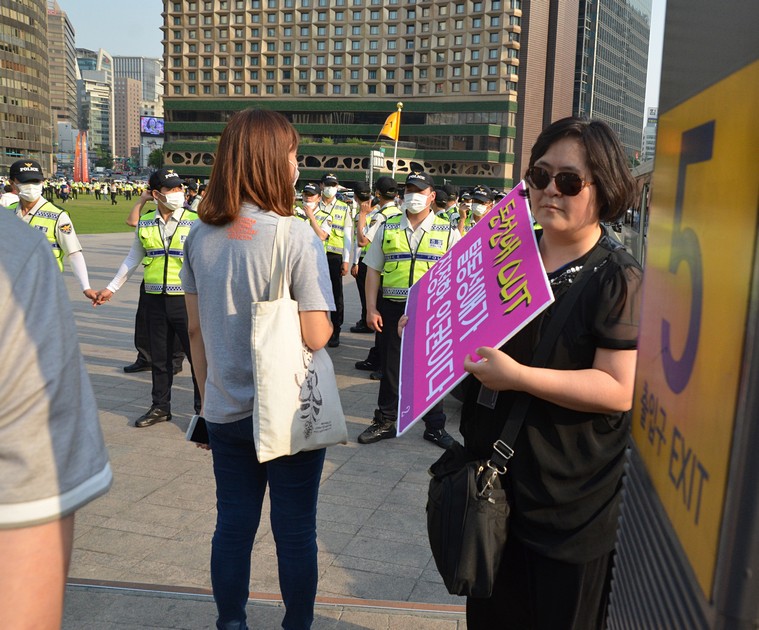
Christian protesters of the Korean Queer Cultural Festival have been getting quite a bit of attention online. As Korea Observer reported, the Christian protesters first managed to submit rally declarations forms for all available spaces in Daehangno, blocking the Korea Queer Culture Festival from being held there; then when they competed with Festival organizers to submit petitions to Namdaemun Police Station, neither was allowed to hold festivals - a victory for the Christian groups. When part of Seoul Plaza was secured for the on June 9, the Christian groups then set out to hold a counter protest, which is the one which has gotten attention online, mostly at this Korea Observer report (do watch the video); many more videos can be seen at Daehanmindecline.

One note I have to make is that there really isn't any justification to be translating '동성애' - 'homosexuality,' or in the context of many of the posters, 'homosexuals' - as 'fags.' Using that word suggests the protesters were using some specific anti-gay slur in Korean when they weren't. In fact, one sign has "queers" written in English, while one handout referred to the "homosexual party" and another directly translates "동성애 문제 대책 위원회" as "Countermeasure Committee for Homosexuality Problem," so I don't see the need to use such an inflammatory word when the messages on the signs are bad enough already.

There were several equating homosexuality and AIDS:

(From the video here.)
Wrong administration causes our children to die of AIDS (above)
Oppose homosexuals!! What is the reason for the increase in teen AIDS patients?
Abolish the student rights ordinance promoted by homosexuals which spreads AIDS
MERS-AIDS fatal virus - desperately oppose the homosexual festival - the increase in AIDS via Homosexuals
There seemed to be several signs ridiculously tying MERS and AIDS together. A number predict the doom of the Korea or use the language of human rights, even addressing UN Secretary General Ban Ki-moon:
Homosexuals will disease Korea’s future.
Is anal sex also a human right?
UN Secretary General Ban Ki-moon - Is homosexuality a human right? (in English)
UN Secretary General Ban Ki-moon! Homosexuals collapse a country built with blood and sweat.
UN Secretary General Ban Ki-moon! Do you really want a homosexual man as a daughter in law or a woman as a son in law?
A number also address Park Won-soon and call for his ouster:
MERS+AIDS fatal virus - Homosexuals collapse a country built with blood and sweat. Homosexual-friendly Mayor Park Won-soon OUT
Homosexuality - Park Won-soon OUT
Park Won-soon, who allowed Homosexuality rally packaged as culture OUT
I can't help but see the 'Out' posters like this one and think of the earliest examples of signs using the English word 'Out' on them - during the mad cow protests against evangelical Christian President Lee Myung-bak:

(Taken on bike path heading up to Haengju Bridge, 2008.)

One of the more jaw-dropping pieces of literature was not the signs the protesters were carrying, but a handout in English addressed to foreign ambassadors being distributed outside of city hall. (First seen here.)


A few notes on this collection of rants that comes rather close to self parody:
That's one of the few times in Korea you'll see Uganda getting praised. Or not being called 'Africa.' As well, we finally find out who the real victims are - those anti-homosexuals who keep being called mean words like 'homophobic.' (Hat tip to Taeyang.)
As well, the last time I checked homosexuality wasn't illegal in Korea. And as for countries with same-sex marriage permitting beastiality and incest, that doesn't seem like the Canada I remember. Which I should be heading to ASAP considering the ending "we want you to leave Korea right now!" Lots of love there. (For comparison, here are some pamphlets handed out by Christians during the 1988 Olympics.)

It's hard to know about the entirety of 5000 years of Korea's "great moral virtue," but according to Richard Rutt and others (as I noted here) homosexuality was practiced and even tolerated in some cases up until at least the Colonial Era; Robert Neff has also uncovered evidence in the writings of early missionaries at the end of the Joseon Dynasty.

I was sent this handout, which names its distributor as the 동성애 문제 대책 위원회" or "Countermeasure Committee for Homosexuality Problem," which they say "consists of 35 major civil groups fighting for our national security, sound religion's [sic] identity, morality and the human rights of North Koreans suffering from dictatorship." It also names 13 embassies (USA, UK, Germany, France, Canada, Spain, Belgium, Slovenia, Denmark, Finland, Norway, Sweden, EU) and states its purpose is "To request ceasing the embassy participation in the 16th queer culture festival in Seoul".


Once again, there is an astonishing amount of linking AIDS to homosexuality: "We are sure the Europe court's __ decision will prevent gay marriage from expanding AIDs [sic] disease everywhere in the [world] threatening the health of mankind. The Europe highest human rights court's decision ___ high level of sound sex moral to save mankind suffering from AIDs [sic]."

And one can’t help but note this: "Koreans have not intervened in other nation and other country their ethics and [culture.] Koreans historically respect other countries." This is a bit on the hilarious side, considering Korean Christian missionaries are all over the world "intervening" in the cultures of those countries by trying to convert non-Christians, with one memorable instance being when a number of missionaries were captured by the Taliban in 2007, with two being killed before they were ransomed, with the Korean government paying an unspecified amount (usually thought to be 20 million dollars). As a result, the Korean government banned Koreans from travelling to a number of countries, mostly to keep missionaries out. As this Korea Herald article points out,
Korea Crisis Management Service, a nonprofit launched in the wake of the kidnapping of 23 Korean Christians doing missionary work in war-torn Afghanistan in July 2007 [...] was founded in part at the government’s request. The nonprofit body trains missionaries working in countries with extreme crime or civil unrest to avoid dangerous situations and, if confronted with trouble, how to get out of it.
The article also points out the desire to 'intervene' in the 'ethics and culture' of other countries:
"Many missionaries want to go to these Muslim countries," Kim of KCMS said. "They have a love for Muslim people and a calling to preach the gospel."
Perhaps if these Christian groups could promise to respect other countries' cultures by keeping their missionaries at home they might not appear so hypocritical. Needless to say, these Christian groups' hateful and ignorant messages aren't going to get any serious attention by their intended recipients. Having groups known for trying to impose their religion on other cultures - a religion whose founder said "Thou shalt love thy neighbour as thyself" - call on foreign embassies to "leave Korea right now!" because they're interfering in Korea's ethics and culture would be funny if it weren't so sad.

Tuesday, June 2, 2015

Interview for the The Korea File podcast

[Update: The second part of the interview, titled "Korean Identity and Anti-Americanism" can listened to here.]

At the beginning of May I was interviewed by Andre Goulet for his podcast The Korea File, "a weekly podcast about music, culture, and society from around the peninsula." Andre has written a number of kind things about my blog over the years and it was great to finally meet him in person. The first part (of three) of the interview, titled "A History of Korean Social Movements," can be listened to here. Have a look under "Episodes" here to look through the other interviews he's done.

Monday, March 2, 2015

Lawmaker criticizes textbooks for correctly describing the violence of the Samil protests

An article in today's Joongang Daily declares in its headline that "Textbooks do disservice to March 1 movement."
Rep. Han Sun-kyo, a lawmaker of the ruling Saenuri Party, told the JoongAng Ilbo on Thursday that he analyzed Korean and Japanese history textbooks he received from the Seoul-based think tank Northeast Asian History Foundation and Korea’s Ministry of Education and found the results troubling.

He said a “considerable number of Japanese history textbooks are distorting the facts or minimizing the significance of the March 1 Independence Movement.”

March 1, 1919, remains a touchstone of Korean nationalism as the day when activists declared Korea’s independence and triggered large-scale peaceful demonstrations against Japanese colonial rule (1910-1945).

One Japanese middle school history textbook published by Jiyusa says the March 1 independence movement in Seoul “initially was planned as a non-violent rally but gradually became a large-scale movement,” and that “the army was mobilized and because of a clash on both sides, there were many casualties.” [...]

But Han added that Korean history textbooks also have inaccuracies, and there are many cases where they “describe the non-violent March 1 movement as violent” or do not mention key events or figures such as Yoo Gwan-soon’s martyrdom. [...]

According to Han’s study, half of the eight Korean high school history textbooks inaccurately described the independence movement as being “violent.” Three other textbooks failed to describe the movement adequately.

He found that only one publisher, Chunjae Education, explained the movement accurately and in detail. “As time passed, the protests grew more intense and military and police fired at people during the demonstrations, leading to deaths,” it said. The text emphasized, “The demonstrations were highly regarded internationally for holding to the principle of non-violence while trying to express resistance to Japanese imperialism.”
The problem is, the textbooks describing the independence movement as being "violent" are being accurate. While some of the Japanese dispatches during the Samil Uprising reported in the New York Times described violence on the part of demonstrators, I didn't realize just how violent the protests were until I read Frank Baldwin's "Participatory Anti-Imperalism:The 1919 Independence Movement" (Journal of Korean Studies, Volume 1, 1979, pp. 123-162). One assumes this contains some of the material in his dissertation, "The March First Movement: Korean Challenge, Japanese Response" (Columbia University, 1969). In his article, he notes that between March 1 and April 10, 1919, there were "approximately 667 peaceful demonstrations" as compared with "approximately 460 violent incidents." Here is his description of the nature of the protests:
Initially the demonstrations were nonviolent, partly to enhance the moral appeal of the protest and partly because of the vastly superior Japanese police and army forces. The usual pattern of demonstrations was that activists assembled a crowd and a local leader read the declaration of independence. The crowd roared its approval and then marched around the area shouting for Korean liberty.

As the independence movement spread and intensified, however, its character changed into often violent confrontation. This was a response to the severe, frequently brutal suppression of the protest by the Government General, which included firing on unarmed crowds and torture of prisoners. In many areas, a peaceful demonstration was suppressed by the authorities with force, and resulted in violent counterattacks on police and gendarmes. In other areas, frustrations, anger, and pent-up grievances turned peaceful demonstrations violent even without official provocation. In still other cases, tension from sustained demonstrations and confrontations, probably exacerbated by official violence, erupted into assaults on Government General personnel and facilities. In late March and early April, parts of Korea were in open, bloody rebellion. Governor General Hasegawa Yoshimichi requested troop reinforcements

During March and April the first stage of the 1919 movement occurred—the overt and violent period. Hundreds of thousands of Koreans engaged in open political actions ranging from lusty shouts for freedom to intrepid assaults on Government General outposts and vengeful mutilation of unlucky Kenpeitai, the Japanese gendarmerie. The second stage of the movement began in May and lasted until about April, 1920. During this stage, the independence activists changed their form of political activity from overt protest to covert planning and organizing, mostly in support of the Korean provisional government formed in Shanghai on April 10, 1919. The presence of additional troops from Japan, mass-arrest tactics, and stringent security measures made open protest activity unfeasible if not impossible.
Before those additional troops arrived, however, the Government General was hard pressed to maintain control and protect its staff, settlers, and infrastructure:
The Government General juggled the available troops, withdrawing some from North and South P'yöng'an and Hwanghae, now regarded as safe, and assigned them to southern Korea, where the violence was rapidly spreading. On March 25 eight infantry companies were spread thinly over five southern provinces—North and South Kyöngsang, North and South Cholla, and South Ch'ungch'öng. The assignment was made with the hope that they would only be needed until March 30. But the Koreans kept up their attacks. Crowds formed everywhere in Seoul, stoning police stations and trolley cars. In five villages near Seoul, myön chiefs were threatened and myön offices attacked. In many places Koreans armed themselves with clubs and stones and attacked the closest police station or my on office. March 27 and 28 were frantic, tragic days as Koreans attacked in many localities only to be beaten off by troops and suffer heavy casualties. Thirty nine Koreans were killed in a single incident in Kyönggi Province. The governor general authorized new troop assignments on the 28th but the attacks continued. On March 31 Koreans armed with clubs, sickles, and other improvised weapons stormed gendarmerie units and police stations at several places in Kyönggi Province. They attempted, sometimes successfully, to burn the local public buildings—myön offices, post offices, police stations—and cut telephone lines. In one place the crowd tried to burn the stores of Japanese merchants. Many Koreans were killed and wounded in the assaults. Despite heavy casualties and against seemingly hopeless Koreans continued the fight. [...] April 2 was perhaps the bloodiest single day of the independence movement as Koreans continued their attacks on gendarmerie units, police stations, myön offices and school buildings. Demonstration marches were a thing of the past: these crowds were prepared to fight.
Below is a list of casualties on the Japanese side:

In a lengthy recounting of a violent protest in Sacheon, Pyeongannam-do on March 4, which Baldwin describes as a "typical demonstration that began peacefully and ended in violence," three Korean police officers are reported as being killed in addition to a Japanese police officer, which makes clear that the numbers above do not include Korean Government General employees, suggesting that more people died than are listed. Most ironic in the assertion that the Samil Protests were peaceful is this statement by Baldwin:
Because of continued Korean violence, the Government General requested troops from Japan, which served to further discredit Japanese rule in the colony and provided additional incentive for the Hara administration in Tokyo to make reforms. Violent forms of participation appear to have been most important in changing Japanese policy.
Additionally, the Jeam-ri massacre (looked at here) is better explained as the culmination of escalating violence on both sides rather than an out-of-the-blue mass killing by the (evil) Japanese.

The tale of "peaceful Samil demonstrations" serves the cause of depicting Koreans as a peaceful people beset upon by marauding outsiders; that is to say, victims with no responsibility for their actions. What better way to depict this fairy tale than a children's book about Yu Gwan-sun from the 한국 위인 전집 (Great people of Korea Collection) published by 노벨과 개미(looked at in more detail here):

Evil Japanese:


Peaceful, victimized Koreans:


Returning to the Joongang Daily article:
Han also found that only one publisher, Jihak Publishing, described the patriot [Yoo Gwan-sun] in its text. In contrast, four out of seven Japanese contemporary history textbooks included Yoo.
The omission of Yu Gwan-sun from Korean textbooks is rather interesting. She's become an icon of the independence movement, much as Sin Mi-seon and Sim Hyo-sun became icons for those protesting the presence of USFK in Korea. Here is a poster which was once on the wall of the Yu Gwan-sun Underground Cell building at Seodaemun Prison:


Can you imagine any of the male icons of the Korean independence movement being depicted in this way? Besides being the oddly cheerful face of the fight for independence, she's often depicted as the embodiment of victimization (and thus embodies Korea throughout its entire history, according to some nationalist takes on Korean history). Here she is in the 'Great people of Korea Collection' book about her:


She also helps sell chicken, apparently (from 2005):

"Eat Ddorae Orae Chicken and protect our land, Dokdo!"

The final paragraph of the Joongang Daily article offers this short biography of Yu:
Yoo (1902-1920) was a prominent independence movement activist who was one of the organizers of the March 1 movement. She eventually faced torture at the hands of Japanese officers and died in prison in September 1920. When her family asked for her body to be returned to them, Yoo’s body was returned cut into pieces.
In truth, most of the "organizers" of the movement offered themselves up for arrest after reading the declaration on March 1, essentially robbing the movement of its most respected leaders at its very inception. Yoo certainly organized protests in Cheonan after leaving the Ehwa school girl for girls, but is more likely remembered because she was a student at a prominent missionary school, and because she is the perfect symbol of innocence brutally snuffed out by the brutal Japanese. The main problem I have with the paragraph above, however, is that she was certainly not "cut into pieces." As is described by Jeannette Walter, an English teacher at Ehwa, in Donald Clark's "Living Dangerously in Korea (The Western Experience 1900-1950),"
Yu Kwansoon, a little sixteen-year-old girl, died in prison. We had her body brought back to the school, and the girls prepared cotton garments for her burial. [...] However, when I was in Korea in 1959, I was interviewed by a group from Kwansoon's school, and I assured them on tape that her body was not mutilated. I had dressed her for burial.
One wonders if it is Rep. Han Sun-kyo or the Joongang Daily that is responsible for that canard once again being trotted out. A disservice may be have been done to the memory of the Samil Movement, but I'm not convinced its the textbook makers who are responsible.

Friday, June 13, 2014

It always interesting when leftist radicals and rightist Christians agree on something

As I pointed out in detail in this post about Korean fears of AIDS prior to (and during) the 1988 Olympics, progressives in South Korea portrayed US soldiers, and Americans in general, as being spreaders of AIDS in Korea, with some radical students protesting in the streets with this message. Two days before the Olympics, the Korea Herald reported that
Police hauled away about 20 demonstrators, mostly young women, when they tried to hold a protest in front of the US army base here Thursday [September 15] alleging that American soldiers were responsible for the spread of AIDS in South Korea.
As AP reported in a September 17 article about the opening of the Olympics,
A small protest was held at Yonsei university with less than 100 students taking part. Students distributed leaflets claiming foreigners at the Olympics would spread acquired immune deficiency syndrome.

“Oppose Olympics which oppose Korean peoples’ health with AIDS,” the leaflets said.
The group asked, “The United States is causing many problems as it pursues pro-gay policies like the recent expansion of same-sex marriage legalization, but is it now trying to expand homosexuality in not just the United States, but Korea, too?” They said homosexuality was the main culprit in the occurrence of AIDS, and that homosexuals were at high risk of getting AIDS. They that the number of patients who contracted AIDS due to homosexual activity in Korea is rising like the United States, and asked if the United States was trying to export AIDS, too, to Korea through its gay diplomacy. - See more at: http://www.rjkoehler.com/#sthash.mrsHcNVI.dpuf
 Or, as I noted in this post, Hustler's 'Korean sex-scene guide,' published during the 1988 Olympics and discovered and translated by students, was
Just the ticket to incite an anti-American demonstration, which is what a young man with a microphone nearby is trying to do.

"You see? The Olympic Games are just an excuse for Americans to come to Korea and pollute our country with AIDS!" he shouts. "Yankees out of Korea!"

"Yankees out of Korea!" echoes the crowd of about 50 students. Across the front of the building are four huge posters proclaiming: "Yonsei University students curse American barbarism."
So it wasn't just soldiers, but foreigners (particularly Americans) who were planning to pollute Korea with AIDS as well.

 In mid-October 1988 the Donga Ilbo reported that
the head of the AIDS countermeasures joint committee Im Jong-cheol pointed out that “USFK is an AIDS powder magazine” and revealed that there was an urgent need for an amendment to the AIDS Prevention Law to implement such things as a regular AIDS checkup for USFK members.
By this point, in the wake of the Olympics, calls were being made to amend the SOFA agreement, in some cases to allow for HIV testing of US soldiers.

The fears stirred up by these leftist activists echoed contemporary North Korean propaganda which accused US soldiers as having infected 100,000 prostitutes in the south with AIDS.

In May 1989, AP described a protest against Yankee 'devils' in Daejeon which sounds similar to such propaganda:
''Let's inflict an irrevocable defeat on U.S. imperialism and advance the unification of our fatherland,'' said student leader Im Chong-suk.

Cheering students chanted, ''Punish Yankee imperialism'' and ''Yankees go home.''

Leaders denounced a proposal to relocate some U.S. military units from Seoul to Taejon. They charged American soldiers would spread AIDS among the local population.

Speakers ridiculed American soldiers as the ''AIDS legion.'' 
So it was not without a sense of irony that I read Robert's post at the Marmot's Hole about right-wing Christian activists protesting in front of the US embassy against alleged US embassy support for the Korean Queer Festival:
Korean Queer Festival
The group asked, “The United States is causing many problems as it pursues pro-gay policies like the recent expansion of same-sex marriage legalization, but is it now trying to expand homosexuality in not just the United States, but Korea, too?” They said homosexuality was the main culprit in the occurrence of AIDS, and that homosexuals were at high risk of getting AIDS. They that the number of patients who contracted AIDS due to homosexual activity in Korea is rising like the United States, and asked if the United States was trying to export AIDS, too, to Korea through its gay diplomacy.
I wonder how comfortable those right-wing Christians would be realizing their accusations mirror those made by left-wing radical students not so long ago. Perhaps their affinity for believing in Korean exceptionalism (especially in exceptional moral uprightness (compared to Americans) and exceptional victimization) which lies at the heart of many narratives of Korean nationalism might allow them to reach across the ideological divide and shake hands for a moment. Or not.

(They both might want to send their kids to this hagwon, at least.)

Oh, and it's not wise to blame the west for the expansion of homosexuality in Korea, considering that it appears to have been at the very least tolerated in Joseon-era rural society, as I noted here, and as Robert Neff discussed here. Richard Rutt also examined this topic in his article 'The Flower Boys of Silla (Hwarang)' published in the October 1961 issue of Transactions of the Royal Asiatic Society (which, along with other Transactions articles, can be downloaded here).

Sunday, October 6, 2013

Hustler magazine tramples the purity of the Korean race

The 1988 Seoul Olympics
Part 1:  The Seoul Olympics, 25 years later
Part 2:  The 1988 Olympics and Korean fears of AIDS
Part 3:  Americans and bad first impressions
Part 4:  Reptilian Style: The 'live-or-die general war' against Hollywood
Part 5:  An attack in a boxing ring
Part 6:  Media responses to the boxing ring incident
Part 7:  No more lion: US swimmers' 'prank' becomes 'diplomatic incident'
Part 8:  KAIST catches Big Ben
Part 9:  Hankyoreh interviews Korean witness to theft by swimmers
Part 10: Stop me if you've heard this one: Four GIs head to Itaewon in a taxi...
Part 11: Taxi-kicking US runner taken to Itaewon police box
Part 12: NBC uses the power of t-shirts to insult Korea... again
Part 13: Cultivating outrage toward America
Part 14: Politicians engage in damage control
Part 15: Heaven on Earth

Part 16: Hustler magazine tramples the purity of the Korean race

In a September 19, 1988 Joongang Ilbo article titled "Women’s Organizations give 'final warning': we can’t take any more sexual abuse," it was reported that the day before the Olympics began, the United Korea Women's Association gave a statement denouncing the attack by US military teens against a pregnant Korean woman (mentioned here) and criticized the "special privileges" of the US military, citing a government statistic that out of 15,000 crimes committed by US soldiers in the past decade, the Korean government had exercised jurisdiction in less than one percent of the cases. As well, they called for the perpetrators' parents and the US Ambassador to publicly apologize to Korea citizens, a speedy and fair investigation and punishment by government authorities, and "revision of the unequal SOFA." They also declared that it "wasn’t simply an assault, but a reflection of Americans' tendency to look down on Koreans." Another such example was given by the association:
As well, they condemned and announced they were considering countermeasures against an article in the most recent issue of the American pornographic magazine Hustler titled "Olympic-goers guide to Korean sex," which insultingly portrayed many Korean women as cheap prostitutes who entice men on the streets.

The article stated that because there were fears that Korean women might be infected with AIDS from the millions of foreigners visiting Korea during the Olympics, some groups argued that foreigners entering the country should carry AIDS test certificates, but were silenced by the government's plan to distribute free condoms in the athletes' village.
That's right, the October 1988 issue of Hustler did indeed feature a 'Korean sex-scene guide':


Introducing the article is a two-page not-safe-for-work illustration, and as the article begins, the title 'Guide to Korean sex' is followed by the subtitle 'The casual Western visitor to Seoul will be astonished to find armies of big-titted, strapping young whores.' While one could understand that offense would be taken at a description of the prostitution available to visitors during the Olympics (again, "the unspoken rule that [journalists] should only look at what Koreans chose to show them"), and at NBC itself broadcasting reports about prostitution in Korea, the article was quite a bit more offensive than that. Here's the opening (click to enlarge):


The writer, Jun Kanda, maker of sex tapes shot in Asia, offers up some howlers as well, such as describing a “culture dominated by women” (because “Even today, a Korean bride keeps her family name after marriage”) and asserting that “The real power in the country is concentrated between the dewy thighs of Korea’s proud vagina owners." He also tells us, "I was cruising Itaewon, the red-light district of Seoul." Right. Kind of like how Myeongdong is the shopping district of Seoul. It gets more offensive, however, as he describes the tutelage of the US military and the nature of Korean women:


At this point, it should be remembered that, like everywhere outside of Europe and America, Korea had been the object of many 'studies' and travelogues in the late nineteenth and early twentieth centuries, some of which were written to justify Japanese occupation of the peninsula, others which were written to make the superiority of western culture stand out in relief. The following paragraph (which I first posted here) from George Kennan's October 8, 1904 Outlook article, "The Land of the Morning Calm":
American friends who have spent in the peninsula more years than I have weeks tell me that the Korean, as a man, is intelligent, courteous, teachable, kind-hearted and superior in many ways to the Japanese; but in the first place, he impresses me as lacking in virility, and, in the second place, he is so abominably dirty in his personal habits and his environment that I find it almost impossible to credit him with a spark of self-respect. His apologists say that he has been crushed and disheartened by centuries of bad government. This is undoubtedly true, and it accounts for many of his weaknesses and defects; but bad government does not prevent him from cleansing his premises, nor a body of citizens from cleaning up their neighborhood. So far as my limited observation qualifies me to judge, the average town Korean spends more than half his time in idleness, and instead of cleaning up the premises in his long intervals of leisure, he sits contentedly on his threshold and smokes, or lies on the ground and sleeps, with his nose over an open drain from which a turkey-buzzard would fly and a decent pig would turn away in disgust.
Even when writers were trying to say nice things, it could come out laced with a large amount of condescension, or worse, as this paragraph from the 1950 book 'The Epic of Korea' (looked at here) reveals:
Korea is a land of gooks ; the Korean is a gook. He is incomprehensible because his thought processes are different, his philosophy not of the earth but of the air. He belongs to another world. But just when we think that we can never understand the Korean, the light of comprehension shows in his dark eyes and in his ready smile and laughter, and we call him gook with foolish tenderness. Almost unwittingly we find ourselves so fond of him that we want to shelter him from all harm.  
And while nowhere near as offensive as the Hustler article, his comments on Korean women are rather objectifying and condescending:
The Korean woman, like all Asiatics, is small, but she is much better proportioned than other Asiatics. Unlike the Japanese, in whom the torso is normal in size, the hips larger than normal, and the rest of the body diminutive, the contours of the Korean woman are superbly regular. Her body is almost rigidly erect, largely because of the burdens she has borne on her head. Unlike the breasts of the Japanese woman, those of the Korean woman are well developed and sometimes even bulging. But, with a kind of winding-sheet, she binds her breasts, outward and downward, to her body. And the Korean woman, although very modest, has no squeamishness or childishly sensual attitude toward the various parts of her body. They were created with her soul and are to be treated with dignity, not laughed at by people with a sudden awareness that the human body has members. By way of example, a young American officer said to a barmaid in Seoul in his broken Japanese, Anata wa, chichi ga arimasen ka? ("But haven't you any breasts?") The barmaid, a very pretty young woman, said, "Yes." With complete aplomb, she reached into her tunic, opened her red flannel undershirt, unwound her winding-sheet, and produced a white-gold orb, which she held in the palm of her hand and said, "See!" Even amid American guffaws she retained her native impassibility. Only complete chastity such as most Korean women possess can produce such perfect self-composure.
The illustration which accompanied the Hustler article can also be connected to images like this (from halfway through Michael Hurt's photo essay here) or to more ribald photos taken by G.I.s I won't link to here.

Needless to say, and no doubt with the type of writing above in mind (at least for some of them), the Hustler article certainly made an impact upon university students. The following was published in a regular column in the Donga Ilbo titled 'Hyujitong,' or 'garbage can' on September 23:
Students from Suwon area universities such as Gyeonggi University and Hansin University are carrying out a signature campaign in opposition to a seven page feature article published in the most recent issue of the American-published lewd magazine Hustler, titled 'Hustler's Korean sex for Olympic tourists,' which provides information about prostitutes to foreigners coming to Seoul to see the Olympic games.

The problematic article in the most recent issue of Hustler says that "Itaewon, an area crowded with apartments and shopping beneath Namsan in Seoul, is a mecca for enjoying Korean sex" and goes as far as introducing hotels where one can easily meet Korean women and how much money to pay for sex. It also insults Korean women, saying "Because some women who tend to prefer foreigners spend lots of money, you don't need any special preparations to enjoy Korean sex."

Regarding the article in the American magazine with distortions and fabrications which sexually degraded Korean women and said they preferred foreigners, students are carrying out a "Signature campaign to prevent sex Olympics and stop AIDS and the commercialization of women" to demand the government formulate measures.
The article gained a wide audience after it was photocopied, translated, and posted up at universities, as the September 30 Miami Herald article titled "Korean Students Fuel Anti-U.S. Sentiment" makes clear:
Come to Korea, where the women are all sluts: so says the latest issue of Hustler magazine. The article has been taped to a wall at Seoul's Yonsei University for all to read, labeled a typical example of American journalism.

Illustrated by a drawing of naked Oriental women frolicking in the basin of the Olympic flame, the magazine piece, titled "Hustler's Olympic Goer's Guide to Korean Sex," is an imaginary and pornographic description of Korean women, who are portrayed as so eager to please visiting Americans that even prostitutes among them will entertain Yanks for free.

Reading the article, which has been translated into Korean, are scores of students of both sexes, their faces intent, sober, controlled. The article is unremittingly vile, vividly insulting.

Just the ticket to incite an anti-American demonstration, which is what a young man with a microphone nearby is trying to do.

"You see? The Olympic Games are just an excuse for Americans to come to Korea and pollute our country with AIDS!" he shouts. "Yankees out of Korea!"

"Yankees out of Korea!" echoes the crowd of about 50 students. Across the front of the building are four huge posters proclaiming: "Yonsei University students curse American barbarism."

Across town at Korea University, about 15 miles from the Olympic stadiums, a group of 1,000 students charged police and hurled firebombs, shouting, "Down with the dictator's Olympics!" and "Yankee go home!" But even this rally, wild by Western standards, is just an afternoon's drill for students here. They used to do this every other day before the Olympics began.
The connection between the Hustler article, AIDS, and America would be made more than once. On September 28, the Hankyoreh published a letter from Seoul resident Jin Jeong-mi, in which she used the term minjok (nation/race/ethnicity) a number of times:
In holding the Olympics, Korean women are mocked
Low American magazine 'Hustler' says they are "traditionally gisaengs"

If you are a Korean woman, or no, if you are citizen of this country, I believe all of you should know about this, and I write these words unable to calm my indignation. A few days ago I saw a poster at school with an image and article which appeared in the pornographic American magazine Hustler. The image had semi-nude Korean women lying in the Olympic torch with a set of giant chopsticks next to them. The picture has the meaning that "Come to Seoul, where the Olympics are being held, and using chopsticks, help yourself to Korean women."

Furthermore, the article next to the image made me feel even more unbearable outrage and humiliation as a Korean. [...]

As I read the article, I was shocked at how the majority of foreigners coming to the Olympics may look at our country's women.  Our history of subordination, with 36 years of Japanese rule followed by the stationing of US military here, has shown our minjok to be the nothing but the plaything of foreigners, and if this country is seen as a den of kisaengs, what in the world do many women, beginning with those volunteering for the Olympics, look like in the eyes of a foreigner.?

The government, meanwhile, hasn't taken any kind of measures against the main route for AIDS into this country, the US military, which is in various places across the country, and during the Olympics, instead of having AIDS tests for foreigners entering the country as they should, they're giving away condoms for free in the Olympic Village, something I really can't help but deplore. Beneath the splendid signs for the Olympics, Korean women are suffering mockery and the purity of the minjok is being trampled. How can this be "the Olympics, pride of the minjok"?

I think that denouncing and severely condemning America, which looks at this country's women as nothing but prostitutes, and the current government authorities who allow this is the least we can do to recover the pride of our minjok. I earnestly appeal as a woman to combine the power of all citizens in order to do this for the country.
As the Miami Herald article noted, the Hustler article had been "labeled a typical example of American journalism," and above we see the writer claim that "America... looks at this country's women as nothing but prostitutes." After the humiliation of seeing their own sporting officials assault a foreign referee in the ring suffering this mockery and trampling of their purity by America, students took further action. On September 30, the Donga Ilbo published the following article:
SNU Student Council Reps Visit US Embassy
Deliver letter protesting distorted media reports

Seoul National University Student Council president Park Jae-hyun (Astronomy and science, 3rd year) and 4 other student representatives went to the US embassy to deliver a open letter protesting a series of recent crimes committed by Americans and distorted news reports.

Seoul National University Student Council's letter claimed that, "The recent series of events involving NBC and US soldiers are more than accidents - we cannot but see the explicit expression of a trend showing implicit contempt for Korea and Koreans." "In regard to this we are also looking into the "88 Olympic Korean Sex Tour" article published by the American magazine Hustler.
And so the tale of the Hustler article ends... at least during the Olympics. It would be invoked in a very prescient article a few weeks later. That will have to wait, however.

[Note: I first learned of the Hustler article here, and it was, ironically, through the Hustler article that I learned about the government's plans to test foreign Olympic visitors for AIDS.]