Showing posts with label Foreigners. Show all posts

Tuesday, February 23, 2016

Partner-swapping meth-heads and Canadian pothead with 4 plants caught; Guess who gets more coverage?

Today the Korea Herald published the following article, "Canadian caught in South Korea growing marijuana in apartment":
A 47-year-old Canadian was caught growing cannabis in his residence and habitually smoking it, South Korean police said Monday. [...]

The man allegedly set up facilities like a ventilator, electronic heater and reflecting plate on the balcony to grow the weed for years.

He reportedly lost his job as a university lecturer as allegations about him smoking cannabis surfaced at his workplace.

The Busan Police Agency booked a total of 42 people on charges of possessing or taking illegal drugs in violation of the act on the control of narcotics. Among them, 15 were booked and 27 were taken into custody.

Police seized 59.31 grams of methamphetamine and 7.59 grams of marijuana from them worth 200 million won ($162,000).

While they don't make it very clear, the amount of pot seized was, at most, 7.59 grams from, at most, 4 plants - hardly a huge haul. It certainly doesn't compare to the money to be earned from the 59 grams of meth seized. 11 out of 25 of the articles mention the foreign professor in the headlines, but  the 41 other people barely register, and only 7 articles mention this fact in their headline, as KNN does.
From marijuana-growing professors to a swapping married couple... various drug crimes

Foreign professor's apartment "marijuana farm"

A foreign university professor who even set up a marijuana farm in his apartment and smoked it was caught by police..

Sexually promiscuous acts were committed while high by astounding drug users who were also arrested.
I had to twist that last sentence a little to capture the way that the Korean sentence "환각상태에서 성적으로 문란한 짓까지 저지른 기막힌 마약사범들도 체포됐습니다" gives sordid details before revealing it is referring to someone else (as in, not the teacher); this blurring also occurs later in the report.

As for the swapping couple and their sexually promiscuous acts, No Cut News fills in the details:
Among [those arrested for meth], it was revealed that Mr. Kim (55) and Mrs. Lee (43), who are in a common law marriage, would engage in swapping with other men and women while high on meth.

Police said that they confessed that when they were swapping, in order to forget their shame and increase their sexual pleasure, they took meth with men and women [or perhaps, a man and a woman] they met through a chatting app and swapped several times. 
Really though, choosing to highlight the foreign teacher with his four pot plants over the above story? Korean media, you just.... you disappoint me.

Oh wait - no you don't, since MBN managed to turn out something I haven't seen in awhile:
Endless native speaking-instructor drug criminals... worry over secondary crimes


Anchor:
A Canadian who grew marijuana on his apartment balcony and even smoked marijuana was arrested. When he was caught it was discovered he had been a native-speaking professor at a university; drug crimes by native speaking instructors placed in educational facilities are never ending.
This is reporter Park Sang-ho.

Reporter:
Police storm into an apartment where a native speaking professor lives.

Upon going to the veranda, they discovered a greenhouse had been set up, with even a heater, reflectors, and a ventilator.

The man, a Canadian national, secretly bought marijuana seeds from Thailand in 2010 and grew them himself and for years made and smoked marijuana.

Interview: Kim Chang-rip, head of the Busan Police Drug Investigation Unit -
"I understand that if the conditions are right within three months of growing the the leaves can be picked, dried and smoked."

Two years ago a kindergarten foreign instructor was caught in Yongin when he smoked marijuana and taught class while high.

In the last three years 1000 or more foreign drug criminals have been caught by police and [the number] is steadily increasing every year.

Drug enforcement by customs also [found that] 20% of the total [caught] is smuggling by foreigners.

As the popularity of native speaking instructors accompanying [Korea's] English fever rises. their crimes tend to rise as well.

In fact, in 2014 it came out that one in five drug smugglers were native speaking instructors.

Much concern is being voiced that there may be so-called secondary crimes due to students learning English from native speaking instructors being exposed to drugs.
Yes, because people who pay inflated prices for pot are going to share it with their students, the same way Korean teachers hand out their imported scotch to students under their care. Ridiculous, as always.

If we look at Immigration statistics from December 2015 (download #3), we see that the number of E-2 visa holders has dropped to 16,144, down from the all-time high of 24,107 in February 2011 (when incoming and outgoing public school teachers overlapped), suggesting rather strongly that the "popularity of native speaking instructors" is not rising at all.

You do have to love the images in the report, however; scaremongering at its best!

Treadmill! 


"My teacher is blurry and made of syringes!" 


The above image purports to show the increase in foreign drug criminals. The problem is, they don't relate at all to the Supreme Prosecutor's Office's statistics, which are higher. I've posted about Supreme Prosecutor's Office reports on annual drug arrests in the past, such as in 2011, 2012 and 2013. The Office publishes statistics monthly here; the year end report for 2013 is here, for 2014, here, and for 2015, here.


To add to this chart, the total number of arrests for foreigners for drug crimes in 2014 was 551, and in 2015, 640. The total number of people arrested in Korea was 9,984 in 2014 and 11,916 in 2015.

Here is a breakdown of arrests by nationality for 2015:

China, 314
Thailand, 122
USA, 53
Uzbekistan, 17
Vietnam, 23
Sri Lanka 13
Canada, 11
Kazakhstan, 8
Philippines, 8
Russia, 7
India, 7
Taiwan, 6

While we're on the topic of these busts in Busan, there was another pot bust there reported on January 19 which involved smuggling pot inside "popular foreign chocolate" by mailing it from New York, where a Korean guy in his mid 20s had bought 20 grams for $200 from a Mexican and mailed a gram each sealed inside the chocolate, selling 10 of them for 100,000 won a piece before being busted.


Perhaps the dog found them.

Monday, February 22, 2016

In 2013 the Korean crime rate was higher than that of foreigners, but...

On February 12, Yonhap published the following article:
Foreign crime rate falls short of Korean rate but murder, robbery rate higher

(Seoul - Yonhap News) Reporter Shin Yuri - It's come out that the crime rate of foreigners living in Korea is lower than the crime rate for Koreans, but their rate of committing murder and robbery is 2.5 times higher.

On the 12th this analysis was shared in the IOM [International Organization for Migration] Migration Research and Training Center's most recent "Issue Brief" titled "Truth and misconceptions about the crime rate of sojourning foreigners," which compares the crime rates of foreigners and Koreans by comparing their population.

According to this, of 1,857,276 crimes committed in total in 2013, Korean crimes amounted to 3,649 crimes per 10,000 people, more than double that of foreigners, which came to 1,585 [per 10,000 people].

The Korean crime rate was higher, and even by type of crime, Koreans, at 48.2 cases per 10,000 people, committed more violent crimes (murder, robbery, rape, etc.) than foreigners (44.2 cases), and also committed more assault crimes (injury, assault, etc.), with 707 cases per 10,000 Koreans compared to 529 for foreigners.

However, if individual crimes are looked at, the foreigner murder rate is 2.5 times higher, the robbery rate is 1.4 times higher, and the assault rate is 1.3 times higher.

By country of origin, Chinese people committed the greatest number of crimes, but this was attributed to their being so many Chinese among foreigners living in Korea.

Contrasting the crime rate by nationality, those with the highest violent crime rates were Pakistan (5.97 times higher than the Korean crime rate), Mongolia (3.86 times higher), Russia (2.92 times higher), Uzbekistan (2.86 times higher), and Sri Lanka (2.66 times higher).

As for rape (including crimes similar to rape) crime rates, Pakistan's was 5.85 times higher than Korea's, Bangladesh was 3.2 times higher, Kyrgyzstan was 2.83 times higher, Sri Lanka was 2.43 times higher, and Mongolia was 1.86 times higher.

The report's diagnosis is that, "In terms of statistics, the foreign crime rate is lower than Koreans,' but since [by type] some violent crimes exceed the Korean rate, there are limits to supporting [the assertion] that the crime rate of foreign nationals is low."

It pointed out that "As the number of foreigners in Korea increases, crimes by foreigners are also steadily rising." "While policies to proactively prevent crimes by foreigners from occurring are required, there is also a need to minimize prejudice against foreign crime." 
The report they speak of can be found here; I don't have time to dig through it, I'm afraid. Since Americans and Canadians aren't at the top of the 'most criminal by nationality' list, it would appear the IOM Migration Research and Training Center has done a better job than the Korean Institute of Criminology did back in 2013, as was related in this series:

From incorrectly calculated foreign crime rates to tabloid TV

Part 1: Incorrect statistics portray Americans and Canadians as more prone to criminality
Part 2: Yonhap reports on the KIC foreign crime study
Part 3: Joongang Ilbo: "Get a Korean woman pregnant": Shock over manual for foreign men
Part 4: JTBC's "We are Detectives" looks at foreign crime using the KIC report

Part 5: JTBC's "We are Detectives" looks at xenophobia and foreign crime
Part 6: For JTBC, consensual sex between white men and Korean women is a "sex crime"

The final post in that series has a classic video, for those who wish to revisit that blast from the past.

Thursday, February 11, 2016

The origin of the Bongo

Update:

The assertion below that the Kia Bongo was named after Omar Bongo appears to be wrong. As Ben pointed out in a comment below, Mazda began making Bongo vans in 1966 and Kia's Bongos are copies of them. I'd wondered why no mention of President Bongo's influence on the Kia Bongo's name appeared when I searched in contemporary newspapers. Now I know. Apologies for believing something that appeared in the Korea Times substantiated a rumor.

Original Post:

Because who doesn't want to watch Kia Bongo ads from 1984?


A couple years ago I was told over beers at Broughton's Club the rumored origin of the name 'Bongo' for Kia's truck and van line. The other day a noticed this in a 2007 Korea Times article:
Thus, we Koreans are familiar with the president of Gabon. Korea established diplomatic ties with Gabon in 1962 _ among the first ties with an African nation. Gabon is situated on the Atlantic coast of Central Africa, at a point in the world quite distant from Korea, and it possesses abundant natural resources, such as oil, minerals, timber and fish. [...]

This visit was the fourth trip to Korea for the Gabonese president, who visited Korea in 1975, 1984 and 1996 as well. In celebration of his visit past years, the Korean government has issued postage stamps. Furthermore, the popular "Bongo" vehicles _ vans and pickup trucks produced by Kia Motors _ were named after President Bongo at the time of his first trip to Seoul in 1975.
[Edit: We now know this is incorrect.] To explain further, Omar Bongo ruled Gabon from the 1960s until his death in 2009, after which his son Ali-Ben Bongo Ondimba was elected president. The Kia vehicle - Gabonese president link is [incorrectly] mentioned in Korean here as well. Stamps issued to commemorate two of president Bongo's visits can be seen here, while photos of his state visit, such as the one below, can be found here.


They really pulled out all the stops for his visit, didn't they?  (Note the digital clock on City Hall - I'd assumed it was installed around the time of the Olympics and had no idea it was around that early.)

The Bongo was first launched in 1980, 5 years after the above visit. Here's another ad:


Another tie between Korea and Gabon is that the President's body guard was reported in 2010 to be Korean. Taekwondo instructor Park Sang-cheol answered an ad recruiting bodyguards for the Gabonese government in 1984 and "was assigned to guard Ali-Ben Bongo Ondimba, the current president and son of former president Omar Bongo. Since then, Park has been by the younger Bongo's side during his studies in France and throughout his career as ministers of foreign affairs and defense and other top-level posts in the government."

As Park notes: "Gabon was the first among African countries to establish diplomatic ties with South Korea and it has continued to support our country on the global stage." Little remembered now is the competition between the two Koreas in the 1960s and 1970s for international recognition, in part for backing in the UN when the "Korean question" came up (as it did in 1975, when both Koreas got resolutions favoring passed at the UN - for the North Korean side of this competition, see Charles Armstrong's Tyranny of the Weak).

But for now... make it funky!

Sunday, June 14, 2015

Protests against the Queer Culture Festival by the Countermeasure Committee for Homosexuality Problem

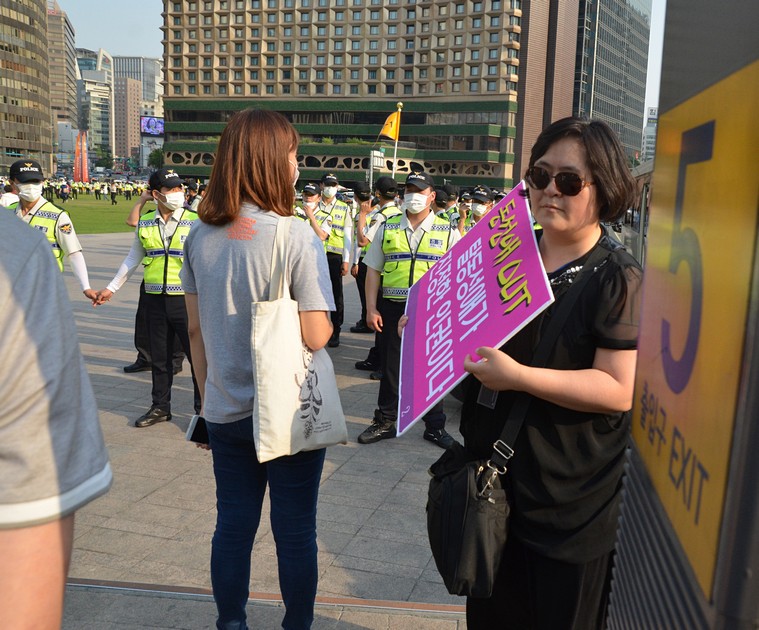
Christian protesters of the Korean Queer Cultural Festival have been getting quite a bit of attention online. As Korea Observer reported, the Christian protesters first managed to submit rally declarations forms for all available spaces in Daehangno, blocking the Korea Queer Culture Festival from being held there; then when they competed with Festival organizers to submit petitions to Namdaemun Police Station, neither was allowed to hold festivals - a victory for the Christian groups. When part of Seoul Plaza was secured for the on June 9, the Christian groups then set out to hold a counter protest, which is the one which has gotten attention online, mostly at this Korea Observer report (do watch the video); many more videos can be seen at Daehanmindecline.

One note I have to make is that there really isn't any justification to be translating '동성애' - 'homosexuality,' or in the context of many of the posters, 'homosexuals' - as 'fags.' Using that word suggests the protesters were using some specific anti-gay slur in Korean when they weren't. In fact, one sign has "queers" written in English, while one handout referred to the "homosexual party" and another directly translates "동성애 문제 대책 위원회" as "Countermeasure Committee for Homosexuality Problem," so I don't see the need to use such an inflammatory word when the messages on the signs are bad enough already.

There were several equating homosexuality and AIDS:

(From the video here.)
Wrong administration causes our children to die of AIDS (above)
Oppose homosexuals!! What is the reason for the increase in teen AIDS patients?
Abolish the student rights ordinance promoted by homosexuals which spreads AIDS
MERS-AIDS fatal virus - desperately oppose the homosexual festival - the increase in AIDS via Homosexuals
There seemed to be several signs ridiculously tying MERS and AIDS together. A number predict the doom of the Korea or use the language of human rights, even addressing UN Secretary General Ban Ki-moon:
Homosexuals will disease Korea’s future.
Is anal sex also a human right?
UN Secretary General Ban Ki-moon - Is homosexuality a human right? (in English)
UN Secretary General Ban Ki-moon! Homosexuals collapse a country built with blood and sweat.
UN Secretary General Ban Ki-moon! Do you really want a homosexual man as a daughter in law or a woman as a son in law?
A number also address Park Won-soon and call for his ouster:
MERS+AIDS fatal virus - Homosexuals collapse a country built with blood and sweat. Homosexual-friendly Mayor Park Won-soon OUT
Homosexuality - Park Won-soon OUT
Park Won-soon, who allowed Homosexuality rally packaged as culture OUT
I can't help but see the 'Out' posters like this one and think of the earliest examples of signs using the English word 'Out' on them - during the mad cow protests against evangelical Christian President Lee Myung-bak:

(Taken on bike path heading up to Haengju Bridge, 2008.)

One of the more jaw-dropping pieces of literature was not the signs the protesters were carrying, but a handout in English addressed to foreign ambassadors being distributed outside of city hall. (First seen here.)


A few notes on this collection of rants that comes rather close to self parody:
That's one of the few times in Korea you'll see Uganda getting praised. Or not being called 'Africa.' As well, we finally find out who the real victims are - those anti-homosexuals who keep being called mean words like 'homophobic.' (Hat tip to Taeyang.)
As well, the last time I checked homosexuality wasn't illegal in Korea. And as for countries with same-sex marriage permitting beastiality and incest, that doesn't seem like the Canada I remember. Which I should be heading to ASAP considering the ending "we want you to leave Korea right now!" Lots of love there. (For comparison, here are some pamphlets handed out by Christians during the 1988 Olympics.)

It's hard to know about the entirety of 5000 years of Korea's "great moral virtue," but according to Richard Rutt and others (as I noted here) homosexuality was practiced and even tolerated in some cases up until at least the Colonial Era; Robert Neff has also uncovered evidence in the writings of early missionaries at the end of the Joseon Dynasty.

I was sent this handout, which names its distributor as the 동성애 문제 대책 위원회" or "Countermeasure Committee for Homosexuality Problem," which they say "consists of 35 major civil groups fighting for our national security, sound religion's [sic] identity, morality and the human rights of North Koreans suffering from dictatorship." It also names 13 embassies (USA, UK, Germany, France, Canada, Spain, Belgium, Slovenia, Denmark, Finland, Norway, Sweden, EU) and states its purpose is "To request ceasing the embassy participation in the 16th queer culture festival in Seoul".


Once again, there is an astonishing amount of linking AIDS to homosexuality: "We are sure the Europe court's __ decision will prevent gay marriage from expanding AIDs [sic] disease everywhere in the [world] threatening the health of mankind. The Europe highest human rights court's decision ___ high level of sound sex moral to save mankind suffering from AIDs [sic]."

And one can’t help but note this: "Koreans have not intervened in other nation and other country their ethics and [culture.] Koreans historically respect other countries." This is a bit on the hilarious side, considering Korean Christian missionaries are all over the world "intervening" in the cultures of those countries by trying to convert non-Christians, with one memorable instance being when a number of missionaries were captured by the Taliban in 2007, with two being killed before they were ransomed, with the Korean government paying an unspecified amount (usually thought to be 20 million dollars). As a result, the Korean government banned Koreans from travelling to a number of countries, mostly to keep missionaries out. As this Korea Herald article points out,
Korea Crisis Management Service, a nonprofit launched in the wake of the kidnapping of 23 Korean Christians doing missionary work in war-torn Afghanistan in July 2007 [...] was founded in part at the government’s request. The nonprofit body trains missionaries working in countries with extreme crime or civil unrest to avoid dangerous situations and, if confronted with trouble, how to get out of it.
The article also points out the desire to 'intervene' in the 'ethics and culture' of other countries:
"Many missionaries want to go to these Muslim countries," Kim of KCMS said. "They have a love for Muslim people and a calling to preach the gospel."
Perhaps if these Christian groups could promise to respect other countries' cultures by keeping their missionaries at home they might not appear so hypocritical. Needless to say, these Christian groups' hateful and ignorant messages aren't going to get any serious attention by their intended recipients. Having groups known for trying to impose their religion on other cultures - a religion whose founder said "Thou shalt love thy neighbour as thyself" - call on foreign embassies to "leave Korea right now!" because they're interfering in Korea's ethics and culture would be funny if it weren't so sad.

Wednesday, June 10, 2015

Part 3 of my interview with The Korea File about the 1975 marijuana crackdown

Last week I posted links to the first two parts of an interview with myself by Andre Goulet for his podcast, The Korea File (Part 1: "A History of Korean Social Movements"  Part 2: "Korean Identity and Anti-Americanism"), and yesterday he posted the third and final part, titled "Weed, Counterculture and Dictatorship," about how rock music and the counterculture were suppressed under the guise of a marijuana crackdown in 1975.

The propaganda film I mentioned (found at ehistory.kr) was found and posted by Mark Russell here.

Thanks again to Andre inviting me to do this interview; have a look under "Episodes" here to look through the other interviews about Korean music, culture, and society he's done.

Wednesday, May 27, 2015

Foreign instructor booked for assault for 'retaliatory driving'

Not many news outlets picked this up - only the Segye Ilbo and JTBC - but JTBC offers video of its news report titled "More 'retaliatory driving' - foreign instructor chases and assaults car that cut him off." Said 40ish instructor, who works at an English hagwon in Gangnam, was driving a scooter two weeks ago when he was cut off by Mr. Jo, who was driving a car, and in retaliation he chased Mr. Jo for a kilometer and then cut in front of him when traffic was reduced to a single lane and stopped, forcing Mr. Jo to stop. He then walked up to Mr. Jo's car, and according to the report, hit him in the face, and then gave him the finger before driving off. [The Segye Ilbo adds that he hit him twice through the open window.] He was booked without detention for assault and property damage. Needless to say, when so many cars have cameras running in them, letting your anger get the better of you has become an even worse idea than it was previously.

Korea Times on the CERD decision and its 'piquing' of the government

Last Friday the Korea Times reported on the CERD ruling in an article titled "UN racism ruling piques government" (hat tip to commenter Jessica). Describing the ruling, the article opens as follows:
The government remains slow in responding to calls for the removal of racist policies, running the risk of further alienating itself from global standards.
[...]
The U.N.-affiliated committee ruled Wednesday that the HIV testing of foreign teachers in Korea is a form of discrimination.
Mind you, nowhere in the article is there any proof offered to back up the assertion that the government has been piqued by or is resentful of this ruling; only the following is reported:
In reaction, the Ministry of Justice admitted that it was aware of the ruling through media reports.

"We have not received an official ruling through the Ministry of Foreign Affairs yet. We will make a decision on how to respond to the ruling after we receive it," a ministry official at the immigration control bureau said.
It will be interesting to see what happens, especially considering the fact that the government took nine months to respond to the CERD petition for in the first place (six months past a 90 day deadline), and the local media ignored the initial acceptance of the petition completely. As well, headlines here are portraying the ruling as Korea being admonished by the UN (Korea Times: "Korea told to scrap HIV test on foreign teachers,"  KBS: 'UN CERD: "Korea, testing only foreign instructors for HIV is a violation of human rights."' SBS: 'UN CERD "Korea, abolish HIV testing of foreign teachers."') which could be spun into a blow to Korea's sovereignty (and pride).

The Korea Times also reported that:
HIV and drug tests were introduced in 2007 for E-2 (foreign language instructor), E-6 (artistic performer) and E-9 (non-professional employment) visa holders.

The government later scrapped the requirement for E-6 and E-9 visa holders after facing criticism from international figures and organizations, including U.N. Secretary General Ban Ki-moon. Yet it still remains for E-2 visa holders.
While it's true that E-2 HIV tests were introduced in 2007 (with a lot of help from Anti-English Spectrum), HIV testing for what would become the E-6 visa [ie, "entertainers"] was in fact introduced in 1989, and came as a result of the anti-AIDS campaigns prior to and during the 1988 Seoul Olympics. The tests for migrant workers, now considered E-9 (non-professional employment) visa holders, but from the late 1980s labeled "industrial trainees," were implemented in 1994, so the E-6 and E-9 HIV testing regimes had been around, in the former case, for over twenty years when they were (so we're told) removed in 2010. As for U.N. Secretary General Ban Ki-moon, he not only called for removal of testing in general, but after the ROK left the E-2 tests in place, he also specifically urged that they be removed as well.

Still, it's nice to see that the KT contacted Immigration for a comment.

Friday, May 22, 2015

CERD rules that HIV tests for foreign teachers in Korea are discriminatory

In late 2009 I posted here about a foreign teacher who was refusing to take second HIV test in order to renew her teaching contract at an elementary school in Ulsan. As a result she lost her job and left Korea, and with Benjamin Wagner representing her, complaints were filed with the National Human Rights Commission of Korea (which rejected it) and Korean Commercial Arbitration Board (which ruled against her. Then in July 2012 it was announced that the United Nations Committee on the Elimination of Racial Discrimination had agreed to hear the case, though not a single Korean media outlet chose to report on this despite receiving a press release from a PR firm. Given 90 days to reply, the ROK instead took 9 months to reply, stating that "since 2010, its guidelines on the employment of foreign teachers do not specify that [foreign teachers] have to submit results of HIV/AIDS and drugs tests to have their contracts renewed," an assertion which I knew personally was not true (and which the Korea Herald looked at here). In 2010 the ROK had in fact officially removed all HIV tests for those registering for residency except for the E-2 visa tests.

In a journal article coauthored by Benjamin Wagner and myself, we asked in the title whether HIV tests were a proxy for racial discrimination, and this week the CERD answered that question: Yes.

As Benjamin Wagner wrote this week,
On May 18, 2015, the United Nations Committee on the Elimination of Racial Discrimination decided the case of a former native English teacher from New Zealand. Ms. “L.G” lost her job and work visa in 2009 after she refused to take a second round of in-country drug and HIV tests demanded by the Education Ministry just months after submitting to identical tests for the purposes of immigration. Korean citizen teachers and even ethnic Korean noncitizen teachers are able to avoid such tests. Ms. L.G. correctly regarded the government’s demands as based on unfounded stereotypes of foreigners as drug users and sexual deviants. While immigration has required a single negative test result for HIV and drugs for prospective foreign teachers since 2007, the Education Ministry began demanding their own tests, meaning that many teachers are tested multiple times during their time in the country.

In 2012, the Committee accepted L.G’s petition after she had exhausted all possible solutions in Korea (a prerequisite for bringing complaints under the CERD) including filing unsuccessful complaints with the National Human Rights Commission of Korea and Korean Commercial Arbitration Board.
An official summary of the decision is here, while the full decision can be downloaded as a .doc here. As can be seen here, of four cases considered this session by CERD, only this case was considered to be in violation of the Convention for Eradication of Racial Discrmination; the summary points out which articles of the convention the ROK was found to be violating in this case.

The summary makes public the justification the UMOE offered for the tests - something that many people taking these tests have known for years, but never admitted by the government:
[D]uring arbitration proceedings, L.G.’s employers, the Ulsan Metropolitan Office of Education (UMOE), said that HIV/AIDS tests were viewed as a means to check the values and morality of foreign English teachers.
One of the Committee's recommendations isn't very surprising:
The Committee recommends that the State party grant the petitioner adequate compensation for the moral and material damages caused by the above-mentioned violations of the Convention, including compensation for the lost wages during the one year she was prevented from working.
It continues with much more sweeping recommendations, however:
It also recommends that the State Party takes the appropriate means to review regulations and policies enacted at the State or local level related to employment of foreigners and abolish, both in law and practice, any piece of legislation, regulation, policy or measure which has the effect of creating or perpetuating racial discrimination. The Committee recommends the State party to counter any manifestations of xenophobia, through stereotyping or stigmatizing, of foreigners by public officials, the media and the public at large, including, as appropriate, public campaigns, official statements and codes of conduct for politicians and the media. The State party is also requested to give wide publicity to the Committee’s Opinion, including among prosecutors and judicial bodies, and to translate it into the official language of the State party.
This doesn't just refer to English teachers, but to regulations for all foreign workers. And as I've covered here, the references to the conduct of the media and politicians is very pertinent, considering the 'Citizens Group for Upright English Education' (also known as Anti English Spectrum) worked closely with the media and had access to politicians when pushing for the creation of the HIV testing policy (among others) in the first place.

As well, national assembly representatives have said a number of negative things about foreign teachers over the year. In June of 2009 Rep Choi Young-hee submitted 3 bills regarding native English teachers to the national assembly which called for drug tests for foreign teachers, with the bills stating that "the crime rate among native-speaking English teachers is getting higher" without offering any proof of such an increase, She also stated that immigration had lost 22,000 E-2 visa holders, but as it turns out, she used the wrong statistics. A few months later, Rep. Lee Gun-hyeon stated that foreign teacher crime was 'serious,' but released statistics showing it to be 5 times less than the Korean crime rate. Rep. Park Min-sik would chime in a month later on the "flood of unqualified native speaking teachers", while National Assembly Rep Lee Ju-yeong stated that "Of foreigners, native speaking teachers are especially potential child molesters" who may have many 'undisclosed crimes' and who may fake their backgrounds. None of this quite compares to the racially charged statements made by Kim Han-gil, who was recently the leader of the opposition party, back in 1997 about the "white good-for-nothings" flocking to Korea to teach English, and despairing that the "low culture of English speaking countries is penetrating into living rooms." He also proved to be ten years ahead of the curve by complaining that foreign teachers "they don't even have to take drug or AIDS tests."

As for the media, this decision is being widely reported. For example:

Source - UN
Republic of Korea’s foreigners-only HIV tests violated New Zealand teacher’s rights — UN experts (Office of the High Commissioner for Human Rights, Geneva; 20 May 2015)
Republic of Korea’s foreigners-only HIV test violated New Zealand teacher’s rights — UN experts (UN News Center; 20 May 2015)
Korea’s foreigner-only HIV tests violate NZ teacher’s rights (Scoop, New Zealand; 21 May 2015)
HIV tests for E-2 visas discrimination, U.N. Finds (Korea Herald, 20 May 2015)
UN Experts Urge S Korea To Compensate New Zealander Who Lost Job Over HIV Test (RTT News; 20 May 2015)
Korea’s foreigners-only HIV test violated New Zealand teacher’s rights: UN experts (NewKerala.com, Kerala, India; 21 May 2015)
Korea’s foreigners-only HIV test violated New Zealand teacher’s rights: UN experts (IndiaBlooms.com, India; 21 May 2015)

I really like the headlines of the first two articles here, and am glad the CERD chose to make UMOE's justification for the tests public:

Source - AFP
South Korea criticised for demanding expat teacher take AIDS test to check ‘values and morality’ (Radio Australia, ABC; 20 May 2015)
South Korea criticised for demanding expat teacher take AIDS test to check ‘values and morality’ (ABC News, Australia; 20 May 2015)
UN experts rap S.Korea over AIDS test for expat teachers (Yahoo! News, Australia; 20 May 2015)
UN experts rap S Korea over AIDS test for expat teachers (Economic Times, India; 20 May 2015)
UN experts rap S.Korea over AIDS test for expat teachers (Business Standard; 20 May 2015)
UN experts rap South Korea over AIDS test for expat teachers (Zee News, India; 20 May 2015)
UN experts rap S.Korea over AIDS test for expat teachers (NGR News, Nigeria; 20 May 2015)
SK demanded Aids test for expat teacher (IOL News, South Africa; 20 May 2015)
UN experts rap S.Korea over AIDS test for expat teachers (Global Post; 20 May 2015)
UN experts rap S.Korea over AIDS test for expat teachers (Bangkok Post; 20 May 2015)
UN experts rap S. Korea over AIDS test for expat teachers (The Straits Times, Asia; 20 May 2015)
UN experts rap S.Korea over AIDS test for teachers (Press Trust of India; 20 May 2015)

Source - NZN
UN says Kiwi kicked out of South Korea for refusing AIDS test should be compensated (TVNZ; 21 May 2015)
UN backs Kiwi teacher kicked out of Korea (NZCity, New Zealand; 20 May 2015)
Kiwi teacher asked to take AIDS test (3 News, New Zealand; 20 May 2015)

As well, unlike how the Korean media was able to ignore the case when it was accepted, it is being reported here in a limited manner (ten articles), with the Korea Herald first breaking the story, followed by Yonhap:

UN CERD "Korea should abolish HIV tests for foreign instructors" (Yonhap; 20 May 2015)
UN CERD: "Korea, testing only foreign instructors for HIV is a violation of human rights" (KBS; 20 May 2015)
U.N. urges S. Korea to abolish HIV testing of foreign teachers (Yonhap English; 20 May 2015)
UN CERD: "Korea, compensate foreigner who refused HIV test" (Money Today; 20 May 2015)
UN: "Korea’s testing of foreign instructors for HIV is a violation of human rights" (; 21 May 2015)
UN CERD "Korea, abolish HIV testing of foreign teachers" (SBS; 21 May 2015)
UN CERD: "Korea, compensate foreigner who refused HIV test" (News1; 20 May 2015)
UN: "Foreign instructor HIV tests are character defamation" (MBN; 21 May 2015)
UN CERD: "Korea, compensate foreigner who refused HIV test for human rights violations" (Le Monde Diplomatic; 21 May 2015)
UN racism ruling piques government (Korea Times; 22 May 2015)

Since Yonhap English news articles tend to be truncated after a few days, here's their English translation of the story:

U.N. urges S. Korea to abolish HIV testing of foreign teachers (Yonhap; 20 May 2015)
GENEVA, May 20 (Yonhap) -- A United Nations committee on Wednesday reprimanded South Korea's mandatory HIV testing of native English teachers as discrimination against foreigners, urging the country to abolish the policy.

Foreigners who come to South Korea to teach English are required to have a criminal background check and tests for illegal drugs and the HIV virus, while Korean nationals in equivalent jobs are not required to go through such scrutiny.

The U.N. Committee on the Elimination of Racial Discrimination (CERD) has deliberated the policy after Lisa Griffin, a former English teacher from New Zealand, filed a complaint when her contract with a local education office was not renewed in 2009 over HIV testing.

Griffin, who had received a negative result on the first test, refused to undergo a second, arguing it could stigmatize foreigners as people who have a higher risk of AIDS and could spread a negative sentiment against them.

The Geneva-based committee said the foreigner-only HIV test was "discriminatory and an affront to her dignity," urging the South Korean government to compensate for "moral and material damages" she suffered.

The mandatory testing "does not appear to be justified on public health grounds or any other ground, and is a breach of the right to work without distinction to race, color, national or ethnic origin," the committee said in a release.

The U.N. committee urged Korean authorities to take steps to revise the policies that stereotype or stigmatize foreigners, giving them 90 days to report back on the process.
As someone who contributed research to the CERD petition, I'm really happy with the results. What happens next is up to the Korean government.

Thursday, March 19, 2015

Elementary school native speaking teacher makes students taste dish soap

According to a Yonhap report from late last night:
Private elementary school native-speaking teacher's corporal punishment of students: "Eat dish soap."

Controversy has arisen after it became known that a native-speaking teacher at a private elementary school in Seoul made students taste dishwashing detergent as a punishment during class.

According to authorities such as the Seoul Metropolitan Office of Education yesterday, on March 12 at a private elementary school in northern Seoul, 'A,' an English teacher from South Africa used corporal punishment on grade six students who broke the rule against using Korean in class.

'A' told the students to choose between tasting dishwashing detergent and bitter medicine as punishment, and some students chose the former, and some the latter.

Once parents found out about this, the school was inundated with complaints and the next day the school dismissed 'A'. On the 18th the school's homepage announced that the native speaking teacher had been changed and carried an apology by the principal.

An official from the Seoul Metropolitan Office of Education said, "Because a private elementary school takes it upon itself to hire a native speaking teacher, the responsibility for the teacher's management is also the school's." "If a problem arises, at the level of Office of Education Support, schools are being guided in order to strengthen the management of native speaking teachers and prevent a recurrence."
The story was actually broken as an exclusive early yesterday evening by KBS, who initially reported that the school was trying to keep things quiet and fired the teacher so as to put an end to the problem. They followed up with a TV news report which included the facts that the bitter tasting medicine was a medicine meant to prevent the biting of fingernails (?), and that there were five students who were punished; three chose the soap, and two chose the medicine. It also included a cartoon illustrating what happened:


Since problem English teachers are almost invariably depicted to be male teachers, one assumes the teacher was indeed female. We're also shown a shot of her apology letter.


It would be interesting to read the entire thing; one wonders what was going through the teacher's head. It was certainly a bad decision (taste dish soap or fingernail-biting-prevention medicine?). I imagine "washing kids mouths out with soap" (which I assume was the intended effect?) would meet a similar reaction in North America. Perhaps - this being near the beginning of a new school year - the teacher was new to Korea. Anyone who has taught grade 6 students can understand how unruly they can be, though usually really bad behaviour would start later in the semester once the students have gotten to know each other.

As of last night, the two reports at KBS were the first and seventh-most viewed articles at KBS News' website.


As of noon today, the TV news report is the third-most-viewed news article and the most-viewed video at KBS, so the story is currently popular. KBS also followed up with a news article last night and a new TV news report this morning, so it's certainly running with the story - as are about two dozen other news outlets so far.

Update: The Chosun Ilbo posted an English language article about this titled "English Teacher Forced Students to Drink Detergent."

Wednesday, March 18, 2015

Foreign graffiti artists deface Seoul's subway trains

The Joongang Daily reported the other day that... well, here's the title: "Graffiti punks from abroad target Seoul’s subway."
On Feb. 2, four Australians in baseball caps and hoodies appeared around Wangsimni Station, eastern Seoul, at three in the morning. They carefully scoped out the area and then stopped in front of a ventilation window behind a bus stop. They cut the bars of the window and swung down to a temporary garage where a car for the Line No. 5 subway was idle. Using spraypaint, they covered the car with graffiti art and then moved on.
They then tagged two more trains, one two days later at Anam Station, and another at Sinnonhyeon Station on Feb. 5. The Joongang Ilbo's Korean-language article includes this graphic (click to enlarge):


And yeah, judging by the noses, they do seem to have been foreigners:


I found this to be a bit spooky:
It was only after they flew back to their home country on Feb. 7 that the police identified the four Australians with security camera footage. They matched their faces on security footage from the airport and then checked immigration records.
We're then told that police are baffled by foreigners who "knew so expertly the subway stations' structures" and that "We believe most of them were painted by foreigners." In fact, they "discovered that most of them are from Australia or Canada based on the style of graffiti paintings." That's some impressive sleuthing. The Joongang Ilbo then goes on to interview a Korean graffiti artist, which begs the question why the police are saying it must have been done by foreigners.
Lim Hun-il, a pioneering Korean graffiti artist better known as Hudini, explained that “seeing a train running around the city with their graffiti art on it is like the biggest honor.”

Another graffiti artist conjectured, “It is likely that foreigners who used to practice graffiti art are working as English teachers during the day and painting at night.”
Actually, though, that's not what the Korean-language article by the Joongang Ilbo reported. In it, after that comment by Lim Hun-il, the journalist adds that "The fact that Korea's subways are so clean may have inspired such 'graffiti expeditions.'" This is followed by a quote from "a graffiti artist" who says, "foreigners who used to practice graffiti art and worked as foreign language instructors after entering the country may have let their friends know about Seoul's subway." One assumes, in the context of talking about how foreigners could have known about the subways, that these "friends" they let know about Seoul's subway were overseas. The article notes that:
No foreigner has been caught by police for defacing the trains, possibly because they have left the country quickly like the Australian group. Property damage is not a serious enough crime to try to extradite them.
Apparently that's not the case in Singapore. The article also notes that incidents of graffiti on trains have been increasing, and lists the locations of each incident:


The Joongang Ilbo has been on a bit of a crusade here, translating another article today, as well as publishing a CBS radio interview with a Korean graffiti artist. I'm not sure that publishing the exact locations of the incidents was the best idea if they wanted to stop it from happening, but then I'm not an editor there.

Wet Casements also has a post about this here.

Sunday, January 18, 2015

A review of "Ode To My Father"

Youn Je-Kyoun's film "Ode to My Father" [국제시장, or 'International Market'] has become the first film this year to top ten million admissions after its release on December 17. I saw the film new year's eve, and it didn't exactly leave viewers in a cheerful mood afterwards. It's a sad film that depicts several events in Korea's modern history through the eyes of one man who sacrifices to take care of his family after the loss of his father during the Korean War. Despite melodramatic excess and some other flaws, it's an interesting film for many reasons, and is well worth watching. (The following review is full of spoilers.)


The film begins in the present and introduces three elderly characters: Deok-su, his wife Yeong-ja, and his best friend Dal-gu. Deok-su runs a store in the international market in Busan, and we follow him as he interacts with: developers who want him to sell his store (he refuses); his adult children (who seem entitled and dump the grandchildren on him and his wife so they can travel); and his memories of the past. These flashbacks reveal that he has participated in some of the more dramatic touchstones of Korea's modern history, starting with the evacuation of UN forces and North Korean refugees from Hungnam during the Korean War, the dispatch to West Germany of Koreans to work as nurses and coal miners, the large role played by Korean civilian contractors and soldiers during the Vietnam War, and the 1983 KBS TV show "Reuniting Separated Families," which was so successful in its first live broadcast that it continued for over four months and led to the reunion of over 10,000 separated families, most of whom had been living in South Korea since the war. In many ways it is like Forrest Gump, in that Deoksu takes part in these historical events and interacts with a number of famous Koreans during these flashbacks.

Director Youn has a flair for integrating the smaller, personal stories with the large scale of some of these historical events, and the actors do an admirable job of portraying characters who age over a 50 year period, though this is definitely a tale of men - after their romance leads to marriage, Yeong-ja fades into the background, and we're left with the tale of the sacrifices made for his family by a son, a brother, and a father. Still, for all these strengths the film doesn't have a lot of narrative depth; the film proceeds by repeatedly presenting a scene in the present which triggers a flashback. The audience does have certain pieces of information withheld from it, and certain flashbacks serve to explain why he acts in inexplicable ways in the present. We also see Deok-su change after reflecting on the past, and the film at times implicitly criticizes the younger generations of today for being too self-centered and unappreciative of the sacrifices their elders made. As the Korea Times noted, "One critic caused controversy by calling Youn's latest film a 'conservative' movie that 'glorifies the sacrifices of the older generation.'" "Glorifies" seems too strong a word, partly since the criticisms it makes - often through juxtaposition of past and present, seem fair enough. The film does lay on the melodrama pretty thickly, in the way only a Korean movie can, though the reunion scene on the KBS TV show set in 1983 was guaranteed to bring the audience to tears regardless of the way it was presented. I was reminded of when I saw the 2004 documentary 'Repatriation' and a fellow audience member said to me, "It really does remind you that we're sitting on an open wound."

For all of its blockbuster and melodramatic elements, there is a lot to unpack with this film, and I thought I'd look at its depiction of history and the way in which the film imagines how Korea's role in the world has changed during fifty years of economic development.

The aforementioned Korea Times article mentions that director "Youn also became the first director with two films to top 10 million. 'Haeundae,' a disaster film released in 2009, attracted 11.45 million viewers the same year." A few years ago I looked at Youn's film Haeundae, which I hadn't realized did so well at the box office. I didn't like it, but thought its crashing wave provided an excellent metaphor for the way in which Korean films of the 2000s have dealt with Korean history, portraying people as blamelessly going about their lives when suddenly history crashes into them and sweeps them off their feet. Some of these films have blamed outsiders (such as when South Korean and North Koreans team up to shoot down American aircraft at the end of Welcome to Dongmakgol), and have rarely attempted to explain why the events portrayed occurred - a far cry from the history films of the 1990s. Haeundae's wave inadvertently provided a useful metaphor for these kinds of films (and one could profitably make 'Korean wave' references here, since it's the fact that Korean films (and TV dramas) are so slickly (and expensively) produced now that a larger box office is needed to recoup costs, which encourages simplistic films which appeal to a broader demographic).

It could be argued that 'Ode to my father' also follows the 'wave pattern' in certain ways. While the main character, Deok-su, works to keep a promise to his father to take care of his family (and makes sacrifices in the hope of meeting his father again), the moments in modern Korean history he takes part in occur when he follows others. He (obviously!) follows his parents when they attempt to flee Hungnam, while its his friend Dal-gu who suggests going to Germany and Vietnam. It's also made clear that the 'decision' to have a child and get married was essentially thrust upon him by his soon-to-be wife, so much of his life is shaped by others' decisions.

One thing I noted was the similarity with 'Welcome to Dongmakgol' of having a lone Korean officer beg the Americans to save Korean lives. In 'Dongmakgol' the officer protests the bombing of a village, while in 'Ode to my Father' an officer begs a general to take refugees aboard at Hungnam. In 'Ode' the general relents at the last second and the soldiers are ordered to take the tanks they just loaded aboard the ship off again, much to the anger of one profanity-shouting soldier, and refugees are put on instead. Unlike the 2004 Korean War film 'Taegukki,' in which American soldiers were not even shown, 'Ode' depicts refugees waiting by the ocean while American soldiers retreat and we're told that behind them "The Chinese are coming!" I don't remember the South or North Korean army being mentioned.

What this leaves out, however, is why these refugees were fleeing, and why filmmakers might want to gloss over the actions of the ROK military in North Korea between October and December 1950. Callum MacDonald, in his 1991 Bulletin of Concerned Asian Scholars article "So Terrible a Liberation - The UN Occupation of North Korea" (which can be downloaded here, and is on pages 3-19) points out how, though the ROK was not given legal sovereignty over liberated North Korea, ROK troops often were the first to arrive in the north and were followed by police and bands of paramilitaries such as the Northwest Youth League (which had carried out much of the repression in Jeju, for example; the dissertation I recently linked to also looks at the use of paramilitaries by the ROK before and during the Korean War). These paramilitaries and police were known to have killed thousands of suspected communist sympathizers after the Incheon Landing in South Korea, so one can only imagine the horror they visited upon North Koreans. As MacDonald notes,
Just before [Syngman Rhee] returned to Seoul [after the Incheon Landing] he informed Hugh Baillie, president of the U.S.-based United Press, that he planned to extirpate communism throughout Korea: "I can handle the Communists. The Reds can bury their guns and bum their uniforms, but we know how to find them. With bulldozers we will dig huge excavations and trenches, and fill them with Communists. Then cover them over. And they will really be underground."
General MacArthur offered his own take on the situation in October 1950 in a conversation with the tutor of the Japanese crown prince, Elizabeth Gray Vining:
"Each house has a North Korean flag and a South Korean flag, and most of the time they don't know which to wave. Both sides line them up and shoot them down. The country was poor to begin with. They will be destroyed, utterly destroyed."
So when the tide of the war turned, it might be easy to understand why those who championed the arrival of the UN forces - or who simply feared being caught in the middle - would want to flee. While starting the story in the middle as the family flees can be explained as wanting to get the story started quickly or due to lack of time, the lack of context, or even reference to the DPRK army or the ROK army, puts the beginning of the film squarely in the "history washed over us" camp of recent Korean films.

As well, while the 'begging for help' scene is not really what happened, it accords with the basic facts,  (to be elaborated on in my next post) which are that Dr. Hyun Bong-hak, an assistant to Maj. Gen. Edward M. Almond, commander of the US X Army Corps in Hamheung, convinced General Almond to evacuate tens of thousands of refugees along with the soldiers and equipment; when there turned out to be 100,000 refugees, attempts were made to evacuate all of them, with one ship, the Meredith Victory (which is depicted in the movie), taking 14,000 aboard, a world record.

In the film, during the evacuation, Deok-su's family is separated from his sister and father, and they go to their aunt's house in Busan, where she runs a store in the international market. In the next flashback, years after the war, Deok-su has grown into a young man who works as a labourer to support his family, and who puts off his own dreams to support his younger brother's university education. He is convinced by his friend Dal-gu to apply to work in West Germany as miners, where they can make lots of money. Germany, however, proves to be a struggle for Deok-su and Dal-gu, and the miners are all depicted as being homesick. They all cry in their bunks as they read letters from home, while Yeong-ja, a nurse Deok-su meets and falls in love with, is also depicted as having a difficult time, washing corpses and studying when she's not working. Again, this appears to be different from the memories of the nurses interviewed in the Kim Won article I cite in my next post, who saw their time in Germany as an opportunity. In fact, as the article notes, "At present [2009], about 5,000 out of the over 20,000 padok workers continue to live in Germany, and some 5,000 padok workers eventually chose to immigrate to the Americas." That over half of the 18.000 Koreans who went to work in Germany didn't return home seems to stand against this portrayal of suffering Koreans who made so many sacrifices (more sacrifices, it's implied, than those who remained in Korea).

However, I would argue that what we're being presented with in 'Ode to My Father' is in fact a national coming of age story. The presentation of Korean refugees at Hungnam as 'shrimp among whales' caught between their powerful neighbours -  Chinese and Americans - and the depiction of a Korean begging an American general to save their lives, along with a last minute decision by the general to do so, contributes to a social Darwinist view of the world as a harsh place in which a weak Korea, beset by poverty and war, must beg the (initially cold and unwilling) Americans for help in order to survive.

Once in Germany, this happens again. Koreans, forced to work hard, often shown in tears, missing home, once again beg the powerful - in this case the German head of the mine - to let them save their missing Korean compatriots who have been caught in a mine shaft collapse. Yeong-ja, in tears, begs for their mercy, switching from German to Korean - just to hammer it home for the audience - that the missing are Korean and they should at least be the ones to find their bodies. The request is denied; it's a harsh world out there. But then, in a moment of self confidence, the Korean miners eschew such dependency; they stop their crying, pick up their tools, and, taking matters into their own hands, they defy the mine owners and rescue their compatriots.

After returning from Germany, the newly married Deok-su goes to Vietnam with Dal-gu to make more money (for reasons we find out later). In Vietnam, Korea is still growing and sits between the US (Dal-gu tries to go into a club for American soldiers, and is told by Deok-su, "You can't go in there - that's for Americans!") and Vietnam, which is poorer than Korea and is going through its own civil war that Korea went through twenty years earlier. After seeing a child die in a bombing by the Vietcong, Deok-su writes to his wife, saying that he's glad it's their generation that had to go through this suffering, and not that of their children. At the end of their time in Vietnam, Deok-su and Dal-gu are rescued from the Vietcong by an ROK military unit which is about to blow up a pier and leave, only to find several dozen Vietnamese villagers asking to be taken with them, Deok-su initially refuses to step up and help them, however, only reluctantly agreeing as the Vietcong close in. Clearly this rescue of the Vietnamese refugees is meant to mirror the evacuation at Hungnam that Deok-su went through as a child. This time, however, Korea has grown up enough that it's no longer the victim, but is the one doing the rescuing.

As a result of this rescue, Dal-gu returns home and marries one of the Vietnamese refugees in what is touted as the "first Korean-Vietnamese marriage." While this isn't true, and the story of the relationship between Vietnam and South Korea is a complicated one (as I'll discuss in my next post), it does mirror the way in which Vietnam is seen today. In "The Bride(s) From Hanoi: South Korean Popular Culture, Vietnam and 'Asia' in the New Millennium"(available as a pdf here), Stephen Epstein looks at this relationship through the lens of the reality show "Meet the In-Laws," which inadvertently compares the poor rural life Vietnamese marriage migrants left behind to their new life with a higher standard of living in Korea. As these migrants are always depicted as female, "Meet the In-Laws both mirrors, and further encourages, Korean attitudes of superiority to an Asian hinterland, which are then coded in gendered terms." As well, the requests by these women's families in Vietnam that they be dutiful daughters-in-law or wives "subsumes Vietnam within a traditional Confucian patrilocal framework and acknowledges a position within that hierarchy that reinforces the gendering of Korea as male and leader." Epstein adds that
Since the turn of the millennium one finds increasing evidence of a radical shift in Korea’s gendering of its encounters with the foreign away from the aggressive male intruder, whose presence in Korea has often been symbolized in tropes of rape and violation, as in gijichon (camptown) fiction, to the foreign as the female to be dominated and domesticated within the national fabric.
This accords, I believe, with the depiction in the film of Korea 'growing up,' moving from a state of dependency to a mature member of the world of nations. The final step in this process is healing the psychological wounds of past trauma, in Deok-su's case the loss of family members during the evacuation of Hungnam. As previously mentioned, in 1983 KBS broadcast the TV show, "Reuniting Separated Families," planning only to do a single broadcast, but when it proved successful it continued for over four months and led to the reunion of over 10,000 separated families (episodes can be watched here). In an incredibly emotional scene, Deok-su is finally reunited with a lost family member, and in the present, remembering this event as presented in a flashback, he is finally able to let go of the past and move on.

Near the end of the film, there's a birthday party where it's learned that Deok-su had taught his five-year-old granddaughter to sing "굳세어라 금순아 (Be Strong, Geumsun)," a trot song about the evacuation of Heungnam, which horrifies her parents, who wonder why he would teach her such a sad song. Deok-su retreats to his room to be alone, and the shot of his apartment from outside, showing two windows, one in which his wife, children, and grandchildren celebrate happily, and the other in which Deok-su weeps alone, remembering the past, visually summarizes the divide between generations. Korea has grown into an adult, developed into a modern nation, but the film admonishes the younger generation for forgetting the struggles along the way. At the same time, however, the way in which Deok-su "moves on" and lets go of the past involves him giving in to a redevelopment project, so the film both criticizes the materialism of the present and gives in to it.

Interestingly, criticisms of the film for being conservative miss the fact that it presents Korea as being cosmopolitan. While it portrays Korea's relationship with different nations, it also portrays how those relations (and others) have changed the make-up of Korean society. When teenagers make fun of a South Asian migrant worker, Deok-su defends him and criticizes the teens, precisely because he himself was once a migrant worker, in Germany. Not only that, the Migrant worker says that because he's lived in Korea for some time, he's Korean too, which is certainly not a conservative statement. Deok-su's best friend marries a Vietnamese woman, echoing the marriage migration occurring in Korea today. And his lost and rediscovered sibling is married to a white American man, and, in a montage of the years passing, is shown present at a family dinner, with no fuss made about his presence.

In my next post I'll look more closely at the historical events the film predicted and at how the film followed or strayed from the facts. Despite certain omissions, and despite its melodramatic excess, and narrative shortcomings, "Ode To My Father" is well acted, and portrays often-forgotten historical moments as stepping stones to Korea's emergence as a modern, confident, and inclusive nation, though perhaps one which could stand to remember the difficult path taken along the way.

Tuesday, December 2, 2014

News on cuts to public school native speaking teachers

The Seoul Sinmun reported November 13 on budget cuts to native-speaking teachers in public schools in an article titled "[Controversy over welfare] Because of daycare, native speaking teachers are saying 'Oh my God!'" The article opens by asserting that, "One local government after another is expanding the budget for free day care programs and reducing native speaking instructors."

According to the budget submitted by the Incheon Office of Education to the Incheon City Government, this year's native speaking teacher budget will be cut from 14,494,000,000 won to 9,076,000,000 won, a reduction of 5,418,000,000 won. There are currently 202 native speaking teachers (180 English teachers and 22 Chinese teachers), and these will be reduced by 76 to 126 teachers next year. The Daegu Office of Education will reduce its budget by 8.8 billion won, reducing its teachers from 443 this year to 323 next year. The Chungcheongnam-do Office of Education will reduce its current 438 teachers by 71 to 367, cutting 42 from elementary schools, 13 from middle schools and 16 from high schools. The Chungcheongbuk-do Office of Education will cut Local Education Subsidies and cut 113 out of 306 native speaking teachers. To make up for this video lessons will be increased and teachers will travel from school to school.

Offices of education are saying that native speaking budgets are getting the most cuts since there is less urgent need for native speakers compared to day care, but parents are complaining, saying that both are important. Incheon's placement rate for foreign teachers is already only 55%, compared to the national average of 81.4% of schools, and the placement rate will only drop.

As well, TBC reports that for next year Daegu has cut the native speaking teacher budget in half, from 18.2 billion won this year. Above, in the Seoul Sinmun article, we see 8.8 billion won has been cut, which accords with 'half the budget' being cut, though it's odd that only 120 out of 443 teachers will be cut. While the Seoul Metropolitan Office of Education isn't talking too openly about it, there may be cuts in Seoul as well. Offers to renew contracts were delayed two weeks until mid-November, though it seems teachers currently working should be able to keep their jobs. Below is a chart from the Kyunghyang Sinmun showing public middle schools in Seoul with native speaking teachers. While SMOE has cut funding to NSETs for middle schools, the district offices can use their own budgets to pay NSETs. Most don't have the resources, but Gangnam and Seocho districts have a 100% NSET placement rate in their public middle schools, while most districts have no teachers at all, leading to fears of this contributing to the gaps between rich and poor neighbourhoods.

(At bottom are the number of public middle schools per district.)

One thing worth noting is that while it's often said that Korean teachers will replace NSETs, it seems hiring Korean English language instructors may also fall by the wayside. A friend of mine in this teaching position in Gangseo-gu in Seoul is about to lose his job due to budget cuts.

According to the Gukje Sinmun, in Busan, the budget has gradually shrunk from 17.6 billion won in 2011, to 13.7 billion won in 2012, to 16.2 billion won in 2013, to 12.4 billion won in 2014, to 6.9 billion won for 2015. The number of native speaking teachers during that time has gradually shrunk from 522 in 2011, to 528 in 2012, to 399 in 2013, to 304 in 2014, to 170 for 2015. The teachers taught at all levels of public school until 2014, after which only elementary school teachers remained. As of next year, teachers at small schools will travel and teach at several elementary schools.

As reported by Yonhap back in late October, Saenuri Representative Yun Jae-ok pointed out then that the native speaking teacher placement rate in schools nationwide has decreased from 81.9% in 2012 to 65.1% in 2014.

According to Rep. Yun, in 2012 there were native speaking teachers placed at 9,315 schools out of a total of 11,368 schools nationwide, making for a placement rate of 81.9%, and this fell to 81.4% in 2013 and 65.1% in 2014. As well, the number of students of per native speaking teacher has increased. In 2012 there were 8,529 NSETs teaching 6,807,637 students nationwide, making for one NSET per 799 students. In 2013 this increased to one NSET per 821.1 students, and in 2014 this increased to one NSET per 947.2 students.

In looking at the history of the EPIK program before, I posted this chart made in 2010 by the Seoul Sinmun showing the number of native speaking teachers placed in public schools between 1995 and 2010, which reveals the hit the program took in 1997 after the financial crisis (it took 7 years to recover the numbers it had then).

(At top are the number of teachers by year, followed by a breakdown by nationality of teachers currently working, and at bottom are the percentages of teachers with qualifications.)

That graph is a bit compressed, height-wise, however, so I made a new one using data from this Korea Observer article which notes that 2,500 native speaking teachers have been cut over the past three years, dropping to 6,785 as of April this year from the high point of 9,320 in 2011.


The number of native speaking teachers in Korean public schools made an incredible jump between 2005 and 2009, from 1,017 to 7,997 before making a smaller increase to 9,320 over the next two years and has seen, as the Korea Observer reported, a decrease of around 2,500 teachers since 2011. Adding up the cuts announced above, at least another 500 teachers will be cut next year.


(Also worth reading on this topic is Akli Hadid's article in The Diplomat which argues that "Government attempts to undercut English have not slowed corporate language demands.")


To finish with a bit of happier news, the Yeongnam Ilbo reported on November 17 that foreign teachers in Daegu had organized a give a gift appeal for children in childcare facilities called Daegu's Time to Give, which has also been reported on by the Korea Herald, and can be found on Facebook here.