Wednesday, May 27, 2015
Foreign instructor booked for assault for 'retaliatory driving'
Not many news outlets picked this up - only the Segye Ilbo and JTBC - but JTBC offers video of its news report titled "More 'retaliatory driving' - foreign instructor chases and assaults car that cut him off." Said 40ish instructor, who works at an English hagwon in Gangnam, was driving a scooter two weeks ago when he was cut off by Mr. Jo, who was driving a car, and in retaliation he chased Mr. Jo for a kilometer and then cut in front of him when traffic was reduced to a single lane and stopped, forcing Mr. Jo to stop. He then walked up to Mr. Jo's car, and according to the report, hit him in the face, and then gave him the finger before driving off. [The Segye Ilbo adds that he hit him twice through the open window.] He was booked without detention for assault and property damage. Needless to say, when so many cars have cameras running in them, letting your anger get the better of you has become an even worse idea than it was previously.

Korea Times on the CERD decision and its 'piquing' of the government
Last Friday the Korea Times reported on the CERD ruling in an article titled "UN racism ruling piques government" (hat tip to commenter Jessica). Describing the ruling, the article opens as follows:
The Korea Times also reported that:
Still, it's nice to see that the KT contacted Immigration for a comment.
The government remains slow in responding to calls for the removal of racist policies, running the risk of further alienating itself from global standards.Mind you, nowhere in the article is there any proof offered to back up the assertion that the government has been piqued by or is resentful of this ruling; only the following is reported:
[...]
The U.N.-affiliated committee ruled Wednesday that the HIV testing of foreign teachers in Korea is a form of discrimination.
In reaction, the Ministry of Justice admitted that it was aware of the ruling through media reports.It will be interesting to see what happens, especially considering the fact that the government took nine months to respond to the CERD petition for in the first place (six months past a 90 day deadline), and the local media ignored the initial acceptance of the petition completely. As well, headlines here are portraying the ruling as Korea being admonished by the UN (Korea Times: "Korea told to scrap HIV test on foreign teachers," KBS: 'UN CERD: "Korea, testing only foreign instructors for HIV is a violation of human rights."' SBS: 'UN CERD "Korea, abolish HIV testing of foreign teachers."') which could be spun into a blow to Korea's sovereignty (and pride).
"We have not received an official ruling through the Ministry of Foreign Affairs yet. We will make a decision on how to respond to the ruling after we receive it," a ministry official at the immigration control bureau said.
The Korea Times also reported that:
HIV and drug tests were introduced in 2007 for E-2 (foreign language instructor), E-6 (artistic performer) and E-9 (non-professional employment) visa holders.While it's true that E-2 HIV tests were introduced in 2007 (with a lot of help from Anti-English Spectrum), HIV testing for what would become the E-6 visa [ie, "entertainers"] was in fact introduced in 1989, and came as a result of the anti-AIDS campaigns prior to and during the 1988 Seoul Olympics. The tests for migrant workers, now considered E-9 (non-professional employment) visa holders, but from the late 1980s labeled "industrial trainees," were implemented in 1994, so the E-6 and E-9 HIV testing regimes had been around, in the former case, for over twenty years when they were (so we're told) removed in 2010. As for U.N. Secretary General Ban Ki-moon, he not only called for removal of testing in general, but after the ROK left the E-2 tests in place, he also specifically urged that they be removed as well.
The government later scrapped the requirement for E-6 and E-9 visa holders after facing criticism from international figures and organizations, including U.N. Secretary General Ban Ki-moon. Yet it still remains for E-2 visa holders.
Still, it's nice to see that the KT contacted Immigration for a comment.
Friday, May 22, 2015
CERD rules that HIV tests for foreign teachers in Korea are discriminatory
In late 2009 I posted here about a foreign teacher who was refusing to take second HIV test in order to renew her teaching contract at an elementary school in Ulsan. As a result she lost her job and left Korea, and with Benjamin Wagner representing her, complaints were filed with the National Human Rights Commission of Korea (which rejected it) and Korean Commercial Arbitration Board (which ruled against her. Then in July 2012 it was announced that the United Nations Committee on the Elimination of Racial Discrimination had agreed to hear the case, though not a single Korean media outlet chose to report on this despite receiving a press release from a PR firm. Given 90 days to reply, the ROK instead took 9 months to reply, stating that "since 2010, its guidelines on the employment of foreign teachers do not specify that [foreign teachers] have to submit results of HIV/AIDS and drugs tests to have their contracts renewed," an assertion which I knew personally was not true (and which the Korea Herald looked at here). In 2010 the ROK had in fact officially removed all HIV tests for those registering for residency except for the E-2 visa tests.
In a journal article coauthored by Benjamin Wagner and myself, we asked in the title whether HIV tests were a proxy for racial discrimination, and this week the CERD answered that question: Yes.
As Benjamin Wagner wrote this week,
The summary makes public the justification the UMOE offered for the tests - something that many people taking these tests have known for years, but never admitted by the government:
As well, national assembly representatives have said a number of negative things about foreign teachers over the year. In June of 2009 Rep Choi Young-hee submitted 3 bills regarding native English teachers to the national assembly which called for drug tests for foreign teachers, with the bills stating that "the crime rate among native-speaking English teachers is getting higher" without offering any proof of such an increase, She also stated that immigration had lost 22,000 E-2 visa holders, but as it turns out, she used the wrong statistics. A few months later, Rep. Lee Gun-hyeon stated that foreign teacher crime was 'serious,' but released statistics showing it to be 5 times less than the Korean crime rate. Rep. Park Min-sik would chime in a month later on the "flood of unqualified native speaking teachers", while National Assembly Rep Lee Ju-yeong stated that "Of foreigners, native speaking teachers are especially potential child molesters" who may have many 'undisclosed crimes' and who may fake their backgrounds. None of this quite compares to the racially charged statements made by Kim Han-gil, who was recently the leader of the opposition party, back in 1997 about the "white good-for-nothings" flocking to Korea to teach English, and despairing that the "low culture of English speaking countries is penetrating into living rooms." He also proved to be ten years ahead of the curve by complaining that foreign teachers "they don't even have to take drug or AIDS tests."
As for the media, this decision is being widely reported. For example:
Source - UN
Republic of Korea’s foreigners-only HIV tests violated New Zealand teacher’s rights — UN experts (Office of the High Commissioner for Human Rights, Geneva; 20 May 2015)
Republic of Korea’s foreigners-only HIV test violated New Zealand teacher’s rights — UN experts (UN News Center; 20 May 2015)
Korea’s foreigner-only HIV tests violate NZ teacher’s rights (Scoop, New Zealand; 21 May 2015)
HIV tests for E-2 visas discrimination, U.N. Finds (Korea Herald, 20 May 2015)
UN Experts Urge S Korea To Compensate New Zealander Who Lost Job Over HIV Test (RTT News; 20 May 2015)
Korea’s foreigners-only HIV test violated New Zealand teacher’s rights: UN experts (NewKerala.com, Kerala, India; 21 May 2015)
Korea’s foreigners-only HIV test violated New Zealand teacher’s rights: UN experts (IndiaBlooms.com, India; 21 May 2015)
I really like the headlines of the first two articles here, and am glad the CERD chose to make UMOE's justification for the tests public:
Source - AFP
South Korea criticised for demanding expat teacher take AIDS test to check ‘values and morality’ (Radio Australia, ABC; 20 May 2015)
South Korea criticised for demanding expat teacher take AIDS test to check ‘values and morality’ (ABC News, Australia; 20 May 2015)
UN experts rap S.Korea over AIDS test for expat teachers (Yahoo! News, Australia; 20 May 2015)
UN experts rap S Korea over AIDS test for expat teachers (Economic Times, India; 20 May 2015)
UN experts rap S.Korea over AIDS test for expat teachers (Business Standard; 20 May 2015)
UN experts rap South Korea over AIDS test for expat teachers (Zee News, India; 20 May 2015)
UN experts rap S.Korea over AIDS test for expat teachers (NGR News, Nigeria; 20 May 2015)
SK demanded Aids test for expat teacher (IOL News, South Africa; 20 May 2015)
UN experts rap S.Korea over AIDS test for expat teachers (Global Post; 20 May 2015)
UN experts rap S.Korea over AIDS test for expat teachers (Bangkok Post; 20 May 2015)
UN experts rap S. Korea over AIDS test for expat teachers (The Straits Times, Asia; 20 May 2015)
UN experts rap S.Korea over AIDS test for teachers (Press Trust of India; 20 May 2015)
Source - NZN
UN says Kiwi kicked out of South Korea for refusing AIDS test should be compensated (TVNZ; 21 May 2015)
UN backs Kiwi teacher kicked out of Korea (NZCity, New Zealand; 20 May 2015)
Kiwi teacher asked to take AIDS test (3 News, New Zealand; 20 May 2015)
As well, unlike how the Korean media was able to ignore the case when it was accepted, it is being reported here in a limited manner (ten articles), with the Korea Herald first breaking the story, followed by Yonhap:
UN CERD "Korea should abolish HIV tests for foreign instructors" (Yonhap; 20 May 2015)
UN CERD: "Korea, testing only foreign instructors for HIV is a violation of human rights" (KBS; 20 May 2015)
U.N. urges S. Korea to abolish HIV testing of foreign teachers (Yonhap English; 20 May 2015)
UN CERD: "Korea, compensate foreigner who refused HIV test" (Money Today; 20 May 2015)
UN: "Korea’s testing of foreign instructors for HIV is a violation of human rights" (; 21 May 2015)
UN CERD "Korea, abolish HIV testing of foreign teachers" (SBS; 21 May 2015)
UN CERD: "Korea, compensate foreigner who refused HIV test" (News1; 20 May 2015)
UN: "Foreign instructor HIV tests are character defamation" (MBN; 21 May 2015)
UN CERD: "Korea, compensate foreigner who refused HIV test for human rights violations" (Le Monde Diplomatic; 21 May 2015)
UN racism ruling piques government (Korea Times; 22 May 2015)
Since Yonhap English news articles tend to be truncated after a few days, here's their English translation of the story:
U.N. urges S. Korea to abolish HIV testing of foreign teachers (Yonhap; 20 May 2015)
In a journal article coauthored by Benjamin Wagner and myself, we asked in the title whether HIV tests were a proxy for racial discrimination, and this week the CERD answered that question: Yes.
As Benjamin Wagner wrote this week,
On May 18, 2015, the United Nations Committee on the Elimination of Racial Discrimination decided the case of a former native English teacher from New Zealand. Ms. “L.G” lost her job and work visa in 2009 after she refused to take a second round of in-country drug and HIV tests demanded by the Education Ministry just months after submitting to identical tests for the purposes of immigration. Korean citizen teachers and even ethnic Korean noncitizen teachers are able to avoid such tests. Ms. L.G. correctly regarded the government’s demands as based on unfounded stereotypes of foreigners as drug users and sexual deviants. While immigration has required a single negative test result for HIV and drugs for prospective foreign teachers since 2007, the Education Ministry began demanding their own tests, meaning that many teachers are tested multiple times during their time in the country.An official summary of the decision is here, while the full decision can be downloaded as a .doc here. As can be seen here, of four cases considered this session by CERD, only this case was considered to be in violation of the Convention for Eradication of Racial Discrmination; the summary points out which articles of the convention the ROK was found to be violating in this case.
In 2012, the Committee accepted L.G’s petition after she had exhausted all possible solutions in Korea (a prerequisite for bringing complaints under the CERD) including filing unsuccessful complaints with the National Human Rights Commission of Korea and Korean Commercial Arbitration Board.
The summary makes public the justification the UMOE offered for the tests - something that many people taking these tests have known for years, but never admitted by the government:
[D]uring arbitration proceedings, L.G.’s employers, the Ulsan Metropolitan Office of Education (UMOE), said that HIV/AIDS tests were viewed as a means to check the values and morality of foreign English teachers.One of the Committee's recommendations isn't very surprising:
The Committee recommends that the State party grant the petitioner adequate compensation for the moral and material damages caused by the above-mentioned violations of the Convention, including compensation for the lost wages during the one year she was prevented from working.It continues with much more sweeping recommendations, however:
It also recommends that the State Party takes the appropriate means to review regulations and policies enacted at the State or local level related to employment of foreigners and abolish, both in law and practice, any piece of legislation, regulation, policy or measure which has the effect of creating or perpetuating racial discrimination. The Committee recommends the State party to counter any manifestations of xenophobia, through stereotyping or stigmatizing, of foreigners by public officials, the media and the public at large, including, as appropriate, public campaigns, official statements and codes of conduct for politicians and the media. The State party is also requested to give wide publicity to the Committee’s Opinion, including among prosecutors and judicial bodies, and to translate it into the official language of the State party.This doesn't just refer to English teachers, but to regulations for all foreign workers. And as I've covered here, the references to the conduct of the media and politicians is very pertinent, considering the 'Citizens Group for Upright English Education' (also known as Anti English Spectrum) worked closely with the media and had access to politicians when pushing for the creation of the HIV testing policy (among others) in the first place.
As well, national assembly representatives have said a number of negative things about foreign teachers over the year. In June of 2009 Rep Choi Young-hee submitted 3 bills regarding native English teachers to the national assembly which called for drug tests for foreign teachers, with the bills stating that "the crime rate among native-speaking English teachers is getting higher" without offering any proof of such an increase, She also stated that immigration had lost 22,000 E-2 visa holders, but as it turns out, she used the wrong statistics. A few months later, Rep. Lee Gun-hyeon stated that foreign teacher crime was 'serious,' but released statistics showing it to be 5 times less than the Korean crime rate. Rep. Park Min-sik would chime in a month later on the "flood of unqualified native speaking teachers", while National Assembly Rep Lee Ju-yeong stated that "Of foreigners, native speaking teachers are especially potential child molesters" who may have many 'undisclosed crimes' and who may fake their backgrounds. None of this quite compares to the racially charged statements made by Kim Han-gil, who was recently the leader of the opposition party, back in 1997 about the "white good-for-nothings" flocking to Korea to teach English, and despairing that the "low culture of English speaking countries is penetrating into living rooms." He also proved to be ten years ahead of the curve by complaining that foreign teachers "they don't even have to take drug or AIDS tests."
As for the media, this decision is being widely reported. For example:
Source - UN
Republic of Korea’s foreigners-only HIV tests violated New Zealand teacher’s rights — UN experts (Office of the High Commissioner for Human Rights, Geneva; 20 May 2015)
Republic of Korea’s foreigners-only HIV test violated New Zealand teacher’s rights — UN experts (UN News Center; 20 May 2015)
Korea’s foreigner-only HIV tests violate NZ teacher’s rights (Scoop, New Zealand; 21 May 2015)
HIV tests for E-2 visas discrimination, U.N. Finds (Korea Herald, 20 May 2015)
UN Experts Urge S Korea To Compensate New Zealander Who Lost Job Over HIV Test (RTT News; 20 May 2015)
Korea’s foreigners-only HIV test violated New Zealand teacher’s rights: UN experts (NewKerala.com, Kerala, India; 21 May 2015)
Korea’s foreigners-only HIV test violated New Zealand teacher’s rights: UN experts (IndiaBlooms.com, India; 21 May 2015)
I really like the headlines of the first two articles here, and am glad the CERD chose to make UMOE's justification for the tests public:
Source - AFP
South Korea criticised for demanding expat teacher take AIDS test to check ‘values and morality’ (Radio Australia, ABC; 20 May 2015)
South Korea criticised for demanding expat teacher take AIDS test to check ‘values and morality’ (ABC News, Australia; 20 May 2015)
UN experts rap S.Korea over AIDS test for expat teachers (Yahoo! News, Australia; 20 May 2015)
UN experts rap S Korea over AIDS test for expat teachers (Economic Times, India; 20 May 2015)
UN experts rap S.Korea over AIDS test for expat teachers (Business Standard; 20 May 2015)
UN experts rap South Korea over AIDS test for expat teachers (Zee News, India; 20 May 2015)
UN experts rap S.Korea over AIDS test for expat teachers (NGR News, Nigeria; 20 May 2015)
SK demanded Aids test for expat teacher (IOL News, South Africa; 20 May 2015)
UN experts rap S.Korea over AIDS test for expat teachers (Global Post; 20 May 2015)
UN experts rap S.Korea over AIDS test for expat teachers (Bangkok Post; 20 May 2015)
UN experts rap S. Korea over AIDS test for expat teachers (The Straits Times, Asia; 20 May 2015)
UN experts rap S.Korea over AIDS test for teachers (Press Trust of India; 20 May 2015)
Source - NZN
UN says Kiwi kicked out of South Korea for refusing AIDS test should be compensated (TVNZ; 21 May 2015)
UN backs Kiwi teacher kicked out of Korea (NZCity, New Zealand; 20 May 2015)
Kiwi teacher asked to take AIDS test (3 News, New Zealand; 20 May 2015)
As well, unlike how the Korean media was able to ignore the case when it was accepted, it is being reported here in a limited manner (ten articles), with the Korea Herald first breaking the story, followed by Yonhap:
UN CERD "Korea should abolish HIV tests for foreign instructors" (Yonhap; 20 May 2015)
UN CERD: "Korea, testing only foreign instructors for HIV is a violation of human rights" (KBS; 20 May 2015)
U.N. urges S. Korea to abolish HIV testing of foreign teachers (Yonhap English; 20 May 2015)
UN CERD: "Korea, compensate foreigner who refused HIV test" (Money Today; 20 May 2015)
UN: "Korea’s testing of foreign instructors for HIV is a violation of human rights" (; 21 May 2015)
UN CERD "Korea, abolish HIV testing of foreign teachers" (SBS; 21 May 2015)
UN CERD: "Korea, compensate foreigner who refused HIV test" (News1; 20 May 2015)
UN: "Foreign instructor HIV tests are character defamation" (MBN; 21 May 2015)
UN CERD: "Korea, compensate foreigner who refused HIV test for human rights violations" (Le Monde Diplomatic; 21 May 2015)
UN racism ruling piques government (Korea Times; 22 May 2015)
Since Yonhap English news articles tend to be truncated after a few days, here's their English translation of the story:
U.N. urges S. Korea to abolish HIV testing of foreign teachers (Yonhap; 20 May 2015)
GENEVA, May 20 (Yonhap) -- A United Nations committee on Wednesday reprimanded South Korea's mandatory HIV testing of native English teachers as discrimination against foreigners, urging the country to abolish the policy.As someone who contributed research to the CERD petition, I'm really happy with the results. What happens next is up to the Korean government.
Foreigners who come to South Korea to teach English are required to have a criminal background check and tests for illegal drugs and the HIV virus, while Korean nationals in equivalent jobs are not required to go through such scrutiny.
The U.N. Committee on the Elimination of Racial Discrimination (CERD) has deliberated the policy after Lisa Griffin, a former English teacher from New Zealand, filed a complaint when her contract with a local education office was not renewed in 2009 over HIV testing.
Griffin, who had received a negative result on the first test, refused to undergo a second, arguing it could stigmatize foreigners as people who have a higher risk of AIDS and could spread a negative sentiment against them.
The Geneva-based committee said the foreigner-only HIV test was "discriminatory and an affront to her dignity," urging the South Korean government to compensate for "moral and material damages" she suffered.
The mandatory testing "does not appear to be justified on public health grounds or any other ground, and is a breach of the right to work without distinction to race, color, national or ethnic origin," the committee said in a release.
The U.N. committee urged Korean authorities to take steps to revise the policies that stereotype or stigmatize foreigners, giving them 90 days to report back on the process.
Monday, May 18, 2015
Ten years
I was a bit too busy yesterday to remember, until late at night, that May 17, 2005, was the date of my first post here. My friend, Jamie Doucette, had convinced me to start the blog Two Koreas with him several months earlier, but wanting to focus on topics outside the focus of that blog, I started this one. I can't say I'm overly fond of my first post, about Dokdo, but I suppose it was a precursor to a number of posts looking at Korean nationalism over the years, so I guess it's not so bad. It ended up coming first because it took me longer than I imagined (as it always does) to write posts about the historical background of the Kwangju Uprising and the escalation of violence during the uprising. Today is the 35th anniversary of the Kwangju Uprising; it's hard to believe so much time has passed (since I started this blog and since the Uprising itself).
Writing this blog has been a great creative outlet and has allowed me to converse with and meet a lot of wonderful and interesting people over the years. I'm thankful for the opportunities writing here has given me and I'm very grateful to the readers who have taken the time to read what I've written on this blog (let's face it, a lot of them are not short posts!). Though I've been rather busy and not had the chance to write as much here as I'd like lately, I will continue to write for the foreseeable future, when I find the time. I've left quite a few unfinished series (The 2005 English Spectrum Incident and the 1988 Olympics series, for example, are almost complete, but not quite) and have a few more I'd like to write at some point.
Thanks for reading these past ten years!
Postscript:
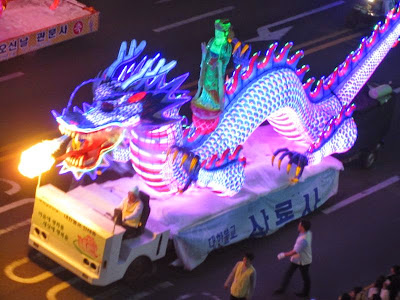
No Dokdo floats at the Buddha's Birthday Parade this year, just animals with rocket launchers and fire-breathing dragons!

Writing this blog has been a great creative outlet and has allowed me to converse with and meet a lot of wonderful and interesting people over the years. I'm thankful for the opportunities writing here has given me and I'm very grateful to the readers who have taken the time to read what I've written on this blog (let's face it, a lot of them are not short posts!). Though I've been rather busy and not had the chance to write as much here as I'd like lately, I will continue to write for the foreseeable future, when I find the time. I've left quite a few unfinished series (The 2005 English Spectrum Incident and the 1988 Olympics series, for example, are almost complete, but not quite) and have a few more I'd like to write at some point.
Thanks for reading these past ten years!
Postscript:
No Dokdo floats at the Buddha's Birthday Parade this year, just animals with rocket launchers and fire-breathing dragons!


Monday, May 4, 2015
RASKB Excursion to Yangcheon Hyanggyo and Gaehwasan next Sunday, May 10
Next Sunday, May 10, I'll be leading a walk around the area of Yangcheon Hyanggyo Station and Gaehwasan Station for the Royal Asiatic Society. The former location was the seat of Yangcheon Hyeon, or prefecture, during the Joseon period and still sports the only remaining Hyanggyo, or Confucian Shrine, in Seoul, as well as a number of other historic landmarks. We will also visit a museum to the innovative Joseon Era landscape painter Jeong Seon (1676–1759), and look at paintings of the area that he made in the mid-1700s. I've mentioned the area before (here and here), and this post at Seoul Suburban covers some of the spots we'll visit.

From there we will take the subway to Banghwa Station to explore Mt. Gaehwasan. After passing through a park with a number of 400-year-old zelkova and gingko trees, we'll head up the mountain to see the numerous tombs, many with beautifully carved tombstones and flanked by stone civic official statues, of the Pungsan Shim clan, who for several generations served the Joseon kings and were memorialized for their meritorious deeds – one of which was taking part in the overthrow of the notorious king, Yonsan-gun.


We will also go to Yaksasa Temple and see a statue of the Buddha and a three-story stone pagoda which date back to the Goryeo Era.

We'll see an even larger such statue dating from the early Joseon period outside Mitasa Temple, on the other side of the mountain. The statue was found buried in the 1930s, when the temple was rebuilt. Both temples were destroyed during the Korean War, but the pagoda and statues survived.

Next to Mitasa is the Memorial to the Loyal Dead, which was erected to remember the 1,100 soldiers of the Korean 1st Army Division who died defending Mt. Gaehwasan - which overlooks Gimpo Airport - during the opening of the Korean War, which will provide an opportunity to learn more about the fighting which took place on the mountain during the war, as well as its military importance in the present. I'll also touch on the importance of the area during the Imjin War.

Being a mountain, of course, there will be lots of opportunities to take in views of the Han River and surrounding area and enjoy what nature has to offer.

If you feel like joining us, please do! The cost of the tour is W20,000 for RAS members and W25,000 for non-members. The excursion will set off next Sunday, May 10, at 1:00 pm from exit 3 of Yangcheon Hyanggyo Station (양천향교) #906 (subway line number 9). For more information, see here.

(Yangcheon District in the 1870s)
From there we will take the subway to Banghwa Station to explore Mt. Gaehwasan. After passing through a park with a number of 400-year-old zelkova and gingko trees, we'll head up the mountain to see the numerous tombs, many with beautifully carved tombstones and flanked by stone civic official statues, of the Pungsan Shim clan, who for several generations served the Joseon kings and were memorialized for their meritorious deeds – one of which was taking part in the overthrow of the notorious king, Yonsan-gun.


We will also go to Yaksasa Temple and see a statue of the Buddha and a three-story stone pagoda which date back to the Goryeo Era.
We'll see an even larger such statue dating from the early Joseon period outside Mitasa Temple, on the other side of the mountain. The statue was found buried in the 1930s, when the temple was rebuilt. Both temples were destroyed during the Korean War, but the pagoda and statues survived.
Next to Mitasa is the Memorial to the Loyal Dead, which was erected to remember the 1,100 soldiers of the Korean 1st Army Division who died defending Mt. Gaehwasan - which overlooks Gimpo Airport - during the opening of the Korean War, which will provide an opportunity to learn more about the fighting which took place on the mountain during the war, as well as its military importance in the present. I'll also touch on the importance of the area during the Imjin War.
Being a mountain, of course, there will be lots of opportunities to take in views of the Han River and surrounding area and enjoy what nature has to offer.
If you feel like joining us, please do! The cost of the tour is W20,000 for RAS members and W25,000 for non-members. The excursion will set off next Sunday, May 10, at 1:00 pm from exit 3 of Yangcheon Hyanggyo Station (양천향교) #906 (subway line number 9). For more information, see here.
Wednesday, April 1, 2015
Screening of "A Single Spark" with English subtitles and interview with director Park Kwang-su this Saturday
This Saturday, April 4, at 2pm, the Royal Asiatic Society Cinema Club and Seoul Film Society will have a free screening of the 1995 Park Kwang-su film "A Single Spark" (아름다운 청년 전태일) with English subtitles at Seoul Global Center's Haechi Hall, on the 5th Floor of M Plaza in Myeong-dong. The screening will be followed by an interview and question and answer period with director Park Kwang-su.
The film is based on the life of Jeon Tae-il, who tried to improve the conditions of workers in the garment factories of Pyeonghwa Sijang near Dongdaemun, where he worked in the late 1960s; I've written about him here. Though he was only able to attend school up to middle school, he eventually came to understand that the Labour Standards Act offered workers protections, but when media attention (by the Kyungyang Shinmun and Donga Ilbo) failed to make any difference he and his coworkers held a protest on November 13, 1970 in which Jeon suddenly set himself on fire. This led politicians to take up the cause of labour standards and inspired the rise of unions, particularly by female workers, throughout the 1970s. An anonymous biography of Jeon was pubished in 1983, written by law student Jo Yeong-rae, who spent six years on the run, wanted by the government for student activism. The film weaves the stories of Jeon and Jo's lives together, with Jeon's life filmed in black and white, and Jo's (set in 1975) filmed in colour. It won the Best Film Award at the 1995 Blue Dragon Film Awards.
After the screening, the film's director, Park Kwang-su will take part in a 90-minute Interview and Question and Answer session after the screening.
While the screening is free, the there will be an admission fee of 7,000 won (5000 won for students) for the interview with the director to cover the cost of the interpreter, etc.
1. 2pm to 2:10pm – My introduction
2. 2:10pm to 4pm – Film screening
3. 4pm to 4:10pm – Interval
4. 4:10pm to 5:40pm – Interview and Question and Answer with Director Park Kwang-su.
Directions to Seoul Global Center's Haechi Hall can be found here and here, and more information about the film is here , and the screening, here.
The film is based on the life of Jeon Tae-il, who tried to improve the conditions of workers in the garment factories of Pyeonghwa Sijang near Dongdaemun, where he worked in the late 1960s; I've written about him here. Though he was only able to attend school up to middle school, he eventually came to understand that the Labour Standards Act offered workers protections, but when media attention (by the Kyungyang Shinmun and Donga Ilbo) failed to make any difference he and his coworkers held a protest on November 13, 1970 in which Jeon suddenly set himself on fire. This led politicians to take up the cause of labour standards and inspired the rise of unions, particularly by female workers, throughout the 1970s. An anonymous biography of Jeon was pubished in 1983, written by law student Jo Yeong-rae, who spent six years on the run, wanted by the government for student activism. The film weaves the stories of Jeon and Jo's lives together, with Jeon's life filmed in black and white, and Jo's (set in 1975) filmed in colour. It won the Best Film Award at the 1995 Blue Dragon Film Awards.
After the screening, the film's director, Park Kwang-su will take part in a 90-minute Interview and Question and Answer session after the screening.
While the screening is free, the there will be an admission fee of 7,000 won (5000 won for students) for the interview with the director to cover the cost of the interpreter, etc.
1. 2pm to 2:10pm – My introduction
2. 2:10pm to 4pm – Film screening
3. 4pm to 4:10pm – Interval
4. 4:10pm to 5:40pm – Interview and Question and Answer with Director Park Kwang-su.
Directions to Seoul Global Center's Haechi Hall can be found here and here, and more information about the film is here , and the screening, here.
Sunday, March 29, 2015
The Accidental Citizen-Soldier: An English teacher's worst nightmare?
In 2002, Young Chun - born and raised in the U.S. by parents who had emigrated from Korea - came to Korea to teach English and pay off university debts. When he applied for an F-4 visa at the immigration office, he was informed by a confused immigration officer that he couldn't get one because he was, in fact, a Korean citizen; someone had put his name on the family register when he was born. Through a string of bad luck, he eventually found himself with an immigration exit ban and orders to report for military service - even though he didn't speak Korean. Given no assistance by the country of his birth, and unable to evade this order without going to prison, he reported for basic training in January, 2004, and began a two-year experience which would even involve deployment to Afghanistan.
 This story is told in Young Chun's recently-released memoir "The Accidental Citizen-Soldier: The Story of an American in the Korean Army." He was kind enough to send me a pdf to review, and within a few pages I was hooked. In addition to having fascinating subject matter, it's well-written, well-paced, and sprinkled with enough humour to lighten an otherwise somber story. Military service is an experience almost all Korean men have to suffer through, and "The Accidental Citizen-Soldier" provides a first-hand look at what it entails, detailing all of the humiliations, power struggles and occasional kindnesses. It's gratifying to see him proceed through what is often an inhumane system and come to understand it and use it to his benefit, even finding time to translate a Korean novel for a translation contest.
More about Young's story can be found in this interview he gave to a Seattle newspaper in 2004 (which didn't go over well when his superiors found out), as well as at his blog, where you can listen to a recent interview given for TBS radio.
The book is well worth reading and can be found at Amazon.com for what should be $2.99 for a Kindle edition (a way to get around a tacked-on $2.00 'international charge' is detailed on his blog). A softcover version is also available and there are currently a handful of copies at the Gwanghwamun branch of Kyobo Bookstore.
I asked Young a few questions about his experience, beginning with the differences between how the ROK and US militaries treat their soldiers:
Thanks to Young for answering my questions.
More about Young's story can be found in this interview he gave to a Seattle newspaper in 2004 (which didn't go over well when his superiors found out), as well as at his blog, where you can listen to a recent interview given for TBS radio.
The book is well worth reading and can be found at Amazon.com for what should be $2.99 for a Kindle edition (a way to get around a tacked-on $2.00 'international charge' is detailed on his blog). A softcover version is also available and there are currently a handful of copies at the Gwanghwamun branch of Kyobo Bookstore.
I asked Young a few questions about his experience, beginning with the differences between how the ROK and US militaries treat their soldiers:
I think the biggest difference is each army's attitude towards its soldiers. The US Army treats its soldiers as human beings with civil rights to be respected and needs to be fulfilled. At the time, I felt like the Korean Army saw its conscripts as nothing more than tools, no different than a shovel or a toilet. Prior to my induction, I had heard that the pay was atrocious; I hadn't heard that I would be worked almost constantly with very little sleep, sometimes having to skip meals because the officers wouldn't let me take a break from work (even though they made sure to go themselves). There was never a guarantee of free time, and there were no counseling services even though I was depressed and frustrated for most of my first year.While the Korean soldiers in Afghanistan are depicted in the book as getting along well enough with the American soldiers there, some incidents - such as one which ends with an high-ranking American officer storming out after muttering, "God damn Koreans" - made me wonder if the ROK military presence there might have done more harm than good:
When I was in Afghanistan, I was amazed at all the welfare facilities available on base. They had almost everything I could think of and a lot I couldn't have even imagined. On the other hand, on my base in Daegu, the only real welfare facility for conscripts was the PX, which was dwarfed by the one in Afghanistan. The BX on Bagram Air Base was a Wal-mart. The PX on my base in Daegu was a 7-11. At least, that's how it felt. My company in Daegu had a small trailer with some gym equipment and a single basketball hoop. I've heard that other units had a noraebang and a computer for conscripts to use; my company had neither. I couldn't even check my e-mail on base.
In Bagram, I was also amazed by how civilly American soldiers treated each other. In Daegu, it was only ridicule and bullying between soldiers. Aside from your donggi (soldiers who started the same month as you), everyone was someone to be feared or someone to order around. It is the ROK Army culture that forces people to act in such an unnatural way. While on deployment, there was no such protocol in the 2nd Construction Company, and it was much more bearable.
I have heard that the ROK Army has been working on treating conscripts marginally better. I've heard that privates now make something like 130,000 won a month and the general atmosphere among conscripts is better, but I don't know for certain. It's kind of a general understanding that it gets a little better and more comfortable every year, and people who did their service earlier are keen to point out that things were more difficult for them.
To be honest, I don't think the Korean Army's presence in Afghanistan made a difference one way or the other. Sure, we were a nuisance, but most of the truly outrageous things were suffered by those in command--the base command and the command of the 109th Engineers--rather than the average soldier. That being said, I don't think anyone thought we really contributed to the war efforts, and I don't think much was expected of us. The Dasan Engineering Unit poured concrete around the base and the Dongeui Medical Unit treated local nationals, and for the most part, the Korean soldiers kept to the Korean compounds when they weren't busy shopping.I also asked him about the effect his experience had upon his attitude toward Korea in general.
I get asked this question often because people are surprised that I decided to stay in Korea and they usually expect me to be very bitter. Of course, I don't look back at the experience fondly, but the Korean Army is the Korean Army and Korean society is Korean society. There are things that I greatly enjoy about Korea and things that frustrate me to no end, but I don't let my experience in the service color my judgment of Korea.Lastly, I asked him about how he went about learning Korean:
With regard to the people, wherever you go in the world, there are good, kindly, decent people, and there are cruel, selfish, arrogant assholes. The US is no different, Korea is no different, the Korean Army is no different. Granted, the culture in the Army brought out the worst in people, which is one of the reasons why I prefer not to see people I met in the Army. I try to surround myself with the former.
I do deeply sympathize when I hear my friends talking about their experiences in corporate Korea because it often reminds me of my time in the Army, and I've determined never to put myself in such a hellish and poisonous environment again.
For the first three or four weeks, I simply parroted whatever I was taught without knowing what the words meant. Once I got my Korean-English pocket dictionary, I was constantly looking up words that I heard throughout the day and tried to piece things together. When I was a private, I once got verbally abused for looking at my dictionary while I was walking. I had only wanted to look up a word before I forgot it. "Privates don't get to read and walk," the sergeant said, after he had given me a good shoulder to the back.
Once I was in Daegu, I had access to a small library in the squad room. I would choose a novel and go through it, looking up every word I didn't know until I could piece together what was being said. It was very slow-going; I remember spending a couple of days on a single paragraph. The book that I translated for The Korea Times Literature Awards was maybe the first Korean novel I was able to read from cover to cover. I also bought a book on Korean grammar when I was on furlough prior to pre-deployment training. I think I copied most of the entries in my journal. Needless to say, I wrote pages upon pages of vocabulary words and grammar points.
That was one aspect of my learning Korean. The other was the hostile environment. If I said something grammatically incorrect or even mispronounced any little word, I was ridiculed and shamed mercilessly. Some people would respond by working harder until their ability was recognized; I basically just shut my mouth and kept to myself. I never yelled at anyone when I was a sergeant, partially because I knew better than anyone how it felt but mostly because I couldn't yell in Korean. I still can't.
It's a little embarrassing, but I couldn't speak Korean decently until after I got discharged. Everything I had studied didn't get processed until I finally had the time to process it. Needless to say, I don't recommend going to the Korean Army if you're interested in learning Korean.
Thanks to Young for answering my questions.
Subscribe to:
Posts (Atom)