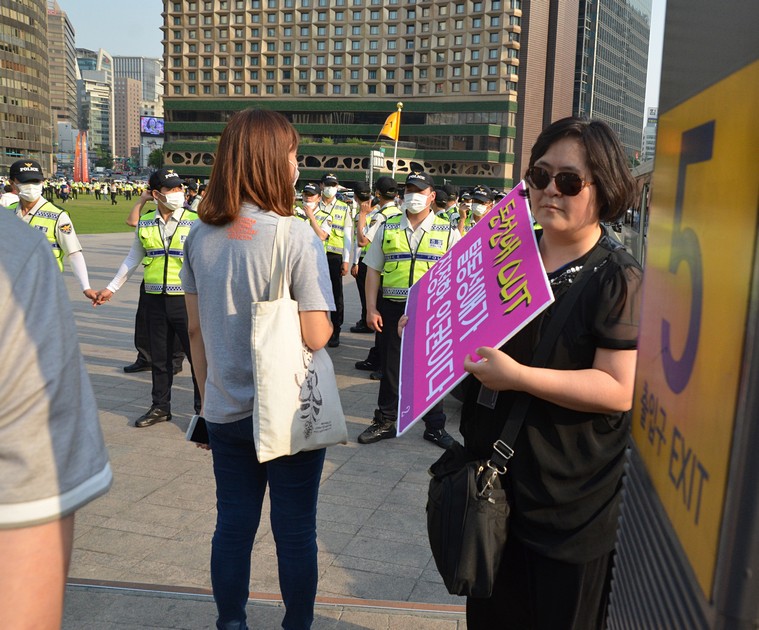
Christian protesters of the Korean Queer Cultural Festival have been getting quite a bit of attention online. As Korea Observer reported, the Christian protesters first managed to submit rally declarations forms
for all available spaces in Daehangno, blocking the Korea Queer Culture Festival from being held there; then when they competed with Festival organizers to submit petitions to Namdaemun Police Station,
neither was allowed to hold festivals - a victory for the Christian groups. When part of Seoul Plaza was secured for the on June 9, the Christian groups then
set out to hold a counter protest, which is the one which has gotten attention online, mostly at
this Korea Observer report (do watch the video); many more videos can be seen at
Daehanmindecline.
One note I have to make is that there really isn't any justification to be translating '동성애' - 'homosexuality,' or in the context of many of the posters, 'homosexuals' - as 'fags.' Using that word suggests the protesters were using some specific anti-gay slur in Korean when they weren't. In fact, one sign has "queers" written in English, while one handout referred to the "homosexual party" and
another directly translates "동성애 문제 대책 위원회" as "Countermeasure Committee for Homosexuality Problem," so I don't see the need to use such an inflammatory word when the messages on the signs are bad enough already.
There were several equating homosexuality and AIDS:
Wrong administration causes our children to die of AIDS (above)
Oppose homosexuals!! What is the reason for the increase in teen AIDS patients?
Abolish the student rights ordinance promoted by homosexuals which spreads AIDS
MERS-AIDS fatal virus - desperately oppose the homosexual festival - the increase in AIDS via Homosexuals
There seemed to be several signs ridiculously tying MERS and AIDS together. A number predict the doom of the Korea or use the language of human rights, even addressing UN Secretary General Ban Ki-moon:
Homosexuals will disease Korea’s future.
Is anal sex also a human right?
UN Secretary General Ban Ki-moon - Is homosexuality a human right? (in English)
UN Secretary General Ban Ki-moon! Homosexuals collapse a country built with blood and sweat.
UN Secretary General Ban Ki-moon! Do you really want a homosexual man as a daughter in law or a woman as a son in law?
A number also address Park Won-soon and call for his ouster:
MERS+AIDS fatal virus - Homosexuals collapse a country built with blood and sweat. Homosexual-friendly Mayor Park Won-soon OUT
Homosexuality - Park Won-soon OUT
Park Won-soon, who allowed Homosexuality rally packaged as culture OUT
I can't help but see the 'Out' posters like
this one and think of the earliest examples of signs using the English word 'Out' on them - during
the mad cow protests against evangelical Christian President Lee Myung-bak:
(Taken on bike path heading up to Haengju Bridge, 2008.)
One of the more jaw-dropping pieces of literature was not the signs the protesters were carrying, but a handout in English addressed to foreign ambassadors being distributed outside of city hall. (First seen
here.)
A few notes on this collection of rants that comes rather close to self parody:
That's one of the few times in Korea you'll see Uganda getting praised. Or not being called 'Africa.' As well, we finally find out who the real victims are - those anti-homosexuals who keep being called mean words like 'homophobic.' (Hat tip to Taeyang.)
As well, the last time I checked homosexuality wasn't illegal in Korea. And as for countries with same-sex marriage permitting beastiality and incest, that doesn't seem like the Canada I remember. Which I should be heading to ASAP considering the ending "we want you to leave Korea right now!" Lots of love there. (For comparison, here are some pamphlets handed out by Christians
during the 1988 Olympics.)
It's hard to know about the entirety of 5000 years of Korea's "great moral virtue," but according to Richard Rutt and others (as I noted
here) homosexuality was practiced and even tolerated in some cases up until at least the Colonial Era;
Robert Neff has also uncovered evidence in the writings of early missionaries at the end of the Joseon Dynasty.
I was sent this handout, which names its distributor as the 동성애 문제 대책 위원회" or "Countermeasure Committee for Homosexuality Problem," which they say "consists of 35 major civil groups fighting for our national security, sound religion's [sic] identity, morality and the human rights of North Koreans suffering from dictatorship." It also names 13 embassies (USA, UK, Germany, France, Canada, Spain, Belgium, Slovenia, Denmark, Finland, Norway, Sweden, EU) and states its purpose is "To request ceasing the embassy participation in the 16th queer culture festival in Seoul".
Once again, there is an astonishing amount of linking AIDS to homosexuality: "We are sure the Europe court's __ decision will prevent gay marriage from expanding AIDs [sic] disease everywhere in the [world] threatening the health of mankind. The Europe highest human rights court's decision ___ high level of sound sex moral to save mankind suffering from AIDs [sic]."
And one can’t help but note this: "Koreans have not intervened in other nation and other country their ethics and [culture.] Koreans historically respect other countries." This is a bit on the hilarious side, considering Korean Christian missionaries are all over the world "intervening" in the cultures of those countries by trying to convert non-Christians, with one memorable instance being when
a number of missionaries were captured by the Taliban in 2007, with two being killed before they were ransomed, with the Korean government paying an unspecified amount (usually thought to be 20 million dollars). As a result, the Korean government banned Koreans from travelling to a number of countries, mostly to keep missionaries out. As
this Korea Herald article points out,
Korea Crisis Management Service, a nonprofit launched in the wake of the kidnapping of 23 Korean Christians doing missionary work in war-torn Afghanistan in July 2007 [...] was founded in part at the government’s request. The nonprofit body trains missionaries working in countries with extreme crime or civil unrest to avoid dangerous situations and, if confronted with trouble, how to get out of it.
The article also points out the desire to 'intervene' in the 'ethics and culture' of other countries:
"Many missionaries want to go to these Muslim countries," Kim of KCMS said. "They have a love for Muslim people and a calling to preach the gospel."
Perhaps if these Christian groups could promise to respect other countries' cultures by keeping their missionaries at home they might not appear so hypocritical. Needless to say, these Christian groups' hateful and ignorant messages aren't going to get any serious attention by their intended recipients. Having groups known for trying to impose their religion on other cultures - a religion whose founder said "Thou shalt love thy neighbour as thyself" - call on foreign embassies to "leave Korea right now!" because they're interfering in Korea's ethics and culture would be funny if it weren't so sad.