Showing posts with label Xenophobia or Nationalism. Show all posts

Sunday, June 14, 2015

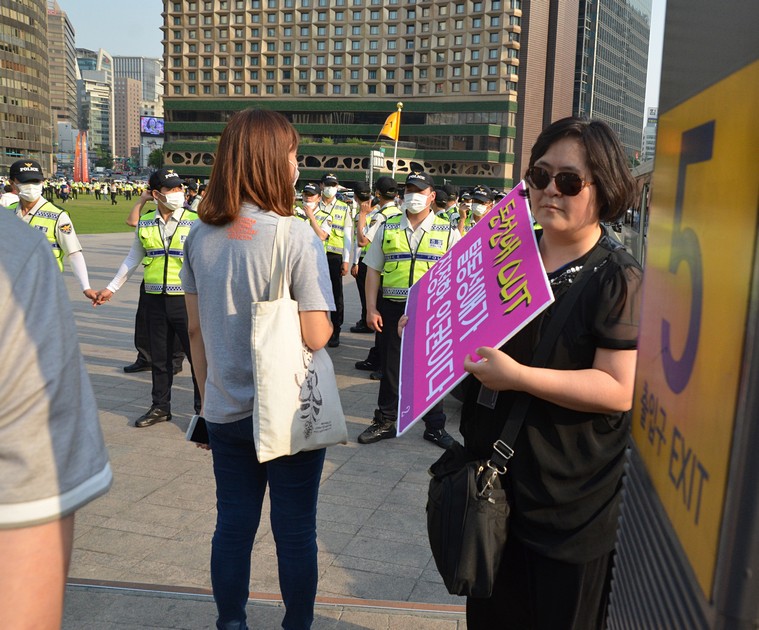
Protests against the Queer Culture Festival by the Countermeasure Committee for Homosexuality Problem

Christian protesters of the Korean Queer Cultural Festival have been getting quite a bit of attention online. As Korea Observer reported, the Christian protesters first managed to submit rally declarations forms for all available spaces in Daehangno, blocking the Korea Queer Culture Festival from being held there; then when they competed with Festival organizers to submit petitions to Namdaemun Police Station, neither was allowed to hold festivals - a victory for the Christian groups. When part of Seoul Plaza was secured for the on June 9, the Christian groups then set out to hold a counter protest, which is the one which has gotten attention online, mostly at this Korea Observer report (do watch the video); many more videos can be seen at Daehanmindecline.

One note I have to make is that there really isn't any justification to be translating '동성애' - 'homosexuality,' or in the context of many of the posters, 'homosexuals' - as 'fags.' Using that word suggests the protesters were using some specific anti-gay slur in Korean when they weren't. In fact, one sign has "queers" written in English, while one handout referred to the "homosexual party" and another directly translates "동성애 문제 대책 위원회" as "Countermeasure Committee for Homosexuality Problem," so I don't see the need to use such an inflammatory word when the messages on the signs are bad enough already.

There were several equating homosexuality and AIDS:

(From the video here.)
Wrong administration causes our children to die of AIDS (above)
Oppose homosexuals!! What is the reason for the increase in teen AIDS patients?
Abolish the student rights ordinance promoted by homosexuals which spreads AIDS
MERS-AIDS fatal virus - desperately oppose the homosexual festival - the increase in AIDS via Homosexuals
There seemed to be several signs ridiculously tying MERS and AIDS together. A number predict the doom of the Korea or use the language of human rights, even addressing UN Secretary General Ban Ki-moon:
Homosexuals will disease Korea’s future.
Is anal sex also a human right?
UN Secretary General Ban Ki-moon - Is homosexuality a human right? (in English)
UN Secretary General Ban Ki-moon! Homosexuals collapse a country built with blood and sweat.
UN Secretary General Ban Ki-moon! Do you really want a homosexual man as a daughter in law or a woman as a son in law?
A number also address Park Won-soon and call for his ouster:
MERS+AIDS fatal virus - Homosexuals collapse a country built with blood and sweat. Homosexual-friendly Mayor Park Won-soon OUT
Homosexuality - Park Won-soon OUT
Park Won-soon, who allowed Homosexuality rally packaged as culture OUT
I can't help but see the 'Out' posters like this one and think of the earliest examples of signs using the English word 'Out' on them - during the mad cow protests against evangelical Christian President Lee Myung-bak:

(Taken on bike path heading up to Haengju Bridge, 2008.)

One of the more jaw-dropping pieces of literature was not the signs the protesters were carrying, but a handout in English addressed to foreign ambassadors being distributed outside of city hall. (First seen here.)


A few notes on this collection of rants that comes rather close to self parody:
That's one of the few times in Korea you'll see Uganda getting praised. Or not being called 'Africa.' As well, we finally find out who the real victims are - those anti-homosexuals who keep being called mean words like 'homophobic.' (Hat tip to Taeyang.)
As well, the last time I checked homosexuality wasn't illegal in Korea. And as for countries with same-sex marriage permitting beastiality and incest, that doesn't seem like the Canada I remember. Which I should be heading to ASAP considering the ending "we want you to leave Korea right now!" Lots of love there. (For comparison, here are some pamphlets handed out by Christians during the 1988 Olympics.)

It's hard to know about the entirety of 5000 years of Korea's "great moral virtue," but according to Richard Rutt and others (as I noted here) homosexuality was practiced and even tolerated in some cases up until at least the Colonial Era; Robert Neff has also uncovered evidence in the writings of early missionaries at the end of the Joseon Dynasty.

I was sent this handout, which names its distributor as the 동성애 문제 대책 위원회" or "Countermeasure Committee for Homosexuality Problem," which they say "consists of 35 major civil groups fighting for our national security, sound religion's [sic] identity, morality and the human rights of North Koreans suffering from dictatorship." It also names 13 embassies (USA, UK, Germany, France, Canada, Spain, Belgium, Slovenia, Denmark, Finland, Norway, Sweden, EU) and states its purpose is "To request ceasing the embassy participation in the 16th queer culture festival in Seoul".


Once again, there is an astonishing amount of linking AIDS to homosexuality: "We are sure the Europe court's __ decision will prevent gay marriage from expanding AIDs [sic] disease everywhere in the [world] threatening the health of mankind. The Europe highest human rights court's decision ___ high level of sound sex moral to save mankind suffering from AIDs [sic]."

And one can’t help but note this: "Koreans have not intervened in other nation and other country their ethics and [culture.] Koreans historically respect other countries." This is a bit on the hilarious side, considering Korean Christian missionaries are all over the world "intervening" in the cultures of those countries by trying to convert non-Christians, with one memorable instance being when a number of missionaries were captured by the Taliban in 2007, with two being killed before they were ransomed, with the Korean government paying an unspecified amount (usually thought to be 20 million dollars). As a result, the Korean government banned Koreans from travelling to a number of countries, mostly to keep missionaries out. As this Korea Herald article points out,
Korea Crisis Management Service, a nonprofit launched in the wake of the kidnapping of 23 Korean Christians doing missionary work in war-torn Afghanistan in July 2007 [...] was founded in part at the government’s request. The nonprofit body trains missionaries working in countries with extreme crime or civil unrest to avoid dangerous situations and, if confronted with trouble, how to get out of it.
The article also points out the desire to 'intervene' in the 'ethics and culture' of other countries:
"Many missionaries want to go to these Muslim countries," Kim of KCMS said. "They have a love for Muslim people and a calling to preach the gospel."
Perhaps if these Christian groups could promise to respect other countries' cultures by keeping their missionaries at home they might not appear so hypocritical. Needless to say, these Christian groups' hateful and ignorant messages aren't going to get any serious attention by their intended recipients. Having groups known for trying to impose their religion on other cultures - a religion whose founder said "Thou shalt love thy neighbour as thyself" - call on foreign embassies to "leave Korea right now!" because they're interfering in Korea's ethics and culture would be funny if it weren't so sad.

Friday, May 22, 2015

CERD rules that HIV tests for foreign teachers in Korea are discriminatory

In late 2009 I posted here about a foreign teacher who was refusing to take second HIV test in order to renew her teaching contract at an elementary school in Ulsan. As a result she lost her job and left Korea, and with Benjamin Wagner representing her, complaints were filed with the National Human Rights Commission of Korea (which rejected it) and Korean Commercial Arbitration Board (which ruled against her. Then in July 2012 it was announced that the United Nations Committee on the Elimination of Racial Discrimination had agreed to hear the case, though not a single Korean media outlet chose to report on this despite receiving a press release from a PR firm. Given 90 days to reply, the ROK instead took 9 months to reply, stating that "since 2010, its guidelines on the employment of foreign teachers do not specify that [foreign teachers] have to submit results of HIV/AIDS and drugs tests to have their contracts renewed," an assertion which I knew personally was not true (and which the Korea Herald looked at here). In 2010 the ROK had in fact officially removed all HIV tests for those registering for residency except for the E-2 visa tests.

In a journal article coauthored by Benjamin Wagner and myself, we asked in the title whether HIV tests were a proxy for racial discrimination, and this week the CERD answered that question: Yes.

As Benjamin Wagner wrote this week,
On May 18, 2015, the United Nations Committee on the Elimination of Racial Discrimination decided the case of a former native English teacher from New Zealand. Ms. “L.G” lost her job and work visa in 2009 after she refused to take a second round of in-country drug and HIV tests demanded by the Education Ministry just months after submitting to identical tests for the purposes of immigration. Korean citizen teachers and even ethnic Korean noncitizen teachers are able to avoid such tests. Ms. L.G. correctly regarded the government’s demands as based on unfounded stereotypes of foreigners as drug users and sexual deviants. While immigration has required a single negative test result for HIV and drugs for prospective foreign teachers since 2007, the Education Ministry began demanding their own tests, meaning that many teachers are tested multiple times during their time in the country.

In 2012, the Committee accepted L.G’s petition after she had exhausted all possible solutions in Korea (a prerequisite for bringing complaints under the CERD) including filing unsuccessful complaints with the National Human Rights Commission of Korea and Korean Commercial Arbitration Board.
An official summary of the decision is here, while the full decision can be downloaded as a .doc here. As can be seen here, of four cases considered this session by CERD, only this case was considered to be in violation of the Convention for Eradication of Racial Discrmination; the summary points out which articles of the convention the ROK was found to be violating in this case.

The summary makes public the justification the UMOE offered for the tests - something that many people taking these tests have known for years, but never admitted by the government:
[D]uring arbitration proceedings, L.G.’s employers, the Ulsan Metropolitan Office of Education (UMOE), said that HIV/AIDS tests were viewed as a means to check the values and morality of foreign English teachers.
One of the Committee's recommendations isn't very surprising:
The Committee recommends that the State party grant the petitioner adequate compensation for the moral and material damages caused by the above-mentioned violations of the Convention, including compensation for the lost wages during the one year she was prevented from working.
It continues with much more sweeping recommendations, however:
It also recommends that the State Party takes the appropriate means to review regulations and policies enacted at the State or local level related to employment of foreigners and abolish, both in law and practice, any piece of legislation, regulation, policy or measure which has the effect of creating or perpetuating racial discrimination. The Committee recommends the State party to counter any manifestations of xenophobia, through stereotyping or stigmatizing, of foreigners by public officials, the media and the public at large, including, as appropriate, public campaigns, official statements and codes of conduct for politicians and the media. The State party is also requested to give wide publicity to the Committee’s Opinion, including among prosecutors and judicial bodies, and to translate it into the official language of the State party.
This doesn't just refer to English teachers, but to regulations for all foreign workers. And as I've covered here, the references to the conduct of the media and politicians is very pertinent, considering the 'Citizens Group for Upright English Education' (also known as Anti English Spectrum) worked closely with the media and had access to politicians when pushing for the creation of the HIV testing policy (among others) in the first place.

As well, national assembly representatives have said a number of negative things about foreign teachers over the year. In June of 2009 Rep Choi Young-hee submitted 3 bills regarding native English teachers to the national assembly which called for drug tests for foreign teachers, with the bills stating that "the crime rate among native-speaking English teachers is getting higher" without offering any proof of such an increase, She also stated that immigration had lost 22,000 E-2 visa holders, but as it turns out, she used the wrong statistics. A few months later, Rep. Lee Gun-hyeon stated that foreign teacher crime was 'serious,' but released statistics showing it to be 5 times less than the Korean crime rate. Rep. Park Min-sik would chime in a month later on the "flood of unqualified native speaking teachers", while National Assembly Rep Lee Ju-yeong stated that "Of foreigners, native speaking teachers are especially potential child molesters" who may have many 'undisclosed crimes' and who may fake their backgrounds. None of this quite compares to the racially charged statements made by Kim Han-gil, who was recently the leader of the opposition party, back in 1997 about the "white good-for-nothings" flocking to Korea to teach English, and despairing that the "low culture of English speaking countries is penetrating into living rooms." He also proved to be ten years ahead of the curve by complaining that foreign teachers "they don't even have to take drug or AIDS tests."

As for the media, this decision is being widely reported. For example:

Source - UN
Republic of Korea’s foreigners-only HIV tests violated New Zealand teacher’s rights — UN experts (Office of the High Commissioner for Human Rights, Geneva; 20 May 2015)
Republic of Korea’s foreigners-only HIV test violated New Zealand teacher’s rights — UN experts (UN News Center; 20 May 2015)
Korea’s foreigner-only HIV tests violate NZ teacher’s rights (Scoop, New Zealand; 21 May 2015)
HIV tests for E-2 visas discrimination, U.N. Finds (Korea Herald, 20 May 2015)
UN Experts Urge S Korea To Compensate New Zealander Who Lost Job Over HIV Test (RTT News; 20 May 2015)
Korea’s foreigners-only HIV test violated New Zealand teacher’s rights: UN experts (NewKerala.com, Kerala, India; 21 May 2015)
Korea’s foreigners-only HIV test violated New Zealand teacher’s rights: UN experts (IndiaBlooms.com, India; 21 May 2015)

I really like the headlines of the first two articles here, and am glad the CERD chose to make UMOE's justification for the tests public:

Source - AFP
South Korea criticised for demanding expat teacher take AIDS test to check ‘values and morality’ (Radio Australia, ABC; 20 May 2015)
South Korea criticised for demanding expat teacher take AIDS test to check ‘values and morality’ (ABC News, Australia; 20 May 2015)
UN experts rap S.Korea over AIDS test for expat teachers (Yahoo! News, Australia; 20 May 2015)
UN experts rap S Korea over AIDS test for expat teachers (Economic Times, India; 20 May 2015)
UN experts rap S.Korea over AIDS test for expat teachers (Business Standard; 20 May 2015)
UN experts rap South Korea over AIDS test for expat teachers (Zee News, India; 20 May 2015)
UN experts rap S.Korea over AIDS test for expat teachers (NGR News, Nigeria; 20 May 2015)
SK demanded Aids test for expat teacher (IOL News, South Africa; 20 May 2015)
UN experts rap S.Korea over AIDS test for expat teachers (Global Post; 20 May 2015)
UN experts rap S.Korea over AIDS test for expat teachers (Bangkok Post; 20 May 2015)
UN experts rap S. Korea over AIDS test for expat teachers (The Straits Times, Asia; 20 May 2015)
UN experts rap S.Korea over AIDS test for teachers (Press Trust of India; 20 May 2015)

Source - NZN
UN says Kiwi kicked out of South Korea for refusing AIDS test should be compensated (TVNZ; 21 May 2015)
UN backs Kiwi teacher kicked out of Korea (NZCity, New Zealand; 20 May 2015)
Kiwi teacher asked to take AIDS test (3 News, New Zealand; 20 May 2015)

As well, unlike how the Korean media was able to ignore the case when it was accepted, it is being reported here in a limited manner (ten articles), with the Korea Herald first breaking the story, followed by Yonhap:

UN CERD "Korea should abolish HIV tests for foreign instructors" (Yonhap; 20 May 2015)
UN CERD: "Korea, testing only foreign instructors for HIV is a violation of human rights" (KBS; 20 May 2015)
U.N. urges S. Korea to abolish HIV testing of foreign teachers (Yonhap English; 20 May 2015)
UN CERD: "Korea, compensate foreigner who refused HIV test" (Money Today; 20 May 2015)
UN: "Korea’s testing of foreign instructors for HIV is a violation of human rights" (; 21 May 2015)
UN CERD "Korea, abolish HIV testing of foreign teachers" (SBS; 21 May 2015)
UN CERD: "Korea, compensate foreigner who refused HIV test" (News1; 20 May 2015)
UN: "Foreign instructor HIV tests are character defamation" (MBN; 21 May 2015)
UN CERD: "Korea, compensate foreigner who refused HIV test for human rights violations" (Le Monde Diplomatic; 21 May 2015)
UN racism ruling piques government (Korea Times; 22 May 2015)

Since Yonhap English news articles tend to be truncated after a few days, here's their English translation of the story:

U.N. urges S. Korea to abolish HIV testing of foreign teachers (Yonhap; 20 May 2015)
GENEVA, May 20 (Yonhap) -- A United Nations committee on Wednesday reprimanded South Korea's mandatory HIV testing of native English teachers as discrimination against foreigners, urging the country to abolish the policy.

Foreigners who come to South Korea to teach English are required to have a criminal background check and tests for illegal drugs and the HIV virus, while Korean nationals in equivalent jobs are not required to go through such scrutiny.

The U.N. Committee on the Elimination of Racial Discrimination (CERD) has deliberated the policy after Lisa Griffin, a former English teacher from New Zealand, filed a complaint when her contract with a local education office was not renewed in 2009 over HIV testing.

Griffin, who had received a negative result on the first test, refused to undergo a second, arguing it could stigmatize foreigners as people who have a higher risk of AIDS and could spread a negative sentiment against them.

The Geneva-based committee said the foreigner-only HIV test was "discriminatory and an affront to her dignity," urging the South Korean government to compensate for "moral and material damages" she suffered.

The mandatory testing "does not appear to be justified on public health grounds or any other ground, and is a breach of the right to work without distinction to race, color, national or ethnic origin," the committee said in a release.

The U.N. committee urged Korean authorities to take steps to revise the policies that stereotype or stigmatize foreigners, giving them 90 days to report back on the process.
As someone who contributed research to the CERD petition, I'm really happy with the results. What happens next is up to the Korean government.

Monday, March 2, 2015

Lawmaker criticizes textbooks for correctly describing the violence of the Samil protests

An article in today's Joongang Daily declares in its headline that "Textbooks do disservice to March 1 movement."
Rep. Han Sun-kyo, a lawmaker of the ruling Saenuri Party, told the JoongAng Ilbo on Thursday that he analyzed Korean and Japanese history textbooks he received from the Seoul-based think tank Northeast Asian History Foundation and Korea’s Ministry of Education and found the results troubling.

He said a “considerable number of Japanese history textbooks are distorting the facts or minimizing the significance of the March 1 Independence Movement.”

March 1, 1919, remains a touchstone of Korean nationalism as the day when activists declared Korea’s independence and triggered large-scale peaceful demonstrations against Japanese colonial rule (1910-1945).

One Japanese middle school history textbook published by Jiyusa says the March 1 independence movement in Seoul “initially was planned as a non-violent rally but gradually became a large-scale movement,” and that “the army was mobilized and because of a clash on both sides, there were many casualties.” [...]

But Han added that Korean history textbooks also have inaccuracies, and there are many cases where they “describe the non-violent March 1 movement as violent” or do not mention key events or figures such as Yoo Gwan-soon’s martyrdom. [...]

According to Han’s study, half of the eight Korean high school history textbooks inaccurately described the independence movement as being “violent.” Three other textbooks failed to describe the movement adequately.

He found that only one publisher, Chunjae Education, explained the movement accurately and in detail. “As time passed, the protests grew more intense and military and police fired at people during the demonstrations, leading to deaths,” it said. The text emphasized, “The demonstrations were highly regarded internationally for holding to the principle of non-violence while trying to express resistance to Japanese imperialism.”
The problem is, the textbooks describing the independence movement as being "violent" are being accurate. While some of the Japanese dispatches during the Samil Uprising reported in the New York Times described violence on the part of demonstrators, I didn't realize just how violent the protests were until I read Frank Baldwin's "Participatory Anti-Imperalism:The 1919 Independence Movement" (Journal of Korean Studies, Volume 1, 1979, pp. 123-162). One assumes this contains some of the material in his dissertation, "The March First Movement: Korean Challenge, Japanese Response" (Columbia University, 1969). In his article, he notes that between March 1 and April 10, 1919, there were "approximately 667 peaceful demonstrations" as compared with "approximately 460 violent incidents." Here is his description of the nature of the protests:
Initially the demonstrations were nonviolent, partly to enhance the moral appeal of the protest and partly because of the vastly superior Japanese police and army forces. The usual pattern of demonstrations was that activists assembled a crowd and a local leader read the declaration of independence. The crowd roared its approval and then marched around the area shouting for Korean liberty.

As the independence movement spread and intensified, however, its character changed into often violent confrontation. This was a response to the severe, frequently brutal suppression of the protest by the Government General, which included firing on unarmed crowds and torture of prisoners. In many areas, a peaceful demonstration was suppressed by the authorities with force, and resulted in violent counterattacks on police and gendarmes. In other areas, frustrations, anger, and pent-up grievances turned peaceful demonstrations violent even without official provocation. In still other cases, tension from sustained demonstrations and confrontations, probably exacerbated by official violence, erupted into assaults on Government General personnel and facilities. In late March and early April, parts of Korea were in open, bloody rebellion. Governor General Hasegawa Yoshimichi requested troop reinforcements

During March and April the first stage of the 1919 movement occurred—the overt and violent period. Hundreds of thousands of Koreans engaged in open political actions ranging from lusty shouts for freedom to intrepid assaults on Government General outposts and vengeful mutilation of unlucky Kenpeitai, the Japanese gendarmerie. The second stage of the movement began in May and lasted until about April, 1920. During this stage, the independence activists changed their form of political activity from overt protest to covert planning and organizing, mostly in support of the Korean provisional government formed in Shanghai on April 10, 1919. The presence of additional troops from Japan, mass-arrest tactics, and stringent security measures made open protest activity unfeasible if not impossible.
Before those additional troops arrived, however, the Government General was hard pressed to maintain control and protect its staff, settlers, and infrastructure:
The Government General juggled the available troops, withdrawing some from North and South P'yöng'an and Hwanghae, now regarded as safe, and assigned them to southern Korea, where the violence was rapidly spreading. On March 25 eight infantry companies were spread thinly over five southern provinces—North and South Kyöngsang, North and South Cholla, and South Ch'ungch'öng. The assignment was made with the hope that they would only be needed until March 30. But the Koreans kept up their attacks. Crowds formed everywhere in Seoul, stoning police stations and trolley cars. In five villages near Seoul, myön chiefs were threatened and myön offices attacked. In many places Koreans armed themselves with clubs and stones and attacked the closest police station or my on office. March 27 and 28 were frantic, tragic days as Koreans attacked in many localities only to be beaten off by troops and suffer heavy casualties. Thirty nine Koreans were killed in a single incident in Kyönggi Province. The governor general authorized new troop assignments on the 28th but the attacks continued. On March 31 Koreans armed with clubs, sickles, and other improvised weapons stormed gendarmerie units and police stations at several places in Kyönggi Province. They attempted, sometimes successfully, to burn the local public buildings—myön offices, post offices, police stations—and cut telephone lines. In one place the crowd tried to burn the stores of Japanese merchants. Many Koreans were killed and wounded in the assaults. Despite heavy casualties and against seemingly hopeless Koreans continued the fight. [...] April 2 was perhaps the bloodiest single day of the independence movement as Koreans continued their attacks on gendarmerie units, police stations, myön offices and school buildings. Demonstration marches were a thing of the past: these crowds were prepared to fight.
Below is a list of casualties on the Japanese side:

In a lengthy recounting of a violent protest in Sacheon, Pyeongannam-do on March 4, which Baldwin describes as a "typical demonstration that began peacefully and ended in violence," three Korean police officers are reported as being killed in addition to a Japanese police officer, which makes clear that the numbers above do not include Korean Government General employees, suggesting that more people died than are listed. Most ironic in the assertion that the Samil Protests were peaceful is this statement by Baldwin:
Because of continued Korean violence, the Government General requested troops from Japan, which served to further discredit Japanese rule in the colony and provided additional incentive for the Hara administration in Tokyo to make reforms. Violent forms of participation appear to have been most important in changing Japanese policy.
Additionally, the Jeam-ri massacre (looked at here) is better explained as the culmination of escalating violence on both sides rather than an out-of-the-blue mass killing by the (evil) Japanese.

The tale of "peaceful Samil demonstrations" serves the cause of depicting Koreans as a peaceful people beset upon by marauding outsiders; that is to say, victims with no responsibility for their actions. What better way to depict this fairy tale than a children's book about Yu Gwan-sun from the 한국 위인 전집 (Great people of Korea Collection) published by 노벨과 개미(looked at in more detail here):

Evil Japanese:


Peaceful, victimized Koreans:


Returning to the Joongang Daily article:
Han also found that only one publisher, Jihak Publishing, described the patriot [Yoo Gwan-sun] in its text. In contrast, four out of seven Japanese contemporary history textbooks included Yoo.
The omission of Yu Gwan-sun from Korean textbooks is rather interesting. She's become an icon of the independence movement, much as Sin Mi-seon and Sim Hyo-sun became icons for those protesting the presence of USFK in Korea. Here is a poster which was once on the wall of the Yu Gwan-sun Underground Cell building at Seodaemun Prison:


Can you imagine any of the male icons of the Korean independence movement being depicted in this way? Besides being the oddly cheerful face of the fight for independence, she's often depicted as the embodiment of victimization (and thus embodies Korea throughout its entire history, according to some nationalist takes on Korean history). Here she is in the 'Great people of Korea Collection' book about her:


She also helps sell chicken, apparently (from 2005):

"Eat Ddorae Orae Chicken and protect our land, Dokdo!"

The final paragraph of the Joongang Daily article offers this short biography of Yu:
Yoo (1902-1920) was a prominent independence movement activist who was one of the organizers of the March 1 movement. She eventually faced torture at the hands of Japanese officers and died in prison in September 1920. When her family asked for her body to be returned to them, Yoo’s body was returned cut into pieces.
In truth, most of the "organizers" of the movement offered themselves up for arrest after reading the declaration on March 1, essentially robbing the movement of its most respected leaders at its very inception. Yoo certainly organized protests in Cheonan after leaving the Ehwa school girl for girls, but is more likely remembered because she was a student at a prominent missionary school, and because she is the perfect symbol of innocence brutally snuffed out by the brutal Japanese. The main problem I have with the paragraph above, however, is that she was certainly not "cut into pieces." As is described by Jeannette Walter, an English teacher at Ehwa, in Donald Clark's "Living Dangerously in Korea (The Western Experience 1900-1950),"
Yu Kwansoon, a little sixteen-year-old girl, died in prison. We had her body brought back to the school, and the girls prepared cotton garments for her burial. [...] However, when I was in Korea in 1959, I was interviewed by a group from Kwansoon's school, and I assured them on tape that her body was not mutilated. I had dressed her for burial.
One wonders if it is Rep. Han Sun-kyo or the Joongang Daily that is responsible for that canard once again being trotted out. A disservice may be have been done to the memory of the Samil Movement, but I'm not convinced its the textbook makers who are responsible.

Monday, October 20, 2014

Giving a presentation on the history of English teachers in Korea this Saturday


This Saturday, October 25, at 4pm, I will be giving a presentation titled ‘From Explorers and Missionaries to Vagabonds and Potential Criminals: Two Hundred Years of Teaching English in Korea’ for the 10 Magazine Book Club at the Seoul Global Cultural Center in Myeong-dong. The hour-long presentation will be followed by a question and answer period. Admission is 5,000 won, but is free for Members of RAS-KB and KOTESOL as well as SMOE teachers. For more information see the event page on Facebook, which also includes a map.

In the presentation I'll look at the first encounters with English explorers, early attempts by the Korean government to hire English teachers in the 1880s, missionary schools, experiences of WWII Australian and British POWs held in Seoul, post Korean-war attempts by the Korean government to establish an English teaching program, the Peace Corps experience teaching English, the language boom of the 1980s and the early days of hagwon English teachers, and the expansion of this in the 1990s and 2000s, as well as the reactions against this (in 1984 and 2005) and the reasons why English teachers quickly became negatively portrayed in the media and by politicians. The cast of characters will include future independence fighters and presidents, journalists, soldiers, smugglers, a former US state senator and many others. Feel free to join us!

Saturday, October 11, 2014

Being wary of foreign men - since 1876!

(Photos from here and here.)


As covered over at the Marmot's Hole, the Donga Ilbo published an article warning women to be wary of foreigners offering them drinks. As the headline and subheadline put it: "Beware of foreign men who offer you drinks in clubs," and "A rise in sex crimes abusing 'curiosity about the exotic.'" The article offers examples of what is purported to be a trend of foreigners sexually assaulting women in clubs, especially by drugging them. A favourite quote:
In Konkuk University police science professor Lee Ung-hyeok's analysis, "Women who see foreigners who appear in overseas movies and develop romantic ideas about foreigners or a curiosity about the exotic may let their guard down easily, putting them in great danger of being exposed to sex crimes."
Hmmm. It would appear, as the Donga Ilbo reported in 1984, "Koreans have a weakness for foreigners." More than the trope of the well-treated white male, this article is more the latest in a series of articles and TV programs from over the years warning Korean women about the dangers of foreign, particularly white, men. It should be noted that the photos accompanying the online article either feature file photos of drugs (scourge of the white man) or statistics showing how many repeat offenders who've committed one of the four great crimes haven't yet been found (nothing about foreigners at all). The other photos, meanwhile, are... interesting:


That's right: Little girls being victimized. Not grown women, but little girls with teddy bears who must be protected from from big bad foreign wolves. I was reminded of a display I saw at the Korean Literature Museum in Incheon back in April about the comfort women, in this case comic strips showing their victimization:


Papers can be (and have been) written about the role of the suffering, sexually exploited, female as the symbol of the nation victimized by the 20th century. While the photos in the Donga Ilbo article were likely not chosen with much care, it's still an interesting juxtaposition.

Of course, warning against the dangers posed by (male) Westerners in Korea has quite a pedigree. For example, Choe Ik-hyeon opposed King Gojong's plans to negotiate what would be known as the Ganghwa Treaty with the Japanese in early 1876 and (as translated in this book) wrote that "Although they call themselves Japanese, they are really Western bandits," and he feared that Korea would be "defiled" and "reduced to the level of wild animals" by their presence, which would be allowed by the treaty and would permit them to "build dwellings and reside within our borders." Due to the agreement, he said, the Korean government would have "no grounds to stop them," and so they would be able to "plunder our property and violate women at will, and no one will be able to restrain them.[...] There will be countless cases of this nature."

In 1946 a book written by the wife of an American officer serving in the US Military Government in Korea described the "warnings," "beatings" and "scorn" that awaited Korean women seen with foreign men, and stated that at least 52 babies were born from unions that occurred during the first 3 months of the US occupation. A look at articles from Stars and Stripes (and other sources) from 1948 and 1949 looking at relations between Korean women and US soldiers uncover a distinct dislike for these relations in some quarters. Ann Chai-hong [안재홍], a member of the government and future presidential candidate, said "the fact that there are too many Korean women married to foreigners shows their adoration of the foreigners," and that these women "had better keep their self-respect since we cannot prohibit their marriages." A secretary working for the US military received a pamphlet warning that "any one of you who shows the following scandalous actions beware that you will be insulted right in front of public."

Moving ahead a few decades (past a catastrophic war which led to bases and camp towns filled with prostitutes dotted across the peninsula, most obviously in Itaewon), in July of 1984, a lengthy Kyunghyang Sinmun article on foreigners in Itaewon looks at shopping, nightlife, foreigner only clubs, population stats, illegal overstayers, foreign crime, vagabonds who teach English, and shook its finger at girls who pay for everything for foreign men and who have 'no self respect.' The next year, after a Le Monde article on young French men teaching languages in Seoul - one of whom married a Korean women (gasp!) - led to a media uproar and new visa regulations for foreign teachers (as well as a TV show in which a French teacher  is beaten in an alley), the film Queen Bee depicted foreigners in Itaewon as rapists...


...who force others to watch...


... but one of the foreigners is murdered in revenge, so it all works out well enough.

In 1988 fear of contact between foreigners and Korean women during the Olympics led to a great deal of hand wringing and calls for HIV testing all visitors; unable to do this, as this post explains,
the government focused its efforts on discouraging sex between Koreans and foreigners. A special police force was to be set up to stand guard at tourist hotels throughout the city in order to prevent foreign guests from entering with Korean sex workers, and even pornographic magazines were removed from hotel bookstores. Olympic hostesses acting as interpreters and assistants for foreign delegates were warned not to have sex with them or risk contracting AIDS. On the eve of the Olympics, the city of Seoul distributed pamphlets to “all households in the city” which stated that "It's a horrible disease that cannot be stopped by any method except preventative measures," warned citizens to take every precaution against it, mentioned that the first diagnosed AIDS case in Korea was an American, and stressed the high number of AIDS cases overseas. 
Another result of the Olympics was heightened anti-Americanism due to US media coverage and highlighted cases of disrespectful male athletes (particularly in Itaewon). Soon the media began to focus on GI crime, with the 1995 subway incident - caused by a young Korean man taking offense at a GI touching his wife's behind on the subway - becoming one focal point of anti-US protests and calls for SOFA to be changed. The incident was reported with headlines like "Sexual harassment by drunken U.S. soldiers on subway; group assault of passenger who protested," and "U.S. army molesters are barbarians," an early example of an article based entirely on netizen opinion, Below is part of a now-faded anti-American mural painted onto the pavement of a traffic roundabout at Chung-ang University in 1999. Note that the woman being dragged by her hair by the GI is wearing a hanbok, pointing to it likely being somewhat symbolic as well of America dominating Korea geopolitically, in addition to it depicting sexual victimization:


Moving into the late 1990s and early 2000s, foreign English teachers began to appear in Korea in greater numbers, and their dalliances with the local ladies were not always appreciated, as the New York Times noted. Rep. Kim Han-gil (very recently leader of the opposition) wrote in a column in 1997 (after discussing a Korean American Playboy model who was "proud of herself for being found sexy by tall white men who speak English well") that it was a 'big deal' that foreign teachers were "personally penetrating each home of our society's middle class under the pretext of English conversation study," especially since "the reason white men really like Korea is to chase after Korean women."

The rest of the media, and society, caught up with Rep. Kim in 2005 during the English Spectrum Incident, after photos of a 'sexy costume party' involving foreign teachers and Korean women became the focus of netizen and media attention (and resulted in the founding of Anti-English Spectrum), causing enough of a furor that the US embassy warned its citizens of "potential threats" in the Hongdae area, and an SBS report made foreign teachers look like drug-using child molesters.

Hongdae was soon painted as a 'haven of desire,' full of temptation for one night stands with foreigners, with the Herald Gyeongje lamenting that "The clubs in front of the Hongik University, known as the birthplace of Korea’s indie culture, are transforming in a foreigner's 'paradise for hunting women.'" The Chosun Ilbo complained about "Rumors about Hongdae by Foreigners [as a] 'Street of pleasures,'" calling it "a bitter distortion" (and featuring one of my favourite cartoons).

"The Girls of Hongdae..."

Anti-English Spectrum teamed up with several media outlets to smear foreign teachers, such as Break News in 2006 (resulting in articles such as "Affairs with High School Students, Spreading Nude Photos on the Internet", as well as another titled "Tracking [down] blacklisted foreign teachers suspected of having AIDS," which links foreign teachers to AIDS for the first time, calls for HIV tests for E-2 visa holders, and is cited in petitions to the Ministry of Justice by AES members. Following up on the AIDS link, they would get the Chosun Ilbo in mid-2007 to publish articles such as "From molestation to AIDS threats - Shocking perversion of some English teachers; Beware the 'Ugly White Teacher.'" [in the Sports Chosun] and "White English Teacher Threatens Korean Woman with AIDS."[in Korean and English].

On TV, a 2007 episode of Pandora's Box (which thanks AES for providing tips) made some fun claims:

"Illegal foreign instructors are violating Korean women!!!"

Anti-English Spectrum's success in getting HIV and drug testing included in new E-2 visa regulations in late 2007 led to a year of relative quiet, but in the summer of 2009 things really began to pick up again, with five negative articles about foreign teachers published at Chosun.com with some help from AES (Korea Beat translated them all: 1 2 3 4 5 ) which featured this lovely quote from AES leader Lee Eun-ung:

"Foreign instructors of low character frequently toss women away without compunction after attaining their goal of meeting them for money and sexual relations, so many of the women have their lives ruined by abortion or, of course, sexually transmitted diseases."

KBS followed up with lengthy news report titled "'Out of Control Foreign English Teacher' Teaches Class while High and Commits Sexual Molestation," another AES-influenced report (which truly is awesome!). By 2010 a former member of AES would contribute to a New Daily article which painted Itaewon as a 'Paradise for losers', but by early 2011 AES would cease to exist following the exit of its leader, Lee Eun-ung, making it clear he'd pretty much single-handedly run a campaign in the media and through petitioning lawmakers to get articles demonizing (white, male) foreign teachers published and get E-2 regulations passed, That he was so successful probably says a lot of unpleasant things about how acceptable such demonization of westerners is, to say noting of the acceptability of misogyny directed toward their Korean partners.

That AES wasn't needed for this was made clear by MBC's May, 2012 broadcast of a xenophobic "news" report warning Korean women of the dangers of relationships with white males. When confronted about anger among foreigners about this, MBC retorted by suggesting that these people have a guilty conscience, among other things. (On the other hand, the responses of some foreigners weren't exactly helpful either.)

Not to be outdone by this, in July 2012 NoCut News published 12 articles criticizing first a foreign instructor who allegedly secretly videoed sex with Korean women, and then, with its series, "The Reality and Twisted Values of Some White Men," white men and foreign instructors in general:

Prologue:
Part A: Foreign instructor lives a double life… Caught red-handed with dozens of ‘Hidden Camera Sex’ tapes
Part B: Yongsan police begin investigation of 'Foreign instructor who secretly filmed sex'
Part C: 'Foreign instructor who secretly filmed sex' 'expelled' from his university

"The Reality and Twisted Values of Some White Men" Series:
Part 1: 'Chris who appeared on Superstar K'... inquiring into what happened [Korean]
Part 2: Internet awash with 'ways to seduce Korean women'
Part 3: What is the reason elementary school native speaking instructors get their hands on drugs?
Part 4: 'Korean women are beautiful, have a drink with me" - the night streets of Itaewon (scroll down)
Part 5: 'Unqualified foreign instructors' can't help but abound.
Part 6: "Charged with a crime, but whatever"... If they look white, it's OK?
Part 7: A foreign English instructor: "Secretly recorded sex? That's really disgusting."
Part 8: After the 'hidden camera sex' report... victim hurt again through 'comment terror'
Part 9: The 'Hidden camera sex video' could spread... anxious police, idle university

A month or so later Ilyo Sisa published a report titled "'Tips for targeting Korean women' spread by foreign English instructor spreads quickly." It featured the helpful subtitle "Treat them as 'sex toys' and throw them away when they're finished," and rehashes (or 'reinvents') scandals going all they way back to 2005 as if they happened yesterday.

Last year, after the Korean Institute of Criminology incorrectly calculated crime statistics, JTBC looked at foreign crime on one of its TV shows:

Part 1: Incorrect statistics portray Americans and Canadians as more prone to criminality
Part 2: Yonhap reports on the KIC foreign crime study
Part 3: Joongang Ilbo: "Get a Korean woman pregnant": Shock over manual for foreign men
Part 4: JTBC's "We are Detectives" looks at foreign crime using the KIC report

Part 5: JTBC's "We are Detectives" looks at xenophobia and foreign crime
Part 6: For JTBC, consensual sex between white men and Korean women is a "sex crime"

That last link features this clip from Youtube:


And this pretty much brings us up to date. It's nice to see the Donga Ilbo has contributed to the greater good of keeping the race pure this season, and we probably won't have to wait long to see the next installment.

(Thanks to Ben and Ami.)

Friday, June 13, 2014

It always interesting when leftist radicals and rightist Christians agree on something

As I pointed out in detail in this post about Korean fears of AIDS prior to (and during) the 1988 Olympics, progressives in South Korea portrayed US soldiers, and Americans in general, as being spreaders of AIDS in Korea, with some radical students protesting in the streets with this message. Two days before the Olympics, the Korea Herald reported that
Police hauled away about 20 demonstrators, mostly young women, when they tried to hold a protest in front of the US army base here Thursday [September 15] alleging that American soldiers were responsible for the spread of AIDS in South Korea.
As AP reported in a September 17 article about the opening of the Olympics,
A small protest was held at Yonsei university with less than 100 students taking part. Students distributed leaflets claiming foreigners at the Olympics would spread acquired immune deficiency syndrome.

“Oppose Olympics which oppose Korean peoples’ health with AIDS,” the leaflets said.
The group asked, “The United States is causing many problems as it pursues pro-gay policies like the recent expansion of same-sex marriage legalization, but is it now trying to expand homosexuality in not just the United States, but Korea, too?” They said homosexuality was the main culprit in the occurrence of AIDS, and that homosexuals were at high risk of getting AIDS. They that the number of patients who contracted AIDS due to homosexual activity in Korea is rising like the United States, and asked if the United States was trying to export AIDS, too, to Korea through its gay diplomacy. - See more at: http://www.rjkoehler.com/#sthash.mrsHcNVI.dpuf
 Or, as I noted in this post, Hustler's 'Korean sex-scene guide,' published during the 1988 Olympics and discovered and translated by students, was
Just the ticket to incite an anti-American demonstration, which is what a young man with a microphone nearby is trying to do.

"You see? The Olympic Games are just an excuse for Americans to come to Korea and pollute our country with AIDS!" he shouts. "Yankees out of Korea!"

"Yankees out of Korea!" echoes the crowd of about 50 students. Across the front of the building are four huge posters proclaiming: "Yonsei University students curse American barbarism."
So it wasn't just soldiers, but foreigners (particularly Americans) who were planning to pollute Korea with AIDS as well.

 In mid-October 1988 the Donga Ilbo reported that
the head of the AIDS countermeasures joint committee Im Jong-cheol pointed out that “USFK is an AIDS powder magazine” and revealed that there was an urgent need for an amendment to the AIDS Prevention Law to implement such things as a regular AIDS checkup for USFK members.
By this point, in the wake of the Olympics, calls were being made to amend the SOFA agreement, in some cases to allow for HIV testing of US soldiers.

The fears stirred up by these leftist activists echoed contemporary North Korean propaganda which accused US soldiers as having infected 100,000 prostitutes in the south with AIDS.

In May 1989, AP described a protest against Yankee 'devils' in Daejeon which sounds similar to such propaganda:
''Let's inflict an irrevocable defeat on U.S. imperialism and advance the unification of our fatherland,'' said student leader Im Chong-suk.

Cheering students chanted, ''Punish Yankee imperialism'' and ''Yankees go home.''

Leaders denounced a proposal to relocate some U.S. military units from Seoul to Taejon. They charged American soldiers would spread AIDS among the local population.

Speakers ridiculed American soldiers as the ''AIDS legion.'' 
So it was not without a sense of irony that I read Robert's post at the Marmot's Hole about right-wing Christian activists protesting in front of the US embassy against alleged US embassy support for the Korean Queer Festival:
Korean Queer Festival
The group asked, “The United States is causing many problems as it pursues pro-gay policies like the recent expansion of same-sex marriage legalization, but is it now trying to expand homosexuality in not just the United States, but Korea, too?” They said homosexuality was the main culprit in the occurrence of AIDS, and that homosexuals were at high risk of getting AIDS. They that the number of patients who contracted AIDS due to homosexual activity in Korea is rising like the United States, and asked if the United States was trying to export AIDS, too, to Korea through its gay diplomacy.
I wonder how comfortable those right-wing Christians would be realizing their accusations mirror those made by left-wing radical students not so long ago. Perhaps their affinity for believing in Korean exceptionalism (especially in exceptional moral uprightness (compared to Americans) and exceptional victimization) which lies at the heart of many narratives of Korean nationalism might allow them to reach across the ideological divide and shake hands for a moment. Or not.

(They both might want to send their kids to this hagwon, at least.)

Oh, and it's not wise to blame the west for the expansion of homosexuality in Korea, considering that it appears to have been at the very least tolerated in Joseon-era rural society, as I noted here, and as Robert Neff discussed here. Richard Rutt also examined this topic in his article 'The Flower Boys of Silla (Hwarang)' published in the October 1961 issue of Transactions of the Royal Asiatic Society (which, along with other Transactions articles, can be downloaded here).

Tuesday, May 13, 2014

Bits and Pieces

Over at asiapundits, Jon Twitch takes a lengthy look at the messy process through which Dongdaemun Design Park came to be, a topic I've touched on before here, here and here. It's well worth reading, and his photos of the destruction of the two Dongdaemun stadiums and of the last days of the flea market alone are worth seeing.

Vanity Fair takes a lengthy look at Samsung's business practices and the Samsung Apple patent war (hat tip to Scott Burgeson).

This Joongang Daily article about discriminatory practices by clubs in Seoul slipped my mind, and isn't particularly surprising (the fingerprint ID only requirement is a nice touch, though), but it did remind me of F5 Waeg's comment that "it does make sense to wish for pure blood if you're a big fan of the incest."

And here's an interview with author Gong Ji-young, perhaps best known for writing Dogani, which was turned into a film of the same name which created enough outrage to bring about new sex crime laws.

Wednesday, April 2, 2014

Writing about 'prejudice against intermarriage'... in 1988 and 1998

One wonders what sparked off the writing of this April 1, 1988 column in the Korea Times (click to enlarge):


There are some fun arguments there, such as saying that marriage to foreigners shows that Korea is "becoming an international, advanced nation," and that marrying a westerner will lead Korean women to get "the best one can out of life." It's also good to know about the possibility of "healthy, tan colored, highly intelligent offspring." My, how sensitivities when it comes to writing about race have changed in 26 years.

Reading his description of the qualities Korean women possess reminded me a little of the way they were written about in this book from 1950, though he doesn't go quite as far as to describe them as "the earthly reflection of heavenly feminine beauty."

His description of such attitudes being due to "unproductive relationships between U.N. soldiers and Korean women" in the 1950s gets close to truth, but it was, in fact, such relationships which had occurred constantly ever since that time which tended to raise the ire of Koreans. As Bruce Cumings described it in this book, "the social construction [by American men] of every Korean female as a potential object of pleasure for Americans" as "the most important aspect of the whole relationship and the primary memory of Korea for generations of young American men who have served there." For those who were witness to that aspect of the relationship, the memory remained as well.

This New York Times article from 1998 describes attitudes as being quite similar:
Interracial relationships are a sensitive issue in many countries, but particularly so in South Korea. Such romances offer a window into the society, for they touch some of the most sensitive nerves in the Korean psyche -- relating to national identity, to attitudes toward foreigners and to ideals about the purity of women.

"I'd like to settle down with my girlfriend, and I wonder if her family would ever accept me," mused Frank A. Dressler, a 36-year-old American who has been going out with a Korean woman in Seoul for two years. "Her family still doesn't know I exist."

To be sure, the family did once get an inkling, and the reaction was not promising. The parents locked the girlfriend in the home for 10 days, telling her to call in sick at her job. Then they alternated interrogations with lectures.

"They said, 'There will be no mixing blood in our family,'" recalled the woman, who insisted that she not be identified. They warned her that any romance with a foreigner would not only ruin her own marriage prospects but would also make it more difficult for her brother and sister to marry. [...]

The sensitivities have become more visible in part because South Korea has the American troops and in part because thousands of other young Westerners have come here, often working as English teachers. Most of them are young, single and male, unfamiliar with South Korean customs and thrilled to be surrounded by what they perceive as throngs of gorgeous and eligible young women.
It's interesting to see that English teachers got a mention, but then even a year earlier they had been written about in the Kukmin Ilbo by current Democratic Party leader Kim Han-gil, who said that "the reason white men really like Korea is to chase after Korean women," and argued that "[t]he seriousness of the problem with unqualified white English instructors, however, is that they are personally penetrating each home of our society's middle class under the pretext of English conversation study."

Mind you, even in 1998, it's stated that things are improving:
"It used to be pretty bad -- I'd get things thrown at me if I were dancing with a Korean girl," said Peter Keusgen, a 29-year-old Australian stock analyst who has spent most of the last six years in South Korea. "Coming from that low base, Korea's come a long way. People are much more accepting now."
No doubt there have been far more changes in attitudes in the 16 years since that article was written as compared to the ten years between it and the Korea Times column.

Wednesday, March 19, 2014

SBS, 'Is Korea their paradise? Blond hair blue eyes' part 3

The 2005 English Spectrum Incident

Part 1: English Spectrum and 'Ask The Playboy'
Part 2: The Kimchiland where it’s easy to sleep with women and make money
Part 3: English Spectrum shuts down as Anti-English Spectrum is created
Part 4: How to hunt foreign women
Part 5: Did the foreigners who denigrated Korean women throw a secret party?
Part 6: The 'Ask The Playboy' sexy costume party
Part 7: Stir over ‘lewd party’ involving foreigners and Korean women
Part 8: The 2003 post that tarred foreign English teachers as child molesters
Part 9: Netizens shocked by foreign instructor site introducing how to harass Korean children
Part 10: 'Recruit a Yankee strike force!'
Part 11: The Daum signature campaign: 'Let's kick out low quality foreign instructors!'
Part 12: Movement to expel foreign teachers who denigrated Korean women
Part 13: "Middle school girls will do anything"
Part 14: Netizens propose 'Yankee counter strike force'
Part 15: Segye Ilbo interview with the women from the party, part 1
Part 16: Segye Ilbo interview with the women from the party, part 2
Part 17: Web messages draw Koreans’ wrath
Part 18: Thai female laborers and white English instructors
Part 19: KBS Morning Newstime: 'I can also suffer from the two faces of the internet'
Part 20: AES: Grandfather Dangun is wailing in his grave!
Part 21: 'Regret' over the scandal caused by confessions of foreign instructors
Part 22: "Korean men have no excuse"
Part 23: "Unfit foreign instructors should be a 'social issue'"
Part 24: Growing dispute over foreign English instructor qualifications
Part 25: 'Clamor' at foreigner English education site
Part 26: Foreign instructor: "I want to apologize"
Part 27: No putting brakes on 'Internet human rights violations'
Part 28: "They branded us as whores, yanggongju and pimps," part 1
Part 29: "They branded us as whores, yanggongju and pimps," part 2
Part 30: Don't Imagine
Part 31: Anti-English Spectrum founder's statement
Part 32: 'Foreign instructor' takes third place
Part 33: Art From Outsider's Point of View
Part 34: U.S. Embassy warns Americans of threats near colleges
Part 35: Internet real name system debated
Part 36: Dirty Korean women who have brought shame to the country?
Part 37: Invasion of Privacy Degrades Korean Women Twice Over
Part 38: 60 unqualified native speaking instructors hired for English instruction
Part 39: The rising tide of unqualified foreign instructors
Part 40: Warrant for Canadian English instructor who molested hagwon owner
Part 41: MBC Sisa Magazine 2580: "Korea is a paradise"
Part 42: Foreign instructor: "In two years I slept with 20 Korean women."
Part 43: Viewers shocked by shameless acts of unqualified foreign instructors.
Part 44: Warrant for the arrest of a man in his 30s for breaking into home of foreign instructors
Part 45: [Cultural criticism] Hongdae club day lewd party incident
Part 46: Unqualified English instructors seen as major problem here
Part 47: Investigation of the realities of 'foreign instructors' methods for luring Korean women'
Part 48: Broadcast announcement: 'For foreign instructors, is Korea a paradise for women?'
Part 49: To white English instructors, the Republic of Korea is a paradise
Part 50: "If they're white, it's okay?" Lots of English instructor frauds...
 
Part 51: A new message from Anti English Spectrum
Part 52:
SBS, 'Is Korea their paradise? Blond hair blue eyes' part 1
Part 53: SBS, 'Is Korea their paradise? Blond hair blue eyes' part 2 
Part 54: SBS, 'Is Korea their paradise? Blond hair blue eyes' part 3

In the last two posts, I looked at the first two thirds of the February 19, 2005 broadcast of the SBS 'investigative news program' 그것이 알고싶다 (I want to know that)'s episode about English Teachers, titled "Is Korea their Paradise? Report on the Real Conditions of Blond-haired, Blue-eyed Teachers." The show can be downloaded in a rar archive here (in four parts - 1, 2, 3, 4 - download them all and click on the first part to extract the file).

In the first third, we were shown how white English teachers are unqualified and only interested in partying with alcohol or drugs and having sex with Korean women, including their underage students. Next we were told more negative stories about white, male English teachers, how they can cheat the system with fake diplomas, and how the hagwon industry, education office, and immigration office overlook this.

From there, host Jang Jin-yeong introduces the next section, in which we will be shown how lightly white foreign teachers get off in comparison to how southeast Asians are treated in regard to enforcement of immigration law. Thanks to Ami for help with transcription and translation.

In Incheon's southeast factory district, immigration police arrest a foreign worker.


The camera then records an altercation in which workers complain that a worker was hit; police say they had to grab him since he ran away, that he wasn't hurt, they just grabbed his clothes. The arrested worker is then shown without his face being masked and when asked says he's Filipino [I guess Filipinos have no right to privacy, SBS?] It's pointed out that he's bleeding, as can be seen below:


Police say he tried to escape and take him away. We see what seem to be immigration police say angrily that they didn't slap handcuffs on a person with proper ID, nor that they hurt his arm.

The worker asks if anyone can speak English and says he wasn't trying to escape, he just didn't have his ID with him. They argue about this, and people we assume to be migrant workers say police put people in handcuffs even if they do have proper ID. When asked if they're put in handcuffs even if they don't resist, they answer, yes. Police say it's for the safety of the arrested person and their own safety.

The worker says, "I was running from immigration because they came in my factory, because I was scared."
A witness, a middle-aged woman, says the police were swearing and were saying 'you bastard, what country are you from?'
A few more quick interviews make clear the point that police are unnecessarily rough with foreign workers who they arrest.

Pyo Chang-won, former Gyeonggi Police foreign affairs chief, now Police academy professor, is interviewed and says that equipment like handcuffs and batons should only be used on important criminals sentenced to death or life imprisonment, or criminals caught in the act. If a foreigner in our country who has legal sojourner status is slapped in handcuffs for no reason it is a violation of the foreigner's human rights as well as a clear violation of the law.

We met someone else who has suffered this, a Pakistani worker named Mari.


In the late morning he was driving down the street with a friend to meet another friend when there was a crackdown. He was confined for ten days in a center. According to the Korean translation, "There were only Indonesians, Pakistanis, Bangladeshis in the center. There were no Americans or Canadians." [He doesn't appear to actually say that last sentence, but SBS needs to beat the audience over the head.]

We then return to Pyo Chang-won, the Police academy professor, who talks about the true threat to Korea:


"In fact, if we're concerned about national evils, foreigners who work illegally in hagwons teaching foreign languages are more harmful. Because they have no qualifications, they can't properly educate [their students]. Because of them the outflow of foreign currency is far greater. Foreigners come in on tourist visas and work in hagwons, but these foreigners are almost never caught or cracked down on. If there is a problem, hagwon students can make a report and they can be caught, but I've never seen one put in handcuffs or forcefully taken to the police station before. We can expect that their embassies would immediately issue a protest to our government and make diplomatic waves and create difficulties for our trade goods entering that country."


Next the camera crew visits the house of a foreign couple - 'Jane,' a Canadian English instructor, and 'Igor,' an illegal factory worker. The interview begins with Jane offering some tea and saying, "I think our skin actually looks really nice together." Introduced as an English instructor and factory worker, mentions are made of the "very different set of standards for English teachers" Koreans have compared to migrant workers. Jane relates the following story:
The immigration officers busted into my classroom and I'm standing there with some chalk, and the students are like, "Ahhhh!"  My boss ended up cutting a deal with immigration and we were allowed to teach again. [Cut] I have good friends who have gotten in trouble with immigration before and generally what they do is just leave the country and come back the next day - no problem.
The narrator then tells us, "But it's different for her husband."
Every day I feel scared and I don’t know if today when the factory finishes or at dinner time I might not come home. If I’m really scared I don’t ride the bus, I take a taxi. When I’ll be caught we don’t know.

Why [Koreans] think like this, I don't know. When I talk with friends, they say we have bad luck because we come from poor countries.
Their story ends with them walking down the street in Itaewon and this comment by Jane:
In Korea there’s kind of a hierarchy of value, that the white, English speaking foreigner has the highest value, and then the white, non-English speaking foreigner has a lesser value, and so on and so on, until you get to the developing countries with people with brown skin and they’re at the bottom of the list.
As I've mentioned before, despite disguising their faces and voices, I immediately recognized them to be my friends Nancy and Kabir, who were involved in the migrant workers' movement at the time. As Nancy told me,
Kabir and I were sort of "tricked" into doing that show. According to Kabir, he was approached by SBS, who said they were doing a show about migrant workers in Korea, and Kabir, being at that time being a bit of a media hound trying to get more exposure on the issue of migrant worker rights, readily said yes, without asking me. When he did ask me (after he had said yes to SBS), I looked into the program and based on what people told me about it, I said no. By that time we had found out that they would be interviewing English teachers, which made me even more nervous as the English Spectrum fallout was then in full swing.

Kabir still thought that it was going to be about migrant workers, and didn't understand that the show was likely going to be a big fat sensationalistic crappy yellow dump on English teachers, which was my fear. Soon after, I arrived home from work one night to find an SBS crew in my apartment. Reluctantly, I agreed to do the show and offered the crew some tea.

I didn't like the reporter. Some of the questions she asked: "How do you feel when you are with a brown man and people stare at you on the subway?" "How does your family feel about you being married to a poor brown man?"

I remember talking a lot about how the illegality of doing privates outside of one's contract encourages the "unqualified" teacher market and that Korea being so rabidly "English crazy" made it next to impossible to ensure that foreign teachers met minimal standards. Not sure if that made the final cut. All I really knew at the time was that I didn't trust the producer/journalist one little bit as they seemed opportunistic, insincere, and slimy.
The part about Korea being rabidly "English crazy" did not make the final cut, though part of the conversation about their different coloured skin did, and is mentioned at the beginning of the interview.


After the interview with Jane and Igor, and her description of the 'hierarchy of value,' the host then shows us what is meant to be a disturbing statistic – of 22,826 'illegal' foreigners arrested in 2004, only 123, or 0.5%, were foreign instructors.


Lee Min-hui, the immigration chief, is interviewed next, and relates that last year [2004], among 400,000 foreigners, were 180,000 illegal foreigners, and it is those foreigners that they intensively focus on catching. In January and February of 2005 they caught 61 illegal foreigners - the same number they caught over a six month period in 2004. He then says they are focusing on foreign instructors who are teaching illegally.

The host stresses the need for strengthened enforcement of laws for illegal native speaking instructors, and spends four minutes telling the story of a woman who met her foreign instructor husband at a hagwon eight years earlier.

In an interview, she says that when he first came he was on a tourist visa, had no money, and just came to travel. He heard from other foreign instructors that it was easy to become an English teacher and began working illegally. He taught at universities and large companies and earned lots of money. He had no university degree. They married, and for eight years she gave him emotional and material support but he wondered how he should live in Korea. She knew all of this but felt really settled down with him.
Host:  However, once their lives stabilized, he started to cheat on her.

Woman: "It's upsetting, very upsetting."


Host:  She was regretting her past choices. The groundless admiration she held for white people had kept her from seeing things clearly.

Woman: I can’t deny that at first, I had a favorable impression of him – he was a white person who was from a different culture [from mine]. But now I really feel that I was used as a stepping stone to his success for 10 years, and once he reached a place where he didn’t need me, I was abandoned.

Host:  She eventually sued him for adultery, but expressed dejection because she felt her husband would not be punished.

Woman: The ambassador came.

SBS: The ambassador came?

Woman: He personally came and basically said that this law doesn’t exist anymore, so I should just let him go, and this was his way of protecting their citizens. They let him go without detention even though he’s a foreigner and can leave the country any time, and he goes to work every day as if nothing’s happened...

Host:  With memories of her painful experience fresh on her mind, she insists that the culture of treating people well just because they are white and can speak English needs to be changed.

Woman: "Now it's like our society has become a place where white people can come and earn money so easily and enjoy pleasures. Korean society in itself... Those people all know. If they go to Korea, it’s a paradise where they can have anything. It's something to look down on Korean society for."
The host then states that "We also met a person who has suffered from racial discrimination in Korea."

Peter Park: 'I'm an American – a Korean American. I went there when I was six. I've lived there for almost twenty years. [He came to Korea five years ago, but did not find it easy to become an English instructor.] They needed an instructor urgently, but I didn’t meet them in an office, but on the subway. I got a phone number, they said, hurry and come soon, it’s urgent. As soon as they saw me they said no. It was like I just deflated.'

The email he got reads: "I think your teaching experience is good and you're a qualified teacher, but you are so familiar because your appearance is similar with us, Korean. They want a teacher who looks like a Caucasian. So I think we have to send a teacher like that."

They then show his degree in business administration from the University of Guam and his transcripts.

Over the phone they say, okay, looks good, but then they ask if he's a Korean American and he says yes, they say, "Sorry, we’re looking for a white person." And that's it. They hired an illegal teacher from New Zealand. White kids used to call me 'chink.' [Visibly moved, he recalls and imitates what they said to him] "Hey, you fricken' chink! You motherfucking chink!"


He explains that in the US, if they really belittle people with contempt, it’s good. Over there, if you immigrated later, they can be very mean. Then to come to Korea and face the same treatment even though he’s not different, he’s Korean - it’s frustrating and upsetting and has brought him to tears.

They go to his house to talk more. He's been teaching English over the phone, and says students mistake him for a white person. He feels bad – he says he's never done anything wrong, but has to lie, and feels bad for this. Isn’t someone who reveals it confidently and honestly a better person?

He’s on the phone for 12 to 20 hours (a week, presumably). He earns 300,000 to 500,000 a month.


The narrator then reiterates his story – a Korean who faced discrimination in the US now faces it in Korea, and though he’s American he can’t get a good job like white people can. We’re then shown photos of this good, proper Korean’s home life – his graduation and wedding photos, his wife and child as they play together wholesomely. This is no one night stand with a misguided Korean harlot or a marriage that ends with the money grubbing white man cheating and leaving her – this is a wholesome Korean family – and just to make that point clear, the final shot of the report is a freeze frame of the family walking hand in hand in the park.


This helps to reiterate the assault upon the wholesome Korean family unit - and the national 'family' - that these white foreigners represent.

The host then reiterates the main points of the show ("White teacher... bad") and it ends with the phone number to report foreigners illegally working (or illegally being hired) and the phone number of the National Intelligence Service (which would likely welcome a break from investigating the current administration’s political opponents).


And so it ends.

To summarize its message, white male English teachers think that Korean women are easy and even try to sleep with their underage students, which is dramatized to help enrage viewers. Stories are presented which show that many work illegally in Korea, don’t work hard, and just want to party and go to Hongdae to pick up girls or try to sleep with university students. Interviews paint a picture of unqualified teachers who have criminal records and do drugs, and another dramatization depicts a foreign teacher doing drugs and drinking with underage students, and even sleeping with one; he’s eventually arrested. It's suggested that many teachers use fake diplomas to con their way into jobs, but it’s too difficult for Koreans to verify these diplomas, so many ignorant people teach English. As well, education offices don’t have the manpower to crack down on foreign teachers, and an immigration office tells us that in the previous year, "There really weren't many white people caught." This stands in opposition to how non-white foreign workers are treated, with tens of thousands of them arrested every year, often roughly. While white teachers are paid well, foreign workers are not, and while illegal foreign workers live in fear of the police, illegal teachers do not. The inclusion of the white male teacher who married a Korean woman, used her as "a stepping stone to success" and then cheated on her and abandoned her mystified at least one blogger when the show was broadcast, but this story is meant to stand in comparison to the Korean American teacher who was discriminated against in the US for being Korean, and who is now discriminated against in his mother country because he isn’t white. While he is portrayed as a good family man, he can barely make ends meet, while the bad white teacher who was also married cheated on his wife while he raked in the cash. Both the abandoned wife and Korean American are symbols of Koreans victimized by a preference for English and white people, for whom Korea is "a paradise where they can have anything.: And the abandoned wife makes clear one of the main points of this episode: "It's something to look down on Korean society for," a point hammered home by the host, who says "the culture of treating people well just because they are white and can speak English needs to be changed."

While the show makes valid points about the lack of a qualification screening system for foreign teachers and the unconditional preference for white teachers, the sensational way in which it went about it – constantly couching it in racial terms, portraying (literally, by dramatizing it) white males as evil child molesters, rapists, and adulterers, leaves something to be desired. Mind you, as a piece of propaganda, it did its job skilfully, and resulted in a huge, angry response online, which will make up the final portion of this series.

[Unfortunately, the final posts might take awhile...]