Tuesday, March 18, 2014

Bits and pieces

Via the Marmot's Hole, this report on the possible horrible fate awaiting space rocks in Korea is an amusing read:
According to Kopri [Korea Polar Research Institute] and local residents, an American meteorite hunter who introduced himself as Robert had distributed business cards and asked people to sell him any meteorite fragments that are found. That has raised fears of precious space rocks that rained down on Korea being spirited overseas.

“We are considering measures to prevent such leaks by designating them as ‘monuments,’ a kind of cultural asset recognized by relevant law,” said an official of the Cultural Heritage Administration of Korea. [...]

According to cases in foreign countries, ownership goes to a person who finds meteorites on his or her own land - which means strangers should keep their hands off of Jinju’s space debris.
Nice to see the Cultural Heritage Administration claiming alien geology as a monument of the minjok.

I found the headline of this Chosun Ilbo article to be amusing: "Seoul Braces for Disruptions for Filming of 'Avengers' Sequel." It makes it sound like a typhoon is about to hit.
Commuters and Seoul residents may experience some inconvenience traveling around the city from March 30 to April 14 due to the filming of the sequel to the Hollywood blockbuster "The Avengers."

Traffic will be blocked in several downtown areas such as Mapo Bridge and Gangnam areas to facilitate the filming of car chase and battle scenes, the Seoul Metropolitan Government said on Tuesday.[...]

"Avengers: Age of Ultron" follows the exploits of a team of superheroes as they do battle with a villainous robot. Major battle and chase scenes set in Seoul will take up about 15 to 20 minutes of the two-hour film. About W10 billion (US$1=W1,071) will be spent on shooting in Seoul. [...]

Seoul will be portrayed as a city featuring cutting-edge technology and ultramodern buildings. The headquarters of a Korean IT institute on a small islet on the Han River will also play a central role as villainous robot Ultron tries to acquire state-of-the-art technology. The superheroes are tasked with protecting the institute and keeping the world safe. [...]

The core scene set in Seoul involves Ultron laying parts of the city to waste. It will be shot partly at densely populated areas near Gangnam Subway Station.[...]
Gangnam Style, indeed.
"We expect that filming the sequel of 'The Avengers' in Seoul will help promote the city," said Kang Ki-hong, vice president of the Korea Tourism Organization.
While there has been criticism of the 'idiots' chorus' of those overselling the benefits of the movie being filmed here, somehow I don't think it's a bad thing that the sequel to one of the highest-grossing movies of all time (as in, 1.5 billion dollars worldwide) is going to feature 15-20 minutes showcasing Seoul "as a city featuring cutting-edge technology and ultramodern buildings."


It's got to be better way of drawing attention to Seoul, at least, than sticking a bizarre ad in the New York times for bulgogi, the latest in a long line of ill-advised ads or billboards, some of the latter of which have apparently not been paid for.

Speaking of food, zenkimchi's posts on 12 myths about Korean food and the gentrification of Itaewon (or its restaurants, at least) are worth reading.

Wednesday, March 12, 2014

Some old photos

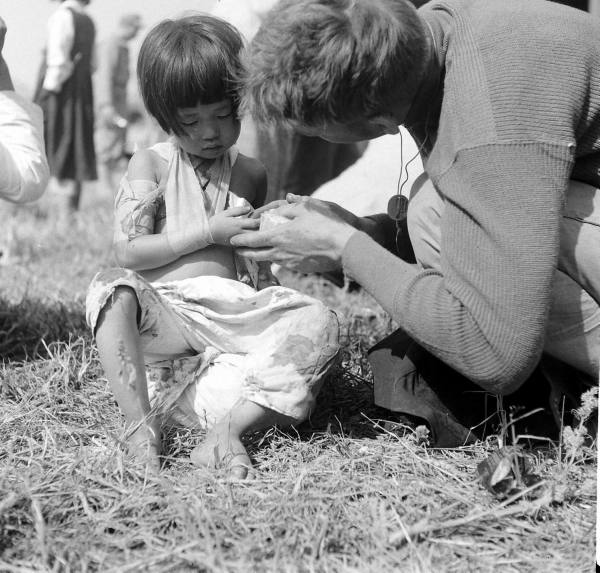
A reader reminded me of this photo of a medic treating an injured girl during the Korean War which I posted a few years ago (it's part of a series: 1, 2, 3, 4).


I found it in the Life Magazine archives, which led me to dig around and find some others, such as these:

This photo of Kim Gu was taken in May 1947 outside his house near Seodaemun Station, which should be included in this tour I'll be leading for the RAS in April.


I also found this photo of Kim Kyu-sik taken around the same time. You can also find photos of other prominent politicians such as Lyuh Woon-hyung (in front of the Chosun Hotel) two months before his murder, and Syngman Rhee.


What's interesting to me about the above photo is the (one presumes) US military housing on the grounds in the background. The caption reads "Kimm Kiusic, chairman of the interim legislative assembly, standing on the balcony outside his office." I can only assume that the interim legislative assembly was located in the former Japanese Government General Building which stood on the grounds of Gyeongbokgung until it was demolished in 1995 (a theory perhaps supported by this photo), which means the US military was camped out on the grounds of Gyeongbokgung, which probably didn't impress people much.

I found this image of what the Russians were up to, building-wise, in Pyongyang to be interesting:


Taken in November 1950, its caption reads "Russian housing at Kim Il Sung Univ. provided modern buildings for Communist faculty members."

The above photo was taken during the war, as, obviously, was this one:


Other aerial photos of Seoul from 1951 can be seen in the related photos at this link.

Those interested in older photos of Korea should check out Pictori, the Korean Media Library here.

Canada - Korea FTA concluded

Well, that took awhile:
Negotiations with Canada were the longest ever for an FTA by Korea. Initial talks began in July 2005, followed by 13 rounds through March 2008. Negotiations were halted in April 2009 after Canada challenged Korea’s ban on imports of Canadian beef six years earlier at the World Trade Organization. Korea instituted the ban in 2003 after an outbreak of bovine spongiform encephalopathy, commonly called mad cow disease.
Korea resumed Canadian beef imports in January 2012, and the trade talks resumed last November. Korea was the last major Asian market to lift its ban. Under the accord reached yesterday, Korea will reduce tariffs on Canadian beef over 15 years.

Canada will eliminate a 6.1 percent tariff on Korean automobiles within two years of the deal being ratified, compared to the five years in Korea’s FTA with the United States, which went into effect in 2012.

Korean automakers had a combined 12 percent share of the Canadian automobile market last year versus 34 percent for Japanese and 45 percent for Americans, and automobiles accounted for 42.8 percent of Korea’s exports to Canada in the same year.

Tariffs on textile machinery, a large export item from Korea, will be removed over five years. Within two years Canada will also remove most of its tariffs on clothing and textile products, which now stand at 18 percent at the maximum.[...]

Bilateral trade volume tallied $9.9 billion last year, and Canada was Korea’s 23rd largest export partner.
According to the Canadian government,
the Canada-Korea Free Trade Agreement is projected to create thousands of jobs for hardworking Canadians by boosting Canada’s economy by $1.7 billion and increase Canadian exports to South Korea by 32 percent.
I love the addition of 'hardworking' above. An article announcing Harper's visit gave this information:
Diplomatic ties between South Korea and Canada were established in 1963. Approximately 230,000 South Korean nationals reside in Canada. 
That's more than ten times the number of Canadians who live here (half of whom are Korean Canadian).

I could only think when I heard about the Prime Minister's visit that the embassy staff here must have been pretty damned busy preparing for it...

Tuesday, March 11, 2014

Sweet Dream online

Several years ago I posted about the 1936 film Sweet Dream, which I interpreted as a "story of how modernity is corrupting women." Back then they were called 'modern women'; more recently they've been known as 'doenjang nyeo,' or 'bean paste girls.'I couldn't help noticing that in Declaration of Idiots (the 1983 film mentioned in my last post), as well as that film's director Lee Jang-ho's next film, Between the Knees (which can be seen here, without subtitles), the vectors of western consumerism and open sexuality are women.

At any rate, Sweet Dream can be watched online with subtitles, courtesy of the Korean Film Archive:

Saturday, March 8, 2014

Screening of 'Declaration of Idiots'

Lee Jang-ho's waaaaaay out there 1983 film 바보선언,  or 'Declaration of Idiots,' is screening for free at the Korean Film Archive Sunday at 4pm. More about the film can be read here (beware the spoilers in the last sentence or two of the synopsis), where we can read this quote from director: "I don't claim to have made Declaration of Idiot: it was created by Korea's dictatorial regime at the time." The film is pretty much unlike anything I'd ever seen before, and with its lack of dialogue (meaning the lack of subtitles is no barrier to understanding it) and humor, it's reminiscent of a silent film, though one which uses music and sound in interesting ways, bashing together pansori and video game sounds to illustrate the clash of the traditional and the modern occurring under the military dictatorship of the time. The regime and the society it ruled over are eviscerated using satire, but in such a way that the censorship authorities simply didn't understand it and allowed it to be filmed and screened.

Here's a short scene from the film:


More about the theater can be found here. Here's a map to the venue:


Thursday, March 6, 2014

What is the problem with hiring foreign instructors?

On February 18, Ilyo Sinmun published the following article:
What is the problem with hiring foreign instructors?
As long as they're pretty or handsome, it's okay?

Foreigners who want to work in Korea as English instructors must submit documents such as criminal record checks and medical certificates which include drug test results. Nevertheless, reports have continually appeared in the media about molestation or drug use by foreign instructors or their denigration of Koreans, creating headaches for employment agencies.

A representative of the company 'Job In Korea,' which arranges for the employment of foreign instructors, said that ,"Before hiring a foreign instructor, they must submit things like a criminal record check from their home country. Misdemeanors like drunk driving here are also inquired into." "However the fact is it's difficult to inquire into their character by only looking into crimes. Currently when a teacher finishes a one year contract in Korea and moves to another hagwon, it's more difficult to make an inquiry into a Korean criminal record."

However, industry officials point out that employers' attitudes have not changed in that their first worry is the foreign instructor's appearance or nationality rather than their ability. In particular, 'appearance' is considered the top qualification for foreign instructors. A representative of a foreign instructor agency who requested anonymity said, "Every time problems with foreign instructors stand out in society, hagwon owners who employ them are very sensitive to it. But even in such a situation the first instructor they want to find is a 'pretty girl.'

Eric Kim (50), of another foreign instructor agency, ESL, said, "There are hagwon directors who say in a word [they want] 'White North American women in their late 20s.' Most, but not all, are like this." "There are hagwon directors who claim that after interviewing them over skype, the foreign instructor who arrives in Korea is different than the person seen over skype, or that their photos are different. It's also unusual in the US to request a photo during the hiring process. There is little consideration given to character or ability [in Korea]."

It's argued that since the fact will never change that employers' preferences are for appearance or particular region [or origin], even if the foreign instructor process is improved it won't be effective.

Eric Kim said, "When he sent in a resume, one white male simply wrote on one line, 'Only Hongdae' (the foreign instructor's preferred area). I don't know how angry I got. In order to improve the learning environment, there should be no cases in which foreign instructors who have ability and like children are excluded because they are black or because of their appearance."
While it starts off by looking at crimes by foreign teachers (though, it must be noted, it correctly notes that "reports have continually appeared in the media" about foreign teacher crime), and makes a bizarre claim about people using stand-ins during Skype interviews (which, what with fake test-taker stories I've heard in Korea, may be a case of projecting), the rest of the article makes good points about the one of the main problems with the system being the choices made by hagwon owners. Of course, they'll simply say they're catering to parents and following what the market wants. The 2011 revision to the Hagwon law was made in part to make sure the hagwon owners were doing what they were supposed to in checking the backgrounds of foreign teachers, and though there were excesses (the drug test requirement and duplication of criminal record checks for E-2 visa holders), there have been some improvements, at least. Even though it comes off as a bit of an advertorial for some recruiting agencies, I wouldn't mind seeing more articles criticize hagwon owners for their lack of due diligence when hiring instructors.

SBS, 'Is Korea their paradise? Blond hair blue eyes' part 2

The 2005 English Spectrum Incident

Part 1: English Spectrum and 'Ask The Playboy'
Part 2: The Kimchiland where it’s easy to sleep with women and make money
Part 3: English Spectrum shuts down as Anti-English Spectrum is created
Part 4: How to hunt foreign women
Part 5: Did the foreigners who denigrated Korean women throw a secret party?
Part 6: The 'Ask The Playboy' sexy costume party
Part 7: Stir over ‘lewd party’ involving foreigners and Korean women
Part 8: The 2003 post that tarred foreign English teachers as child molesters
Part 9: Netizens shocked by foreign instructor site introducing how to harass Korean children
Part 10: 'Recruit a Yankee strike force!'
Part 11: The Daum signature campaign: 'Let's kick out low quality foreign instructors!'
Part 12: Movement to expel foreign teachers who denigrated Korean women
Part 13: "Middle school girls will do anything"
Part 14: Netizens propose 'Yankee counter strike force'
Part 15: Segye Ilbo interview with the women from the party, part 1
Part 16: Segye Ilbo interview with the women from the party, part 2
Part 17: Web messages draw Koreans’ wrath
Part 18: Thai female laborers and white English instructors
Part 19: KBS Morning Newstime: 'I can also suffer from the two faces of the internet'
Part 20: AES: Grandfather Dangun is wailing in his grave!
Part 21: 'Regret' over the scandal caused by confessions of foreign instructors
Part 22: "Korean men have no excuse"
Part 23: "Unfit foreign instructors should be a 'social issue'"
Part 24: Growing dispute over foreign English instructor qualifications
Part 25: 'Clamor' at foreigner English education site
Part 26: Foreign instructor: "I want to apologize"
Part 27: No putting brakes on 'Internet human rights violations'
Part 28: "They branded us as whores, yanggongju and pimps," part 1
Part 29: "They branded us as whores, yanggongju and pimps," part 2
Part 30: Don't Imagine
Part 31: Anti-English Spectrum founder's statement
Part 32: 'Foreign instructor' takes third place
Part 33: Art From Outsider's Point of View
Part 34: U.S. Embassy warns Americans of threats near colleges
Part 35: Internet real name system debated
Part 36: Dirty Korean women who have brought shame to the country?
Part 37: Invasion of Privacy Degrades Korean Women Twice Over
Part 38: 60 unqualified native speaking instructors hired for English instruction
Part 39: The rising tide of unqualified foreign instructors
Part 40: Warrant for Canadian English instructor who molested hagwon owner
Part 41: MBC Sisa Magazine 2580: "Korea is a paradise"
Part 42: Foreign instructor: "In two years I slept with 20 Korean women."
Part 43: Viewers shocked by shameless acts of unqualified foreign instructors.
Part 44: Warrant for the arrest of a man in his 30s for breaking into home of foreign instructors
Part 45: [Cultural criticism] Hongdae club day lewd party incident
Part 46: Unqualified English instructors seen as major problem here
Part 47: Investigation of the realities of 'foreign instructors' methods for luring Korean women'
Part 48: Broadcast announcement: 'For foreign instructors, is Korea a paradise for women?'
Part 49: To white English instructors, the Republic of Korea is a paradise
Part 50: "If they're white, it's okay?" Lots of English instructor frauds...
 
Part 51: A new message from Anti English Spectrum
Part 52:
SBS, 'Is Korea their paradise? Blond hair blue eyes' part 1
Part 53: SBS, 'Is Korea their paradise? Blond hair blue eyes' part 2 

[Note: the episode files have been re-uploaded for those who couldn't get them.]

In the last post, I looked at the first third of the February 19, 2005 broadcast of the SBS 'investigative news program' 그것이 알고싶다 (I want to know that)'s episode about English Teachers, titled "Is Korea their Paradise? Report on the Real Conditions of Blond-haired, Blue-eyed Teachers." The show can be downloaded in a rar archive here (in four parts - 1, 2, 3, 4 - download them all and click on the first part to extract the file).

In the first third, we were shown how white English teachers are unqualified and only interested in partying with alcohol or drugs and having sex with Korean women, including their underage students.

This is followed by other stories of unfit foreign teachers told by foreigners speaking in English:
Sam (English Instructor): 'There was a Korean American guy who was supposed to sell hashish to high school students.'
- He was a hagwon teacher?
'Yes.'
-Two or three [students]?
'Well, he used the word students. That means more than one.'
Alex (English Instructor): "I don’t know how, but they met some underage girl and she was 16 years old and was in high school or something and he had sexual relations with her. Middle or high school. You need to, y'know, watch some foreign teachers. You should be careful."

Choi Su-yeon (former recruiter): 'One seemed like he had schizophrenia, a Canadian, and he got treatment and fled. Many marijuana addicts come. There were some with bad credit or who were bankrupt who came as well.'

Ryu Il-yun (Hagwon manager for 3 years): 'The only thing we can check is the person’s inflated resume. For example if there’s mental disorder or drug use maybe there’s a criminal record. It’s impossible to check.'
-Out of all foreign teachers, how many have proper qualifications?
'From what I’ve seen, 5%.'

The host then says there are teachers who are arrested for drugs, and it’s hard to know who is teaching our children and we should be concerned about the danger they may pose. Hagwons hire native speakers and bring them to Korea; what kind of experience do they have?

'Last December, police caught an American. He was working at a university.'

This story is related in this Korea Herald article:
The news last November of a foreign bellboy-turned-profesor who forged his degree spurred some universities to confirm the credentials of their staff. But still, it is easy for fake degrees to slip past, especially if an international phone call isn't made.
Hector Manuel Ramos, Jr. taught at Konkuk University in Seoul for two years until he was arrested by police on charges of forged documents. He worked as a bellhop in a New York hotel before he bought forged degrees in Thailand, one purporting to be from Columbia University and the other from Central Michigan University, according to police.
The arrested teacher was interviewed at the police station: 
'The reason I can't work in America? It's fake. You know my evaluation? I have a 90% evaluation from students.'

Student: 'I'm surprised. How did he become a professor, and how did the school not know about it?'
 
It goes on to point out that he was a high school graduate who had worked as a bellboy and was also growing and smoking marijuana.


They then use the same foreign actor who previously molested little girls and slept with a high school girl to re-enact how the above teacher was able to do it.


In the scenes where he’s interviewed by police at the police station, he not only smokes a cigarette – he also yells at them and carries on in what sounds to be fluent Korean. This is made clearer in this Yonhap article, which shows his fake PhD diploma which has 'Kim' as his last name, as opposed to his Masters diploma, which has a different surname. What's hilarious is that on the show, they censor out only the diploma with 'Kim' on it (at right, below):


A university official says that among foreigners coming to Korea not many try to be professors, and that people with a PhD, Americans, are extremely hard to find and are a resource, and are treated as valuable.

The teacher in question also used other people’s theses and had them published in a journal. (His name can be made out on the table of contents below, but it does not appear in the table of contents for that issue today.


University official: 'His thesis was in a prestigious journal so we were very surprised, he didn't seem like a very deep person. He made 4 million won each time an article was published, 12 million in all. They didn't confirm his diploma because it would take too much effort, they usually depend on whether someone answers questions well or not.'

The host then says an E2 visa is needed which requires a 4 year university degree, but it's not easy to confirm degrees.

They then switch to the story of Robert, who we're told is an illegal English teacher working on a tourist visa.

He says, 'In Thailand they bought their degree. So, basically you say, "I'll have a degree in Law from Yale." And then they print it. And they came to Korea and got jobs on an E-2 visa. Online, it's easy to buy a degree.' [Emphasis added.]

Note that while he is clearly talking about someone else buying a fake degree, the subtitles make no such distinction, and make it appear that he's talking about himself. Which, again, raises doubts that he is what the host claims he is, an illegal teacher.


[Cue menacing music.] The host tells us that, in truth, you can easily buy a fake diploma on the internet and come to Korea on a tourist visa.

Robert: 'I can post my resume and photo and some information on the internet and within a day or two agencies will be calling me. They call all the time, almost every day.'

A recruiter talks about how teachers can go to a hagwon and meet the director and say they’re happy to work on a tourist visa. Others don’t use recruiters and do it this way and hide the fact they’re only working 3 months.

A former recruiter adds that hagwons might be onto those who come with fake diplomas, but with a year long contract in place, the need to hire a new teacher, and possible complaints from parents, they don’t let it out. If you’re white with blonde hair it just takes one resume posted online, and within a week they'll be contacted for jobs, especially if they're female.

A hagwon owner says that stress is put on appearance; preferences are for white, female, young teachers.


Ryu Il-yun, who has operated a hagwon for three years, asks how they can properly teach the next day if they go dancing and drink at night. They should come to Korea to teach children and put effort into preparing classes, 'but between you and me they never do.'

They interview a student who says that her foreign teacher doesn't know the difference between a noun and verb and that she has to look up stuff in the electronic dictionary to show the teacher. Her mother says mistakes are made even with the alphabet.

Choi Su-yeon, a former recruiter, says that most foreign instructors teach a lot of slang, which makes her feel embarrassed when she sees the class. They hold grammar books but make mistakes, and it's surprising. They don't know grammar, they really are that ignorant. The lecture in itself is funny.

Then they talk to an official from SMOE. Outside of periodic fact finding or crackdowns, there's no way to enforce [laws]. Asked why there's no crackdown, he says there aren't enough people. They only have 40 enforcement personnel to deal with 70 or 80,000 hagwons.


They they talk to Song Hyo-geun, head of Incheon Immigration office, who says that last year they caught 2,200 people.
- Among those people, were there many white people arrested, as opposed to southeast Asians?
'There really weren't many white people caught.'
- Last week two hagwon instructors were caught and deported. Currently there is one white person reported to be an illegal sojourner.
Our host returns to show the costs of hiring a foreign instructor:
1.5 million for recruiting fee, 2.5 for salary, 1.5 for return airfare, and housing and furniture is provided as well. This adds up to 40 million won per year.

This will lead into the last part of the show, in which such lenient attitudes towards foreign teachers, upon whom too much money is spent, are compared to attitudes towards migrant workers from third world countries.